Autograph letter from William Brunton, Engineer, giving a description of his Steam Horse, Butterley Iron Works
- Made:
- 28 April 1813
- maker:
- Brunton, William


 This image is released under a CC BY-NC-SA 4.0
Licence
This image is released under a CC BY-NC-SA 4.0
Licence
License this image for commercial use at Science and Society Picture Library
License
Science Museum Group Collection
© The Board of Trustees of the Science Museum
William Brunton
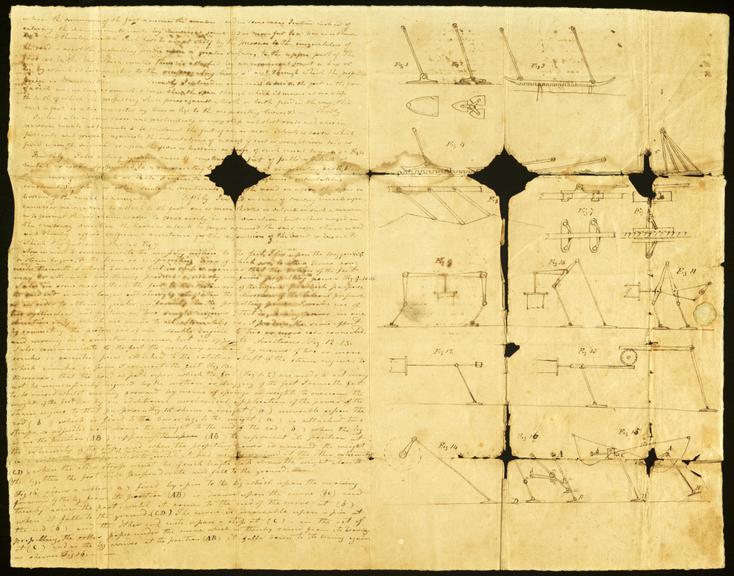
Autograph letter from William Brunton to his brother John, written whilst he was working at the Butterley Iron Works near Derby giving a description of his Steam Horse, patent no.3700/1813, dated April 28th 1813. The letter includes diagrams and an explanation of the workings of the 'legs' and 'feet' that propelled the engine. Also included are examples of how the materials and design could be change to suit different surfaces and how the mechanism could be attached to boats for use on canals. The letter is addressed to Job Rider, a watch maker and engineer of Belfast, for whom John Brunton was working and was received on 11th May 1813.
Details
- Measurements:
-
325.00mm (height)415.00mm (width)
- Extent:
- 1 document
- Identifier:
- BRUN
- Access:
- Access is given in accordance with the NRM access policy. Material from this collection is available to researchers through Search Engine
- System of Arrangement:
-
Show
Single Item
- Transcription:
-
Show
My Dear Brother Butterley Iron Works near Derby
28 ap[ri]l – 1813
Upon the first sight of this sheet you will be ready to exclaim, hell!! William has been determined to atone for his “diffidence” in not writing earlier, by sending me the substance of 2 or 3 letters at once; however, on perusal you will find your mistake and I must endeavour to apologize for what I fear you may have construed into neglect, particularly when so very painful a bereavement seem[e]d to demand an exchange of sympathy between two who had by death been deprived of an invaluable Parent. Indeed my Dear Brother I found it a most trying providence, which nothing but a reflection upon the delightful exchange our beloved Mother has made from a world of sin & sorrow to a heaven of bliss, from earthly & mortal friends to dwell forever with an unchangeable God, could have rendered tolerable: may it be our concern to improve the dispensation and aim at following her as far as she followed Christ and pray for increasing fitness to meet her on that happy shore where seperation [sic] will never be known. I hope our Father has and will experience divine support. It is now 2 months since I heard from them, and in respect to Rob[er]t I [sincerely?] wish it were it my power to obtain a situation for him but can hear of nothing likely to suit him. I know on many accounts it would not .... him at these works, I am going in ab[ou]t a fortnight into the North and shall of course see our Fat[her] ....what is likely to be done with him. I have been exceedingly busy for the last 4 or 5 .... that I have scarcely found an hours [sic] leisure, that my Dear little Babes ought not [wi?] .... claim. Rebecca is still suffering at times from her teeth John is a fine stout lad & I think quite like yourself [underlined] in the face: What your Dear Mary had done that you should not mention her at all [underlined] in your last I cannot tell, however, my Anne is very good & desires her Kind love to you & yours. You dont [sic] tell me whether my little ones may send their Cousin [underlined a Kiss [underlined], how stands that part of the business? I have been as you will easily perceive in the scheming way lately and invented a horse to go by steam for which I have taken out a Patent and am now very busy in drawing up the specification a rough copy of which is underneath. I shall be much obliged to you carefully to peruse it & write me as soon as possible whether from it you could make the machine attempted to be described, as the Patent will not be tenable unless from the specification a mechanic could [do] the same thing. The Title of the Invention is as follows A Method & Machinery for Propelling or Drawing carriages upon roads or railways and towing vessels upon canals or navigations by means of certain levers or legs alternately or conjointly acting upon such road, railway, canal &c or upon machinery attached thereto.
In compliance &c I the said WB do hereby declare that the nature of my said invention and the manner in which the same is perform[e]d is particularly described and ascertained in manner & form following, that is to say, I attach to The Waggon, Carriage, boat or vessel intended to be drawn or propell[e]d certain instruments herein de[s]cribed and which I call feet, to which by means of a steam Engine or any other engine sufficiently powerfull [sic] & compact fixed upon the said waggon, carriage, &c is communicated a reciprocating motion (or that I may be better understood a motion somewhat similar to that of a mans [sic] foot when in the act of walking) the feet are thereby made to act or press alternately or conjointly against the way or road upon which the waggon or carriage is intended to be moved, or when the way or road is much upon the ascent or the load particularly heavy I make the feet to act upon indentations or teeth of metal, wood, stone, or other suitable materials fixed in or laid upon the said way or road
I also cause the said feet by means aforesaid to act or propel against the bottom sides or usual towing path, or, upon indentations formed upon the bottom, sides or usual towing path of the canal or navigation upon which the boat or vessel to which the feet &c are attached is intended to be drawn, or I cause the feet to act against, or upon rods or bars of wood or metal or upon ropes or chains fastened alonge [sic] the sides, suspended over, or, fixed to the bottom of such canal or navigation Now that it may be clearly comprehended in what manner the aforesaid is to be put in practice I hereby declare that the methods herein described of constructing the feet and of giving to them the necessary motion are such as I intend principally to make use of, and which are fully answerable to the purpose proposed. But be it clearly understood that I do not hereby bind myself to any particular methods or mode herein described of effecting the same, but may vary the construction of the feet and also the methods of communicating motion to them as circumstances require or as my experience from time to time may point out -
And first, I make the feet of wood or of metal some what like horse shoes, which may be varied in form or dimensions to suit them to the nature of the road upon which they are intended to act Fig 1 where the materials of the road are tender or the load very heavy I either enlarge
[Page 2]
enlarge the dimensions of the foot or increase the number and in some cases I intend instead of enlarging the dimensions, to unite by universal joint 2, 3 or more feet to a bar as is shewn Fig 2 and thereby enable each foot to adapt itself by the pressure to the inequalities of the road & exert the propelling power upon a greater surface, to the upper part of the foot or to the bar which unites them is attached by a universal joint a bar or leg by which is connected to the reciprocating lever &c and through which the propellors [sic] power is transmitted Secondly I intend in some cases to make the foot in the form of a rack and as long or somewhat longer than the space through which it moves at one step the teeth of which in propelling shall press against a tooth or teeth fixed in the way, this rack or foot is also connected by bars or legs to the reciprocating levers &c – Thirdly I intend also in some cases and particularly on very steep and short roads and also in narrow canals or tunnels &c to construct the feet of one or more detents or hooks which fall into and propel against indentations of a rack of cast or wrought iron laid or fixed upon the said road or upon the sides or bottom or roofs of such canal tunnels &c Fig 4
Fourthly I also intend in some cases to construct .... feet of palls[sic] or detents of metal or wood suspended by joints to a reciprocating le[ver?] .... a reciprocating bar Fig 6 The [?][?] of the detents or Palls I cause to a .... against indentations constructed of stone or other suitable materials the road or upon the sides or bottom of the canal or navigation – Fifthly I in[ten]d in cases of drawing vessels upon canals or navigations to attach to the foot one or more hooks or detents in such a manner as to permit the rod, chain or rope to pass easily in one direction but when urged in the contrary direction the hooks or detents to press against the said rope, chain or rod and thereby afford sufficient resistance for the repulsion of the boat or vessel to which the feet are attached Fig 7
Now in order to communicate the necessary motion to the feet, I fix upon the waggon &c &c a Steam Engine, to the beam or reciprocating levers of which, or, to other levers connected therewith I attach 2 or more feet in such a manner that the action of the feet may be alternate and thereby produce a nearly uniform propelling power Fig 9. 10. 11. I also in some cases attach the feet to the Piston rod of the Engine for which purpose the said rod is made longer and strongly stay[e]d in the direction of the lateral pressure or in order to obtain a greater uniformity in the propelling power I make use of two syllinders [sic] and pistons, or, two single engines, that is, having power in one direction only, which are made to act alternately, or, I produce the same effect by connecting the piston rod of one double engine to two or more rods connected, and moving in a similar manner, but in opposite directions. Fig 12-13. I also communicate to the feet the necessary motion by means of two or more cranks or excentric [sic] pins attached to the rotative shaft of the steam engine, to which cranks or pins I connect the feet Fig 13.
Moreover, that the road or path upon which the feet (Fig 1. 2) are made to act may not be unnecessarily injured by the motion or dragging of the feet I cause the feet to be raised whilst moving or forward by means of springs or weights to overcome the weight of the foot, or by an additional mechanical application of the power of the steam engine to that purpose.. Fig 15 shews [sic] a weight (a) moveable upon the rod (b) which is fixed to the bar or leg, to the weight (a) is attached two straps, so adjusted as to draw the weight to the end of the rod (b) when the leg is in the position (AB) supposing (AB) to represent its position at the extremity of the step and when the propelling power is removed the weight (a) will then preponderate and the foot will be raised until it nearly arrived at the other extremity (CD), when the other strap must be of such length as to draw the weight close to the leg, then the foot will preponderate and fall to the ground.
Fig 16 shews [sic] a roller (a) fixed by a pin to the leg which upon the moving forward of the leg from its position (AB) is drawn upon the curve (bc) and thereby raises the foot, until it comes to the end of the curve at (b) when it falls to the ground (CD). The curve is moveable upon a pin at the end (b) and the other end rests upon a strap at (C), in the act of propelling, the roller passes under the curve which is thereby raised from its bearing at (C) and as the leg arrives at the position (AB) it falls down to its bearing again as shewn[sic] in Fig 16. –
Should you have any railways in your neighbourhood I should be very much obliged to you if you would endeavor[sic] to introduce this contrivance and we would allow you a commission upon them. This I am anxious should be done soon as I suspect that one of the clerks in the English Patent office is taking out a Patent for the same thing in Ireland and he makes use of my communications for that purpose. I found this out, by his endeavouring to forestall me in my Scotch Patent – I trust it will be found a very useful apparatus and I anticipate very many orders for them. but I should have observed that an introduction of one before he takes his Patent would prevent it – I have been expecting to hear from Mary every day for a great while and we had some hopes of seeing her in Derbyshire this summer which would make us very happy. I hope your health remains good which I shall be glad to hear. give my kind respects to Mrs Brunton and accept
My Dear Brother the sincere affection of your W Brunton
Mr John Brunton
care of Job Rider
Belfast Foundry
Belfast Ireland
- rights:
- Copies may be supplied of items in the collection, provided that the copying process used does not damage the item or is not detrimental to its preservation. Copies will be supplied in accordance with the NRM’s terms and conditions for the supply and reproduction of copies, and the provisions of any relevant copyright legislation