Copy letter from Isambard Kingdom Brunel to the Directors of the Great Western Railway
- Made:
- 22 March 1839
- maker:
- Brunel, Isambard Kingdom


 This image is released under a CC BY-NC-SA 4.0
Licence
This image is released under a CC BY-NC-SA 4.0
Licence
License this image for commercial use at Science and Society Picture Library
LicenseThis image is released under a CC BY-NC-SA 4.0
Licence
License this image for commercial use at Science and Society Picture Library
LicenseThis image is released under a CC BY-NC-SA 4.0
Licence
License this image for commercial use at Science and Society Picture Library
LicenseThis image is released under a CC BY-NC-SA 4.0
Licence
License this image for commercial use at Science and Society Picture Library
License
Science Museum Group
© The Board of Trustees of the Science Museum
Science Museum Group
© The Board of Trustees of the Science Museum
Science Museum Group
© The Board of Trustees of the Science Museum
Science Museum Group
© The Board of Trustees of the Science Museum
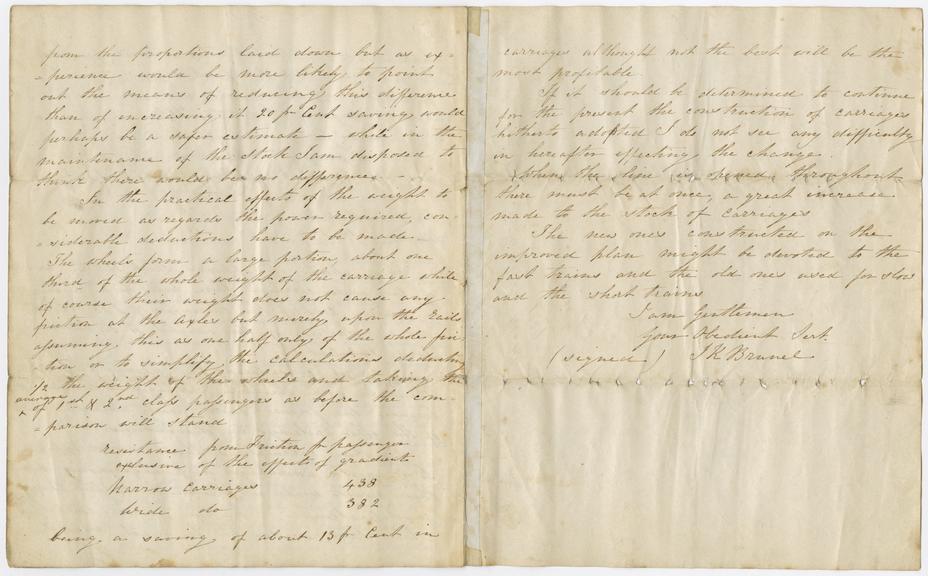
Copy letter dated 1839 Mar 22. Sent from Duke St. (Brunel’s offices), Westminster to the Directors of the Great Western Railway. It puts forward comparative advantages of wide bodied carriages over narrow carriages set between the wheels. Brunel begs to lay before them ‘observations upon the comparative advantages of wide carriages constructed as those at present in use between Paddington and Maidenhead and of narrow carriages the bodies of which may be placed between the wheels’.
Details
- Extent:
- 1 item
- Identifier:
- BRU
- Access:
- Access is given in accordance with the NRM access policy. Material form this archive is available to researchers through Search Engine
- Transcription:
-
Show
Great Western Railway
18 Duke Street Westminster
22nd March 1839
Gentlemen,
In compliance with your directions I beg to lay before you the following observations upon the comparative advantages of wide carriages constructed as those at present in use between Paddington and Maidenhead and of narrow carriages the bodies of which may be placed between the wheels –
Some of the principal advantages of the first are obvious, a greater number of Passengers may be carried with less weight and prime cost of the carriage and the number and total length of the stock of carriages required for the traffic being reduced, many of the collateral expenses such as shed room labor [sic] of making up trains &c &c are also reduced.
In the construction of the carriages the buffing apparatus wheels & axles axle guards &c the whole of the lower carriage remain near-by the same for the narrow as for the wide carriage – Some reduction may be
[Page 2]
made in the weight of some of the parts in proportion to the reduction of weight in the bodies but not to any very great extent and the expence of the lower carriage will remain nearly the same – In the body the most expensive part namely the side panels & [passing?] are unaltered and the principal saving by the reduction of width will be in the saving of cloth & trimmings in the lining.
The following will I think be found a tolerably correct estimate of the prime cost as weight of a first class and of an open carriage of the two widths. I have taken six-wheeled carriages as I think they will ultimately be also used for general purposes and 4 f[oo]t wheels as the most convenient for the wide carriages
First Class
No of passengers Cost Cost per Weight [?] [?] Weight Passengers [?] Weight including Comparative length
carried passenger for Passengers & luggage of Trains
Wide 32 £680 £21.5 6.10 455 600 75
Narrow 34 645 26.17.6 6.0 560 705 100
Open Carriages
[?] [?]
Wide 72 £320 £4.8.9 £6.5.0 194 339 66
Narrow 48 295 6.2.9 5.15.0 268 413 100
[Page 3]
Favour of the wide carriage so for the question is capable of calculation but against this saving in weight there have to be balanced those advantages obtained by the narrow carriage which are not not capable of accurate measurement but which I have always considered as likely to be ultimately of very great importance and which Mr B Smith, who has addressed the Directors on the subject appears to have thoroughly appreciated and has already explained in all their details, the reduced width of the body must receive less resistance from the air and from the greatly reduced height of the centre of gravity the oscellating, or rolling, motion which I believe at high speed causes more than one half the friction will be greatly diminished.
Taking these advantages into consideration I believe that even with the same sized wheel, the narrow carriage will not require more power than the wide while the facility of increasing the diameter of the wheels affords the means of further reducing the resistance
Upon a review of all the circumstances it appears therefore that the advantages attending the adoption of narrow bodied carriages placed between the wheels
[Page 4]
and low would consist principally of increased steadings of motion and safety and at very high speeds such as 40 & 45 miles per hour a decided dimination of resistance
That these advantages would be obtained however at an increase of 20 per Cent in the original cost of carriages and of firstly 25 per Cent in the extent of shed room and shops in the stations. I have no doubt in my own mind that eventually these advantages will be found to be far more than equivalent to the economy in prime cost effected by the wide carriage but I am not prepared to press their adoption at present. our average speed is increasing, our road is improving and we are gradually obtaining experience in the peculiar construction required in the springs which appears to be a most important as well as most difficult part of the subject, requiring to be modified and in such case adapted to the peculiarities of the road. the speeds and the form & dimensions of the carriages, when considerable improvement has been made in each of these [branches?] we shall derive the full advantage of the wide guage [sic] and low carriages, until then I believe the wide
[Page 5]
and supporting that the trains will generally carry 2 second Class to 1 first Class,
The comparison will stand
Average of 1st & 2nd Class
Cost of Carriage per Passenger Weight to be carried
including Passenger &
luggage
Wide £10.0.10 426
Narrow 13.1. 510
From which it appears that by the use of the wide carriage there will be a saving in prime cost of the carriages of £23 per Cent and a reduction of the weight to be moved of about 16 per Cent
I have considered the narrow Class as the standard and the wide carriages as the [variative?], because the former more nearly resemble those of the other railways in dimensions.
By these calculations there would appear to be greater advantages in point of economy but these results would in practice be subject to some modification. In the prime cost probably there would not be much variation
[Page 6]
from the proportions laid down but as experience would be more likely to point out the means of reducing this difference than of encreasing [sic] it 20 per Cent saving would perhaps be a safer estimate – while in the maintenance of the Stock I am disposed to think there would be no difference –
In the practical effects of the weight to be moved as regards the power required, considerable deductions have to be made – The wheels form a large portion, about one third of the whole weight of the carriage while of course their weight does not cause any friction at the Axles but merely upon the [Rails?] assuming this as one half only of the whole [function?] or to simplify the calculations deducting 1/2 the weight of the wheels and taking the acerage of 1st & 2nd class passengers as before the comparison will stand
Resistance from Friction for passengers
exclusive of the effects of gradients
Narrow Carriages 438
Wide Carriages 382
being a saving of about 13 per Cent in
[Page 7]
carriages although not the best will be the most profitable.
If it should be determined to continue for the present the construction of carriages hither to adopted I do not see any difficulty in here after effecting the change.
When the line is opened throughout there must be at once, a great increase made to the stock of Carriages
The new ones constructed on the improved plan might be devoted to the fast trains and the old ones used for slow and the short trains
I am Gentlemen
Your Obedient Ser[van]t
(signed) I K Brunel
Back page:
I. K. Brunel
Duke St[ree]t 22nd March
1839 –
Rec[eive]d 26th March
- rights:
- Copies may be supplied of items in the archive, provided that the copying process used does not damage the item or is not detrimental to its preservation. Copies will be supplied in accordance with the NRM’s terms and conditions for the supply and reproduction of copies, and the provisions of any relevant copyright legislation.