
Tsantsa (shrunken head) of a male sloth, Shuar, Ecuador, 1850-1930
Tsantsas, commonly referred to as ‘shrunken heads’, were made by the Shuar, an indigenous group from the Chicham linguistic family – formally known by the pejorative colonial term ‘Jivaro’ or 'Jivaroan' – who live in the Amazon Basin between the borders of eastern Ecuador and northern Peru. Tsantsas can be made of human or animal skin (primarily sloth or monkey), and are often decorated with feathers, beads and beetle wings.
The process of creating a tsantsa involved removing the skull and placing the skin in simmering water before filling the cavity with hot stones and sand. The facial features were moulded by hand during the shrinking procedure to retain their shape.
Tsantsas were originally prepared for ceremonial purposes in order to harness the spirit of the deceased and use that power to serve the group. From the 1870s they acquired significant monetary value as curios on the Western art market. This economic incentive drove production of non-ceremonial tsantsas for trade by Shuar and unconnected peoples. The practice was largely ended by 1960 through missionary and government intervention. Tsantsas continue to hold dual status as human remains and cultural artefacts with spiritual significance for Shuar communities. Sloth tsantsas were made for both ceremonial and trade purposes.
This tsantsa was purchased on behalf of Henry Wellcome’s Historical Medical Museum from a London auction house in 1930 for £2 7s. 6d. It was formerly part of the collection of M.G. Palmer Esq. The auction catalogue listed it as: 'A similar example of the male sloth, from Seipa, also rare.'
Details
- Category:
- Ethnography and Folk Medicine
- Collection:
- Sir Henry Wellcome's Museum Collection
- Object Number:
- A88118
- Measurements:
-
length 175 mm
width 45 mm
- type:
- sloth tsantsa
- credit:
- Wellcome Trust
Related Objects

Small green carved anthropomorphic figure
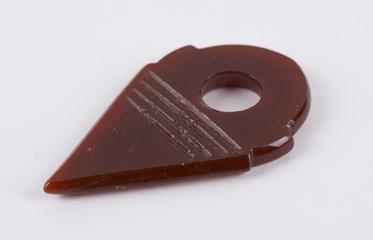
Glass arrowhead trade amulet
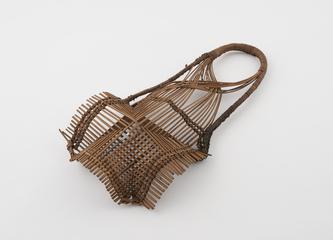
Cane work milk skimmer, interwoven cane scoop, 1890-1925
Reddish brown glass trade amulet of "arrowhead" shape
