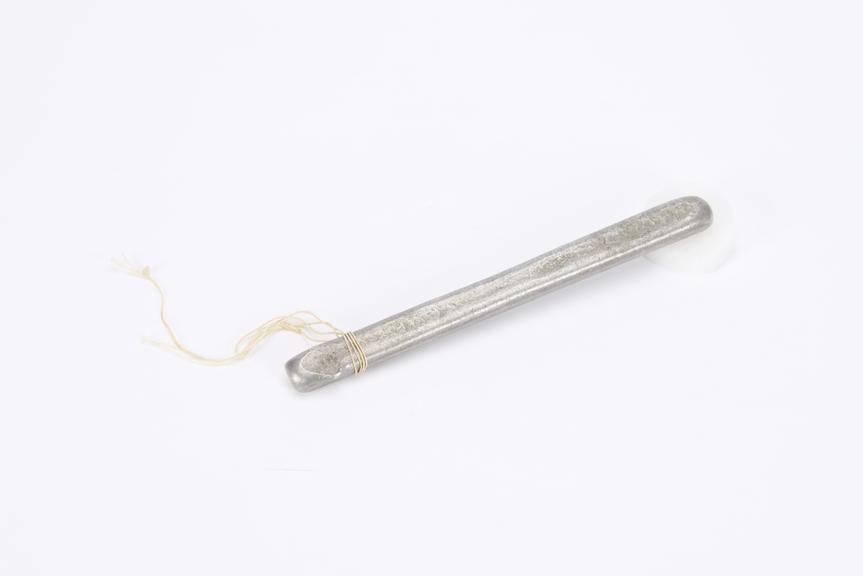
Bar of aluminium given to Michael Faraday by Napoleon III, c1855
- Made:
- 1850-1859
 This image is released under a CC BY-NC-SA 4.0
Licence
This image is released under a CC BY-NC-SA 4.0
Licence
License this image for commercial use at Science and Society Picture Library
License
Science Museum Group
© The Board of Trustees of the Science Museum
Bar of aluminium given when first produced in bar to Faraday by the wish of Louis Napoleon. Faraday added the string to demonstrate to resonant qualities
Until the electrolytic process for its extraction was discovered, aluminium was an expensive curiosity and it was classed as a precious metal. In the nineteenth century it was used to make expensive jewellery, but in the twentieth century it has been used for a wide range of products, in particular in the aerospace industry. Today aluminium is desirable because of its lightness and corrosion resistance and its ease of shaping. Attractive coloured surfaces can be obtained by anodising, an electrolytic process which increases the thickness of the oxide film on the surface of the metal.
Details
- Category:
- Experimental Chemistry
- Object Number:
- 1911-341/7
- Materials:
- aluminium (metal)
- Measurements:
-
overall: 15 mm x 260 mm x 20 mm, .2 kg
- credit:
- Blaikley, A J