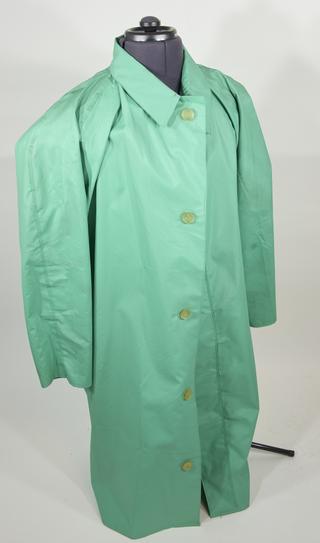
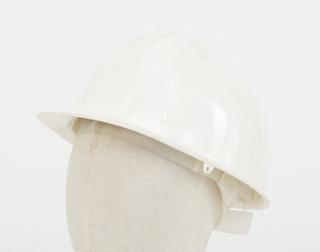
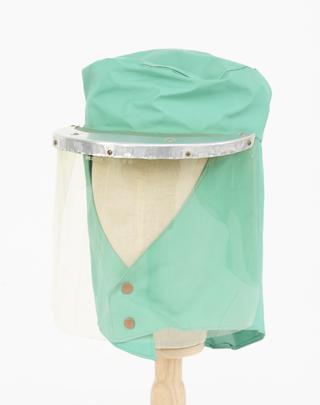
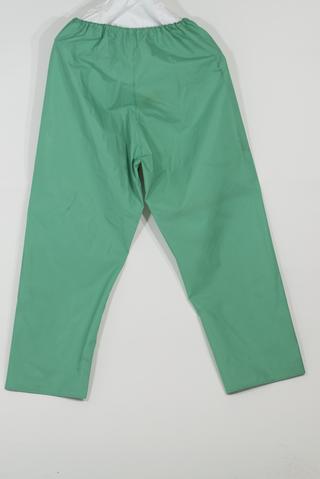
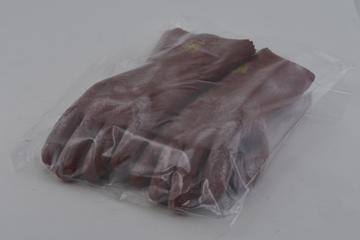
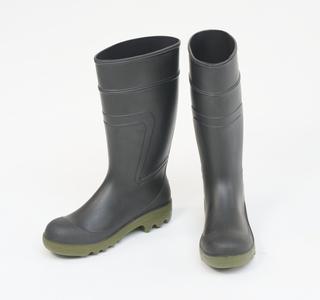
Firefighting 'Fleet' suit with helmet, boots and gloves (suit type Bristol HS 2/3), designed for use on board ship, by Bristol Uniforms Limited, Bristol, England, 1981. Designed to follow the SOLAS Regulations of 1974 (Safety of Life at Sea) that required vessels to carry specialised safety equipment. Two-piece suit made of Heatshield cloth, a textile that retains its structure in flames up to 1000°C, protecting from intense radiant heat, (though not from flames), and limited protection against cold, most acids, oils and other chemicals. The wrists and ankles are elasticated to avoid exposure to radiant heat. Coat, trousers and gauntlet mittens made of modacrylic beta-glass fibre yarn mixture cloth, lined with non-flammable twill. Helmet made of heavy duty glassfibre with Heatshield cloth neck curtain and polycarbonate visor. Chrome hide leather boots with nitrile rubber sole and steel toe cap. Shipboard firefighting suit
Explosive ordnance disposal suit, Mark II, with Mark II helmet, detachable sleeve, lower front and back body protection armour plates, PVC draw-string bag for carrying the Mark II helmet, and large holdall for carrying the suit and all components, made by the Stores and Clothing Research and Development Establishment, British, 1978 Explosive ordnance disposal suit: helmet, detachable sleeve, body armour plates and bags
Aircrew helmet Mk3c (large): aircrew equipment for high altitude flying, with two storage cases, by RAF Institute of Aviation Medicine, British, 1980-1984 Aircrew helmet Mk3c (large), with two storage cases