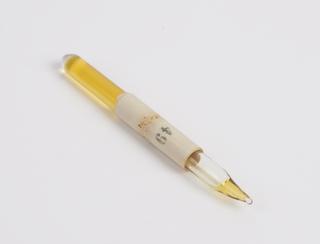
Flask designed and used by Johan Kjeldahl, 1880-1900
- Made:
- 1880-1900

 This image is released under a CC BY-NC-SA 4.0
Licence
This image is released under a CC BY-NC-SA 4.0
Licence
License this image for commercial use at Science and Society Picture Library
LicenseFlask designed and used by Kjeldahl
Science Museum Group
© The Board of Trustees of the Science Museum
Flask designed and used by Johan Kjeldahl (1849-1900), a Danish chemist who developed a laboratory technique for determining the amount of nitrogen in organic compounds in 1883. The flask was later presented to the Biochemical Society.
Kjeldahl flasks are round bottom laboratory flasks with long necks used in chemical analysis. Danish chemist Johan Kjeldahl (1849–1900) designed the flask in 1888, in his work developing a laboratory technique ('the Kjeldhal method') for measuring the amount of nitrogen in organic compounds. It was the first accurate, simple, and speedy way to determine nitrogen content in organic matter. The long-necked, round-bottomed flask was designed to avoid dangerous splashbacks when heating solutions - a key step in the Kjeldahl method requires heating a sample in concentrated sulfuric acid.
Kjeldahl worked in Copenhagen at the Carlsberg Laboratory, associated with the Carlsberg Brewery, where scientific research was applied to improve the process of beer making. He was given the job to determine the amount of protein in grain used to make beer - higher levels of protein resulted in less beer. His research led him to develop the Kjeldahl technique.
Kjeldahl directed the chemistry department of the laboratory from 1876 until his fatal heart attack in 1900. The Kjeldahl method continues to be an important chemical analytical technique. This flask was presented to the UK Biochemical Society, founded in 1911.
Details
- Category:
- Biochemistry
- Object Number:
- 1981-367
- Materials:
- glass
- type:
- flask
- credit:
- The Biochemical Society
Related Objects

Grey clear plastic component of Model 362 Gene Scanner, United States, 1989

White plastic component of Model 362 Gene Scanner, United States, 1989