

 This image is released under a CC BY-NC-SA 4.0
Licence
This image is released under a CC BY-NC-SA 4.0
Licence
License this image for commercial use at Science and Society Picture Library
LicenseThis image is released under a CC BY-NC-SA 4.0
Licence
License this image for commercial use at Science and Society Picture Library
License
Science Museum Group Collection
© The Board of Trustees of the Science Museum
Science Museum Group Collection
© The Board of Trustees of the Science Museum
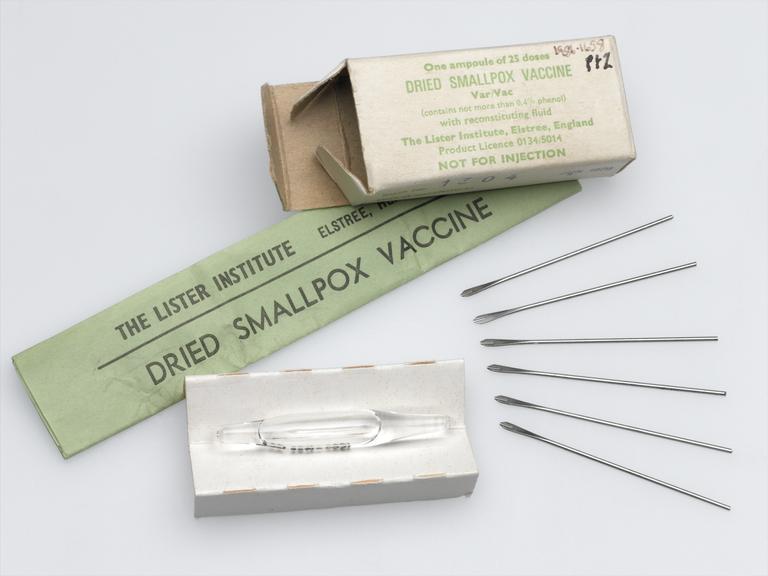
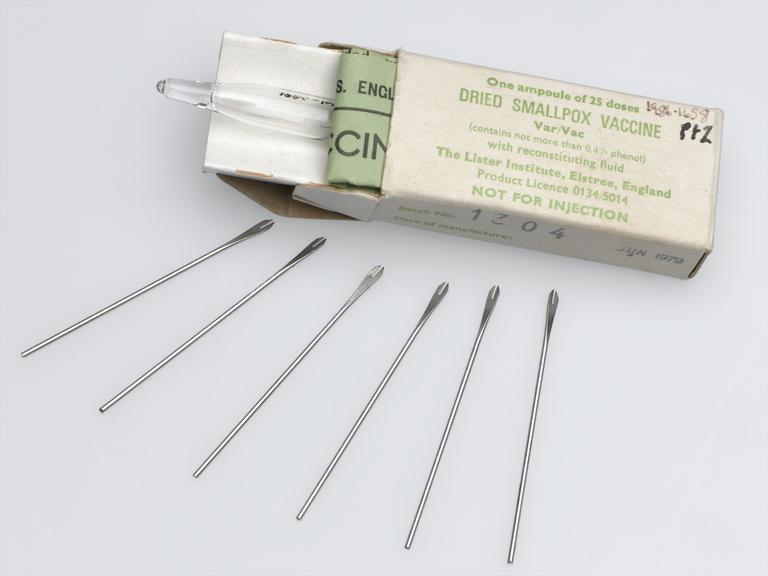
Six bifurcated needles for smallpox vaccination, developed by Wyeth Laboratories, German(? ), 1975-1978
Bifurcated needles were a simple means to deliver a smallpox vaccination. For this procedure, a small drop of smallpox vaccine is placed between the two prongs and approximately 15 small punctures are then made into the surface of the upper arm of the skin. The skin of the person to be vaccinated would not be disinfected beforehand as it could deactivate the vaccine.
The needles were easy to use and asy to sterilise, through boiling water or or passing through a flame and the technique could be easily learned, making widespread effective vaccination programmes possible. The needles were found to be more effecient and safer than so-called gun injectors and other more hi-tech jet injectors. Such needles were used as part of the World Health Organisation’s (WHO) smallpox global eradication campaign. As a result of which, WHO officially announced that they had achieved their goal in 1980.
The needles were developed by Wyeth Laboratories for the WHO’s eradication programme and the company waived the patent royalties to the needles making the technology more affordable and available to all. The needles are shown here with dried smallpox vaccine (1986-1658 Pt2).
Details
- Category:
- Public Health & Hygiene
- Object Number:
- 1979-61
- Materials:
- metal
- Measurements:
-
Each needle: 7 mm x 52 mm x 7 mm, .0003 kg
- type:
- vaccination needle
- credit:
- Paterson, A.D.
Related Objects
Double headed vaccination lancet
Vaccination lancet

Lancets belonging to Edward Jenner
Plastic Bag for Covid-19 Health Pack
