

 This image is released under a CC BY-NC-SA 4.0
Licence
License this image for commercial use at Science and Society Picture Library
LicenseThis image is released under a CC BY-NC-SA 4.0
Licence
License this image for commercial use at Science and Society Picture Library
License
Science Museum Group
© The Board of Trustees of the Science Museum
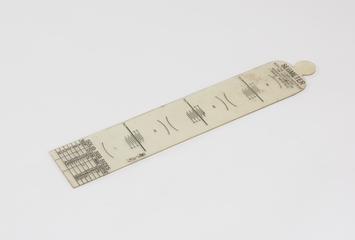
Test-types with rear illumination, for testing visual acuity
Science Museum Group Collection
© The Board of Trustees of the Science Museum
Test-types with rear illumination, for testing visual acuity, English, probably c.1950
Back lit for a clearer view, this display is a chart of letters used by an optician to test a person’s sight at various distances. Such charts are perhaps the most iconic objects in sight testing. A patient with good vision should be able to read the letters at a distance of six metres. The original sight charts were developed in the 1850s by Dutch ophthalmologist Hermann Snellen (1834-1908). The letters, from largest to smallest, are all a precise shape and size. Such charts are still commonly used.
Details
- Category:
- Ophthalmology
- Collection:
- Sir Henry Wellcome's Museum Collection
- Object Number:
- A627002
- Materials:
- brass, brass (copper, zinc alloy), copper (metal), steel (metal), acrylic, glass, rubber (unidentified) and wood (unidentified)
- Measurements:
-
overall: 507 mm x 219 mm x 166 mm, 2.5674 kg
- type:
- snellen test types


