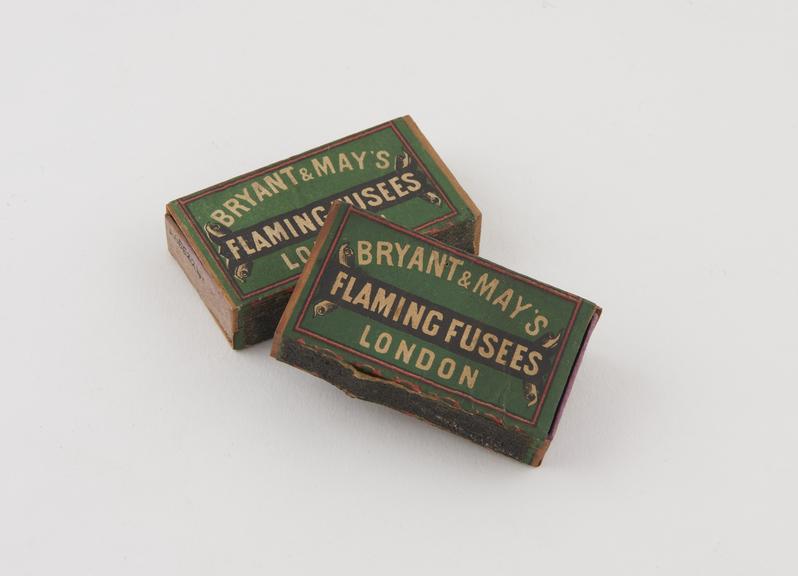
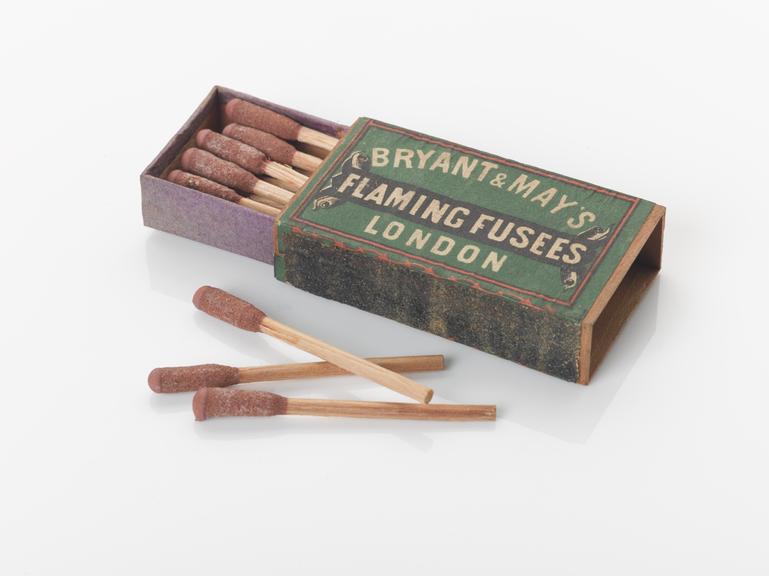

Two boxes of Bryant & May ‘Flaming Fusees’ matches

Two boxes of Bryant & May ‘Flaming Fusees’ matches Two boxes of Bryant & May ‘Flaming Fusees’ matches Two boxes of Bryant & May ‘Flaming Fusees’ matches Two boxes of Bryant & May ‘Flaming Fusees’ matches

Creative Commons LicenseThis image is released under a CC BY-NC-SA 4.0 Licence

License this image for commercial use at Science and Society Picture Library

License

Creative Commons LicenseThis image is released under a CC BY-NC-SA 4.0 Licence

License this image for commercial use at Science and Society Picture Library

License

Creative Commons LicenseThis image is released under a CC BY-NC-SA 4.0 Licence

License this image for commercial use at Science and Society Picture Library

License

Creative Commons LicenseThis image is released under a CC BY-NC-SA 4.0 Licence

License this image for commercial use at Science and Society Picture Library

License

Science Museum Group
© The Board of Trustees of the Science Museum

Science Museum Group Collection
© The Board of Trustees of the Science Museum

Science Museum Group Collection
© The Board of Trustees of the Science Museum

Science Museum Group Collection
© The Board of Trustees of the Science Museum

Two chipboard matchboxes containing "Flaming Fusees" Vesuvian matches for cigar or pipe, by Bryant and May, London, 1861-1895

Match-making was a particularly dangerous job in the 1800s. Workers – mainly women – employed by companies such as Bryant & May to make matches commonly experienced a condition known as phossy jaw. This was caused by poisoning from the yellow phosphorous used in the head of the match.

Phossy jaw was a terribly disfiguring and sometimes fatal condition. Eventually, a combination of this health danger, poor pay and long hours led to the formation of a trade union for the workers. The Match Girls Strike of 1888, led by social activist Annie Besant (1847-1933), was a landmark industrial action and led to better pay. In 1901, Bryant & May finally stopped using yellow phosphorous in their matches.

Details

Category:
Smoking
Collection:
Sir Henry Wellcome's Museum Collection
Object Number:
A655224
Materials:
chipboard, glass paper, black and paper
Measurements:
overall: 15 mm x 62 mm x 36 mm,
type:
match box

Parts

Chipboard matchboxes containing "Flaming Fusees" Vesuvian matches for cigar or pipe, by Bryant and May, London, 1861-1895

Bryant & May ‘Flaming Fusees’ matches for cigars and pipes, London, England, 1861-1895

Chipboard matchboxes containing "Flaming Fusees" Vesuvian matches for cigar or pipe, by Bryant and May, London, 1861-1895

More

Match-making was a particularly dangerous job in the 1800s. Workers – mainly women – employed by companies such as Bryant & May to make matches commonly experienced a condition known as phossy jaw. This was caused by poisoning from the yellow phosphorous used in the head of the match.

Phossy jaw was a terribly disfiguring and sometimes fatal condition. Eventually, a combination of this health danger, poor pay and long hours led to the formation of a trade union for the workers. The Match Girls Strike of 1888, led by social activist Annie Besant (1847-1933), was a landmark industrial action and led to better pay. In 1901, Bryant & May finally stopped using yellow phosphorous in their matches.

Measurements:
overall: 15 mm x 62 mm x 36 mm, .02 kg
Materials:
chipboard , glass paper and paper
Object Number:
A655224/1
type:
match box
Chipboard matchboxes containing "Flaming Fusees" Vesuvian matches for cigar or pipe, by Bryant and May, London, 1861-1895

Bryant & May ‘Flaming Fusees’ matches for cigars and pipes, London, England, 1861-1895

Chipboard matchboxes containing "Flaming Fusees" Vesuvian matches for cigar or pipe, by Bryant and May, London, 1861-1895

More

Match-making was a particularly dangerous job in the 1800s. Workers – mainly women – employed by companies such as Bryant & May to make matches commonly experienced a condition known as phossy jaw. This was caused by poisoning from the yellow phosphorous used in the head of the match.

Phossy jaw was a terribly disfiguring and sometimes fatal condition. Eventually, a combination of this health danger, poor pay and long hours led to the formation of a trade union for the workers. The Match Girls Strike of 1888, led by social activist Annie Besant (1847-1933), was a landmark industrial action and led to better pay. In 1901, Bryant & May finally stopped using yellow phosphorous in their matches.

Measurements:
overall: 15 mm x 62 mm x 36 mm, .02 kg
Materials:
chipboard , glass paper, black and paper
Object Number:
A655224/2
type:
match box