
Amputation saw
Amputation saw, steel blade, ebonite handle, by John Weiss, 62 Strand, London, England, 1831-1870.
- Measurements:
-
length 350 mm
width 19 mm
height 101 mm
- Object Number:
- A500502 Pt1
- type:
- amputation saws


 This image is released under a CC BY-NC-SA 4.0
Licence
This image is released under a CC BY-NC-SA 4.0
Licence
License this image for commercial use at Science and Society Picture Library
LicenseThis image is released under a CC BY-NC-SA 4.0
Licence
License this image for commercial use at Science and Society Picture Library
LicenseThis image is released under a CC BY-NC-SA 4.0
Licence
License this image for commercial use at Science and Society Picture Library
License
Science Museum Group
© The Board of Trustees of the Science Museum
Amputation set, comprising saw, three large knives
Science Museum Group Collection
© The Board of Trustees of the Science Museum
Amputation set, comprising saw, three large knives
Science Museum Group Collection
© The Board of Trustees of the Science Museum
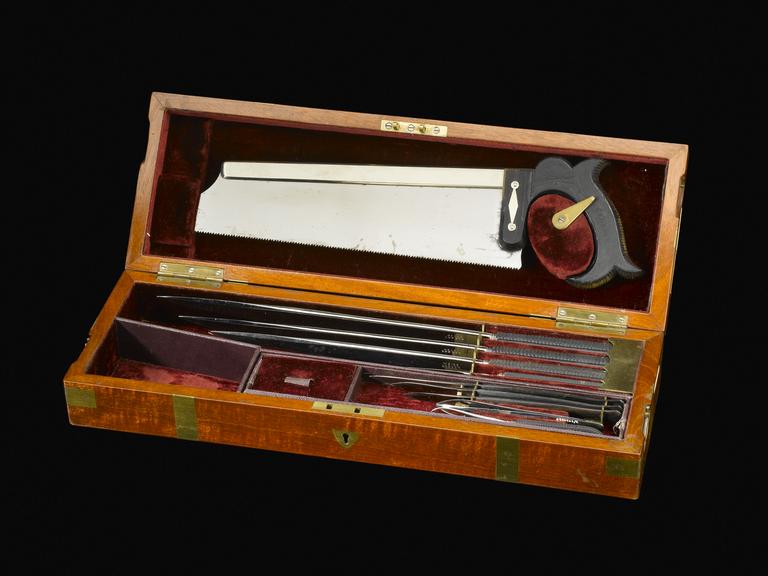
Amputation set, comprising saw, three large knives, one finger saw, three scalpels, one pair artery forceps, one tenaculum, one pair bone forceps, one tourniquet, one roll ligature silk, in mahogany case, by Weiss of London, mid 19th century
Carried in a mahogany chest, this set contains a range of instruments needed by a surgeon to carry out a limb amputation. It includes an amputation saw, four Liston knives, a finger saw, three scalpels, artery forceps, bone forceps, a tenaculum (a hook-like instrument to move arteries and blood vessels out of the way). Also, a tourniquet and silk ligatures to sew up and close wounds.
Liston knives are named after their inventor, Robert Liston (1794-1847), a Scottish surgeon renowned for his speed and skill in amputation. Liston performed the first operation in Britain under anaesthetic, taking just 25 seconds. The set was made by John Weiss, a leading surgical instrument maker based in London.
Amputation saw, steel blade, ebonite handle, by John Weiss, 62 Strand, London, England, 1831-1870.
Liston's amputation knife, steel blade, ebonite handle, by Weiss of London, mid 19th century
Liston's amputation knife, steel blade, ebonite handle, by Weiss of London, mid 19th century
Liston's amputation knife, steel blade, ebonite handle, by Weiss of London, mid 19th century
Finger saw, steel blade, ebonite handle, by Weiss of London, mid 19th century
Liston's finger knife, steel blade, ebonite handle, by Weiss of London, mid 19th century
Scalpel, steel blade, ebonite handle, by Weiss of London, mid 19th century
Scalpel, steel blade, ebonite handle, by Ferguson of London, 1822-1869
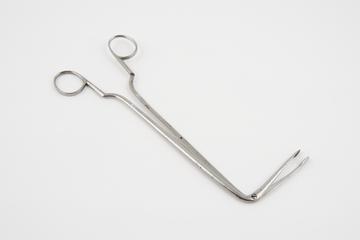
Fenestrated artery forceps, steel, by Ferguson of London, 1822-1869
Tenaculum, steel shaft, ebonite handle, by Weiss of London, mid 19th century
Ferguson's bone forceps, screw-joint, steel, by Weiss of London, mid 19th century
Petit's screw tourniquet, brass, leather and canvas, by Weiss of London, mid 19th century
case, mahogany, for amputation set by Weiss of London, mid 19th century