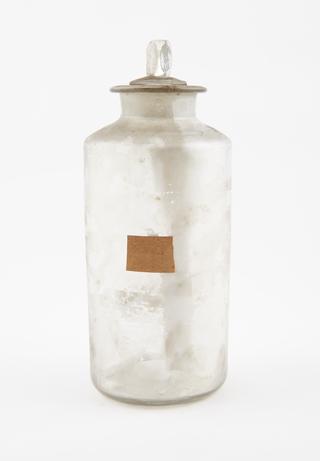
Glass specimen bottle containing witch hazel leaves and twigs from North America
- Made:
- 1880-1940 in North America and England


 This image is released under a CC BY-NC-SA 4.0
Licence
This image is released under a CC BY-NC-SA 4.0
Licence
License this image for commercial use at Science and Society Picture Library
LicenseThis image is released under a CC BY-NC-SA 4.0
Licence
License this image for commercial use at Science and Society Picture Library
License
Science Museum Group
© The Board of Trustees of the Science Museum
Science Museum Group
© The Board of Trustees of the Science Museum
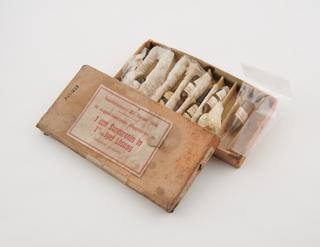
Glass specimen bottle containing witch hazel leaves and twigs from North America, used as a preparation on the skin for bruises and haemorrages
Found in North America, witch hazel has a long history of medicinal and cosmetic use. Extracts made from the leaves and twigs, or preparations made into a salve would be rubbed onto the skin to treat bruises and bleeding, as well as open sores and sore muscles. Witch hazel has also been used to reduce swelling and treat colds, liver and eye conditions.
European white settlers in North America eventually learned about the medical uses of witch hazel from Indigenous Americans. Its growing popularity led to the commercialisation of the plant, primarily for similar healing purposes and witch hazel became a key ingredient in the first mass-marketed skin cream in the United States. Witch hazel continues to be used in skincare products today, including creams, lotions, and toners, particularly for its skin-tightening and soothing properties.
Details
- Category:
- Materia Medica & Pharmacology
- Collection:
- Sir Henry Wellcome's Museum Collection
- Object Number:
- A667138
- Materials:
- glass and plant extract
- Measurements:
-
overall: 85 mm x 50 mm x 50 mm, 77 mm, .095 kg
- type:
- specimen bottles