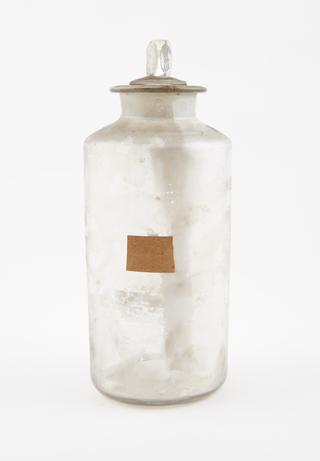
Specimen jar containing sassafras bark
- Made:
- 1830-1930 in England and North America


 This image is released under a CC BY-NC-SA 4.0
Licence
License this image for commercial use at Science and Society Picture Library
LicenseThis image is released under a CC BY-NC-SA 4.0
Licence
License this image for commercial use at Science and Society Picture Library
License
Science Museum Group
© The Board of Trustees of the Science Museum
Science Museum Group
© The Board of Trustees of the Science Museum
Specimen jar containing sassafras bark used by the Nanticoke Indigenous people of Delaware, North America
The bark of the sassafras tree was used by the Nanticoke for its multiple healing properties. Various parts of the sassafras plant, including the bark and the leaves were used by Indigenous groups to aid upper respiratory tract infections, treat rheumatism and kidney dysfunction and prepare poultices for wounds and skin infections.
The Nanticoke, whose name translates to ‘tidewater people’ or ‘people of the tidewaters’, are an Indigenous American group whose traditional territories included what is now Delaware in the United States. As colonial expansion progressed, they moved to what is now Oklahoma, where they joined the Delaware Nation, and to Canada, where they joined the Six Nations of the Grand River. These are areas where they continue to reside today.
According to Hartman Deetz citizen of the Mashpee Wampanoag Indigenous nation and cultural consultant for the Science Museum’s temporary exhibition ‘Becoming America’ sassafras tea has stimulant properties similar to coffee. Due to this, sometimes its consumption was accompanied by warnings that too much could disrupt sleep.
Sassafras was one of the first plants traded between American colonists and Europeans, with Indigenous knowledge likely contributing to its early use and trade. In Europe and colonial America, the bark was particularly valued and used to make root beer, which was being marketed for its supposed medicinal properties.
Details
- Category:
- Materia Medica & Pharmacology
- Collection:
- Sir Henry Wellcome's Museum Collection
- Object Number:
- A667175
- Materials:
- glass and plant extract
- Measurements:
-
overall: 85 mm x 50 mm x 50 mm, 77 mm, .095 kg
- type:
- specimen jars