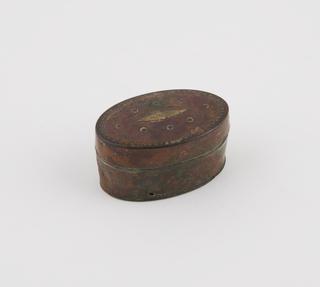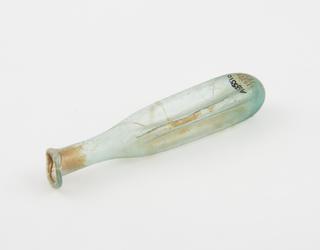
Specimen bottle containing castor oil seeds
- Made:
- 1901-1940 in Sierra Leone


 This image is released under a CC BY-NC-SA 4.0
Licence
This image is released under a CC BY-NC-SA 4.0
Licence
License this image for commercial use at Science and Society Picture Library
LicenseThis image is released under a CC BY-NC-SA 4.0
Licence
License this image for commercial use at Science and Society Picture Library
License
Science Museum Group
© The Board of Trustees of the Science Museum
Science Museum Group
© The Board of Trustees of the Science Museum
Specimen bottle containing castor oil seeds (Ricinus communis) from Sierra Leone
Across many regions of West Africa, including Sierra Leone, castor seeds have been pressed to extract their versatile oil.
Castor oil has been valued for its wide range of medicinal and practical applications. In medical systems across across Africa, Asia and the Americas, the oil has been used for its laxative and purgative benefits as well as for treating wounds and inflammation. Beyond medicine, it has also been used as lamp oil and engine lubricant.
During the mid-1700s, castor oil became common as a household medicine in colonial America and Caribbean. Castor bean plants were introduced from Africa through the transatlantic trade. Enslaved Africans carried knowledge of the plant and its medicinal properties, passing these uses down to their descendants.
Castor oil can still be found in cosmetic, medicinal, and industrial products. While processed castor oil is safe for human use, ricin, a poisonous protein to humans and animals, can also be found in varied amounts throughout the plant. This could cause health problems for workers that harvest it by hand.
Details
- Category:
- Materia Medica & Pharmacology
- Collection:
- Sir Henry Wellcome's Museum Collection
- Object Number:
- A673318
- Materials:
- glass and stopper, glass
- Measurements:
-
overall: 85 mm x 50 mm x 50 mm, 77 mm, .095 kg
- type:
- specimen bottles
Related Objects

Fungus known as Fu ling in Traditional Chinese Medicine, China, 1850-1920
Stoneware dispensing pot
Information document 'System for Thalidomide Education and Prescribing Safety'
Box containing bottle of Ostellin tablets and instruction sheet