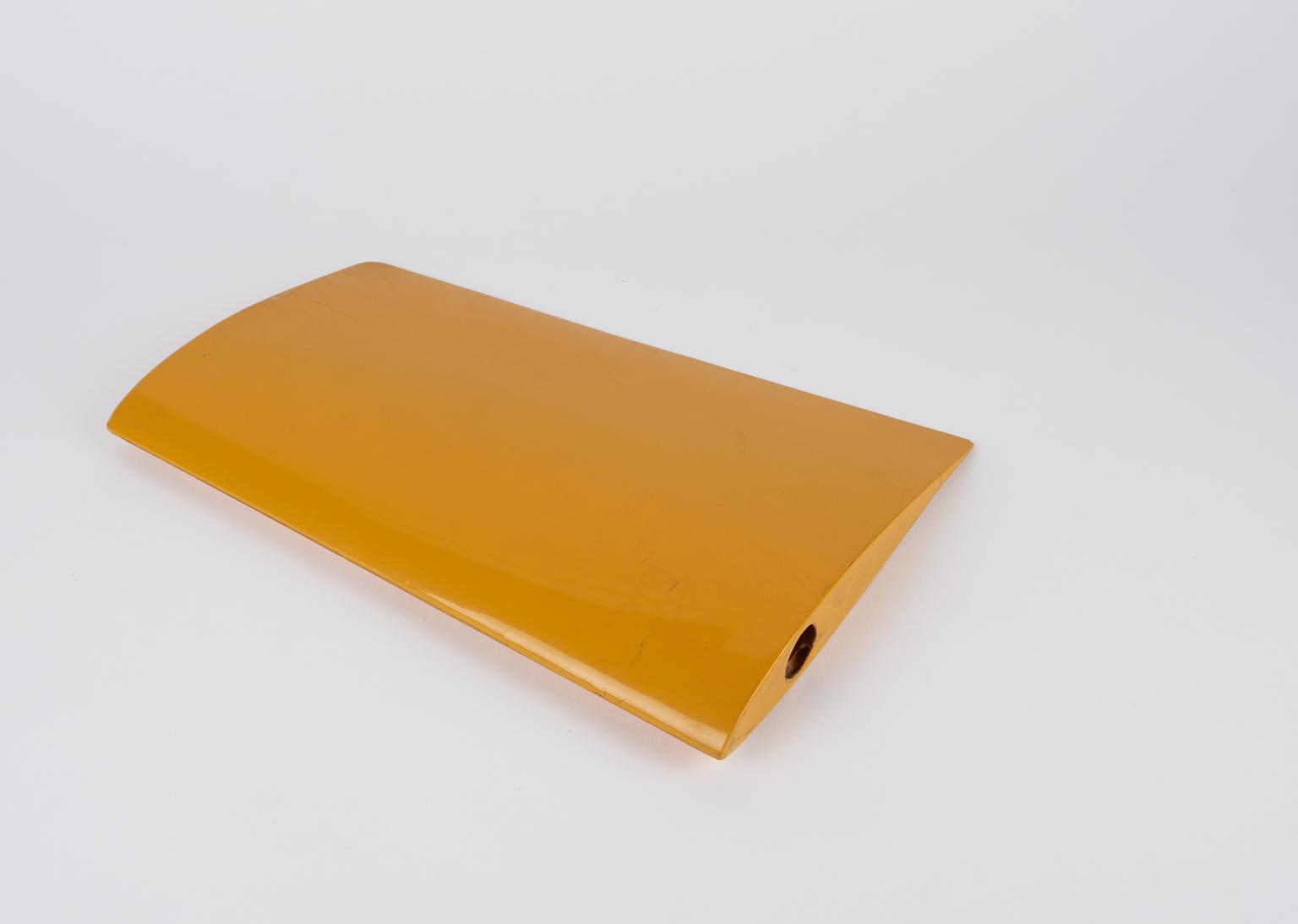
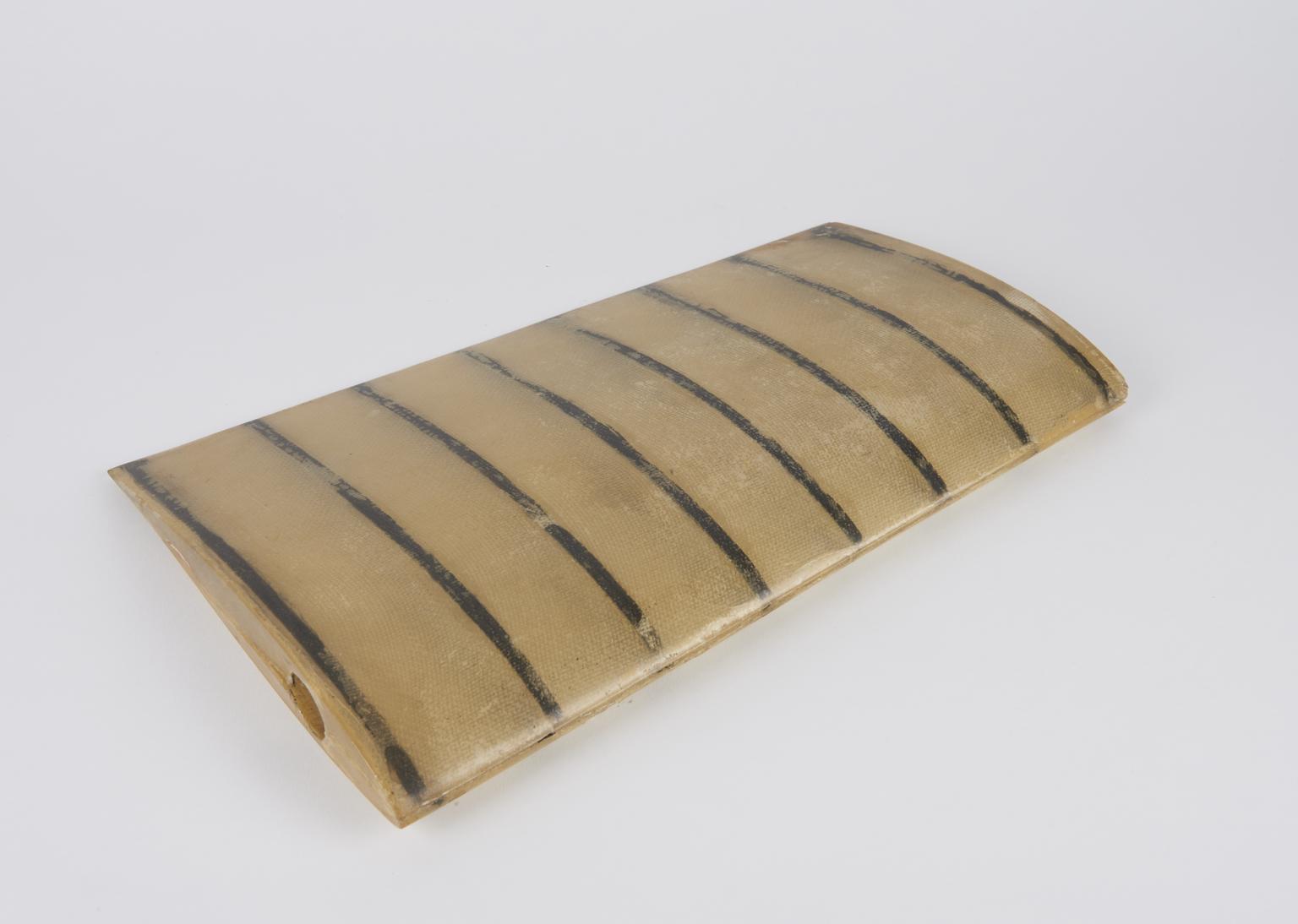
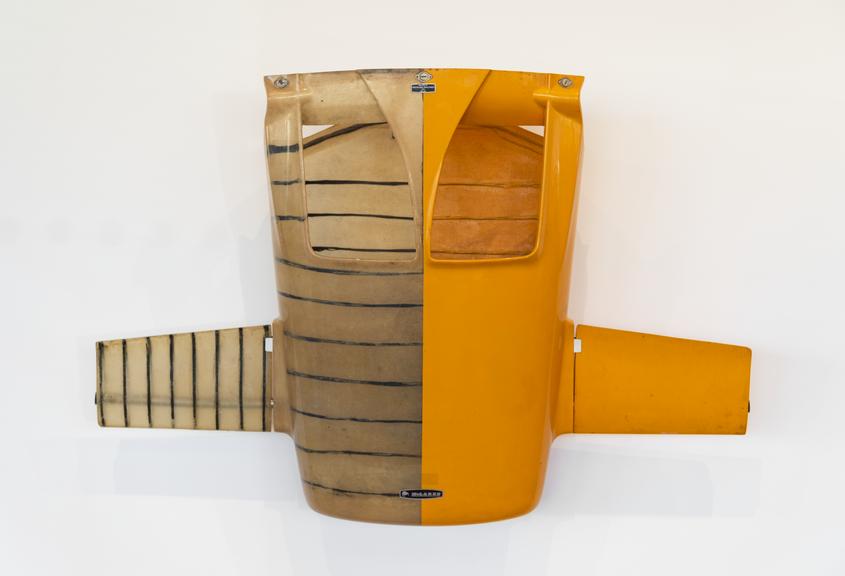
Nosecone of a McLaren M7A Formula One car, made in 1968. Half-painted orange in the McLaren livery, and half left unpainted to show the construction of the chassis. On the unpainted side, there are visible carbon fibre "bootlaces" braced around the interior of the fibreglass body and the accompanying wings - this reinforced the fibreglass construction. The nosecone features a small metal plaque of the original McLaren logo in black and silver, featuring a kiwi bird, and a plaque for Specialised Mouldings Ltd, who produced many components of McLaren's early cars.
Designed by Robin Herd and Gordon Coppuck in 1968, the M7 series gave McLaren their first ever Formula One victory, at the 1968 Belgian Grand Prix at the Circuit de Spa-Francorchamps. Driven by team founder Bruce McLaren, the M7A qualified sixth but took victory on the last lap after a chaotic race.
The McLaren M7A was the first F1 car to use carbon fibre in its construction, and possibly the first car of any kind to do so. Carbon fibre materials have been in use since the nineteenth century, but a means to produce a consistent structure with high strength and stiffness transformed the potential for practical application. William Johnson, William Watt, and Leslie Phillips were granted the patent for this process in 1968, based on their research at RAE Farnborough, a military and civilian research site.
Before moving to McLaren, designers Robin Herd and Gordon Coppuck had been working on the development of Concorde at Farnborough. The movement of a number of staff between Farnborough and McLaren is perhaps how McLaren were able to take advantage of carbon fibre so soon after Johnson, Watt, and Phillips were granted the patent for its manufacture.


 This image is released under a