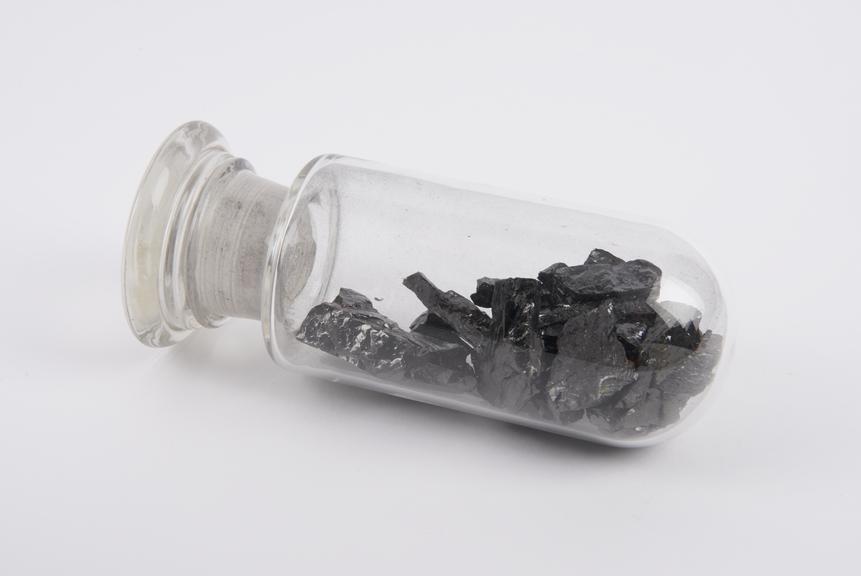

Anthracite from Landshipping Colliery

Anthracite from Landshipping Colliery

Creative Commons LicenseThis image is released under a CC BY-NC-SA 4.0 Licence

License this image for commercial use at Science and Society Picture Library

License

Science Museum Group
© The Board of Trustees of the Science Museum

Anthracite from Landshipping Colliery, Haverfordwest, Pembrokeshire, analysed by W.J. Ward

This specimen is part of the Percy Collection, assembled by the metallurgist Dr John Percy between 1842 and 1889. It contains over four thousand specimens illustrating fuels, ores, metals, alloys and metallurgical processes. The collection was not systematic, but derived from samples sent to Percy for analysis by students and industrial contacts, often because they were thought to be unusual or novel. It is a unique record of British metallurgy in the later 19th century, together with extra material from other countries, and earlier times.

This specimen belongs to the ‘British coals’ section of the collection. Many historians have argued that Britain’s industrialisation depended upon its plentiful coal resources. Coal was not simply a source of heat: different varieties behaved differently when burned or converted into coke, making their identification and analysis important to ironmaking, gas production and other industrial processes.
Details

Category:
Metallurgy
Object Number:
1889-164/122
Materials:
anthracite
type:
specimen
credit:
John Percy Collection

Parts

Anthracite from Landshipping Colliery, Haverfordwest, Pembrokeshire, analysed by W.J. Ward

Anthracite from Landshipping Colliery

Anthracite from Landshipping Colliery, Haverfordwest, Pembrokeshire, analysed by W.J. Ward

More

This specimen is part of the Percy Collection, assembled by the metallurgist Dr John Percy between 1842 and 1889. It contains over four thousand specimens illustrating fuels, ores, metals, alloys and metallurgical processes. The collection was not systematic, but derived from samples sent to Percy for analysis by students and industrial contacts, often because they were thought to be unusual or novel. It is a unique record of British metallurgy in the later 19th century, together with extra material from other countries, and earlier times.

This specimen belongs to the ‘British coals’ section of the collection. Many historians have argued that Britain’s industrialisation depended upon its plentiful coal resources. Coal was not simply a source of heat: different varieties behaved differently when burned or converted into coke, making their identification and analysis important to ironmaking, gas production and other industrial processes.

Materials:
anthracite
Object Number:
1889-164/122/1
type:
specimen
Anthracite from Landshipping Colliery, Haverfordwest, Pembrokeshire, analysed by W.J. Ward. A handwritten note listing out the components and the ratio from the analysis results - carbon, hydrogen, oxygen, nitrogen, sulphur, water, ash.

Anthracite from Landshipping Colliery

Anthracite from Landshipping Colliery, Haverfordwest, Pembrokeshire, analysed by W.J. Ward. A handwritten note listing out the components and the ratio from the analysis results - carbon, hydrogen, oxygen, nitrogen, sulphur, water, ash.

More

This specimen is part of the Percy Collection, assembled by the metallurgist Dr John Percy between 1842 and 1889. It contains over four thousand specimens illustrating fuels, ores, metals, alloys and metallurgical processes. The collection was not systematic, but derived from samples sent to Percy for analysis by students and industrial contacts, often because they were thought to be unusual or novel. It is a unique record of British metallurgy in the later 19th century, together with extra material from other countries, and earlier times.

This specimen belongs to the ‘British coals’ section of the collection. Many historians have argued that Britain’s industrialisation depended upon its plentiful coal resources. Coal was not simply a source of heat: different varieties behaved differently when burned or converted into coke, making their identification and analysis important to ironmaking, gas production and other industrial processes.

Materials:
anthracite
Object Number:
1889-164/122/2
type:
specimen