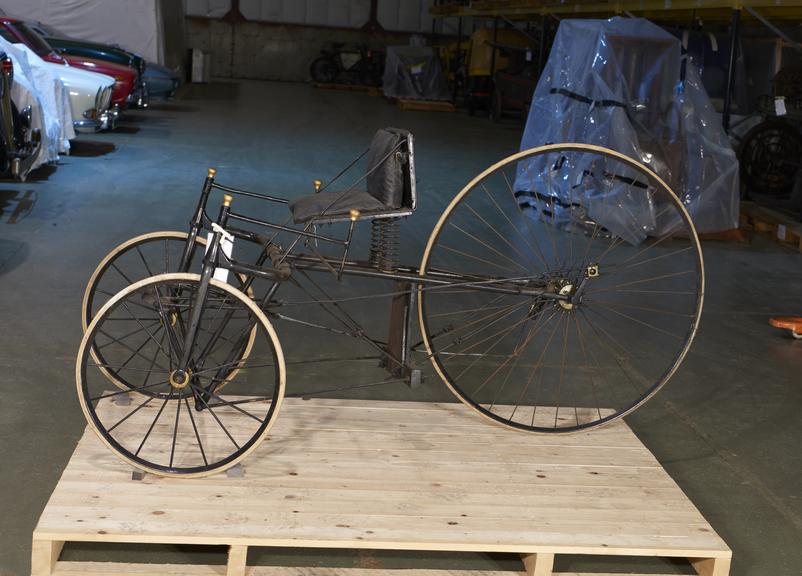
This 'Dublin' Treadle-Driven Tricycle was built in around 1876 by the Carey Brothers Company in Dublin.
The tricycle has a large 29-inch diameter driving wheel with a pair of smaller 23 inch diameter front steering wheels, all of which use solid rubber tyres. The main frame consists of a pair of parallel horizontal tubes extending from either side of the rear wheel to a u-tube with forks connected to the front wheels at each end. The frame is also trussed with adjustable tie bars and a wooden strut in front of the driving wheel for added support.
An Ackermann steering system is used where the front wheels are linked by a lever setup controlled by a pair of handles either side of the saddle, which is mounted on two helical springs. The rear wheel is driven via cranks, rods and levers to clog treadles positioned between the front wheels.
Following the rising popularity of two-wheel velocipede bicycles in the mid-19th century, interest grew in more stable three-wheel designs. The 1870s arguably became the decade of the tricycle, and many of its most foundational designs were developed in this period.
Two of the most successful designs were 'Dublin' and 'Coventry' tricycles, which together helped to popularise the general use of tricycles in everyday life for those that could afford one. Tricycles were safer and more stable, meaning they were not restricted to athletic men and could accommodate the large skirts women wore in this period.
The 'Dublin' tricycle was first patented by Mr. W. B. Blood in 1876, and the first models were made and sold by the Carey Brothers Company in Dublin.
This example is likely one of the first 'Dublin' tricycles made by the Carey Brothers, and features an uncommon treadle, rod and lever drive design. Coventry rotary tricycles would, by contrast, use chain drives. This model of 'Dublin' tricycle also has an unusual dual steering system which allowed a driver to turn each of the front steering wheels in slightly different angles during cornering which improved stability.
Despite very different designs, the 'Dublin' and Coventry' tricycles were considered the practical tricycles in the UK.
Details
- Category:
- Road Transport
- Object Number:
- 1913-471
- Materials:
- iron, steel (metal), rubber (unidentified) and leather
- Measurements:
-
overall: 1130 mm x 2130 mm x 930 mm, 57 kg
- type:
- tricycles
- credit:
- Geoghegan, E.