Singer 'Xtraordinary' Bicycle
- Made:
- 1884-1886
- maker:
- Singer and Company Limited
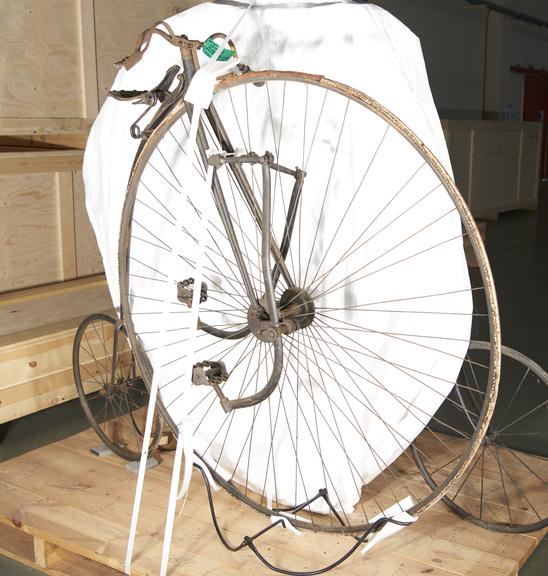
This Singer 'Xtraordinary' bicycle was built by Singer and Company Limited in around 1884 as a safer design of penny farthing (or ordinary) bicycle.
The bicycle has a raked front fork over its large front wheel, with the saddle mounted further back from the wheel. The front wheel drive uses modified extended levers and cranks and come with height adjustable pedals.
The handlebars, similar to the saddle, are fitted slightly behind the top of the front wheel and connect to the front wheel via the head tube which is set at a slight angle to the raked front fork.
Operating the pedals on a typical penny farthing required the rider to be positioned almost on top of the front wheel. This meant that even a small obstruction on the road was enough to throw the rider forward over the handlebars.
Many attempts were made to design a safer bicycle. Some manufacturers chose to produce modified versions of the popular penny farthing (also known as an ordinary), while others opted for a more radical redesign. One of the earliest and most successful designs was the Singer Xtraordinary bicycle. This safer design was patented by Singer and Co in 1878 (patent No.4265).
The Xtraordinary bicycle is essentially a modified penny farthing, where the seat is not mounted directly above the front wheel and is instead slightly behind it.
Singer and Co learned that safety could be improved by raking the front fork backwards, but this resulted in heavy steering. To maintain the ease of steering George Singer bent the fork so that the centre line of the steering axis passed through the point at which the wheel touched the ground. This has since become a feature of nearly all bicycles. The rearward position of the saddle necessitated an indirect method of driving the front wheel by means of cranks and levers.
The Xtraordinary bicycle was a sales success and had an extensive ten-year production run. However, the chain-driven safety bicycle with two equal-sized wheels ultimately won out as the standard bicycle design.
Details
- Category:
- Road Transport
- Object Number:
- 1916-75
- Measurements:
-
overall: 1600 mm x 690 mm x 1920 mm, 27 kg
overall (estimate): 1500 x 2000 x 500 mm
- type:
- bicycles
- credit:
- Singer & Co. Ltd.