


 This image is released under a CC BY-NC-SA 4.0
Licence
This image is released under a CC BY-NC-SA 4.0
Licence
License this image for commercial use at Science and Society Picture Library
License
Science Museum Group
© The Board of Trustees of the Science Museum
Science Museum Group
© The Board of Trustees of the Science Museum
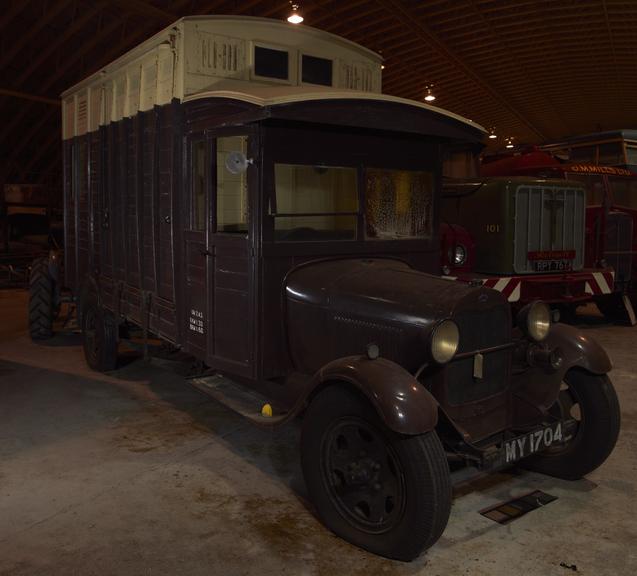
Ford Model A with Curtis horse-box body, 1929. Engine and chassis no. AA1669265. Baico chassis extension no. 21311. Reg. no. MY1704. The Ford Model A chassis was extended by Baico Patents Ltd. and the horse box body built by The National Motor Horse Box Co. Ltd. in accordance with Curtis patents. A groom travelled in the rear-most compartment and communicated with the driver by means of a bell.
In 1927 the Ford Model T was distinctly old fashioned. Sales had fallen since 1923, and Chevrolet were pressing the Ford Motor Co very hard. With some reluctance on the part of Henry Ford (1863-1947) the replacement car, the Ford Model A, was launched late in the year, a new factory at Dearborn having been built to make it. This reveals a weakness in Ford's approach to mass production as the machinery at Highland Park was built specifically to make the Model T, and the efficiencies gained were at the cost of a lack of flexibility in the tooling and production machinery. The new car required more or less completely new machinery, and, in this instance, a new factory, a substantial new investment. As with its forerunner, the Model A proved popular. Available with a variety of car bodies, it also formed the basis for light commercial and specialist vehicles.
This example was formally called the Curtis “De Luxe” Special General Utility and Livestock Vehicle, which cost around £585 for the Ford Model A variant in around 1930. It was capable of transporting up to three horses securely and safely across long distances. This design came withhad a long wheelbase chassis, detachable waterproof canvas top, two paneled rear doors, adjustable ventilation for the horse box itself, and a winch gear and double action winding cable for pulling carcasses on board. This, along with its adjustable ramp, meant this vehicle was suitable for transporting almost any agricultural or domestic animal commonly found in the UK.
Its original owner was Sir Richard Cruise (1876 –1946), a British ophthalmic surgeon who most notably served as the surgeon-oculist to King George V and Queen Mary. He served until his death, and this vehicle eventually moved into a private collection until 1982.
Details
- Category:
- Road Transport
- Object Number:
- 1982-1170
- Materials:
- metal (unknown), wood (unidentified), paint, glass and leather
- Measurements:
-
overall: 3200 mm x 1760 mm x 6100 mm,
- type:
- motor vehicles, special road vehicles, horse boxes and private cars
- credit:
- Wilkins, C.