Rudge 'ordinary' or 'penny farthing' bicycle
- maker:
- Rudge-Whitworth Limited



 This image is released under a CC BY-NC-SA 4.0
Licence
This image is released under a CC BY-NC-SA 4.0
Licence
License this image for commercial use at Science and Society Picture Library
LicenseThis image is released under a CC BY-NC-SA 4.0
Licence
License this image for commercial use at Science and Society Picture Library
LicenseThis image is released under a CC BY-NC-SA 4.0
Licence
License this image for commercial use at Science and Society Picture Library
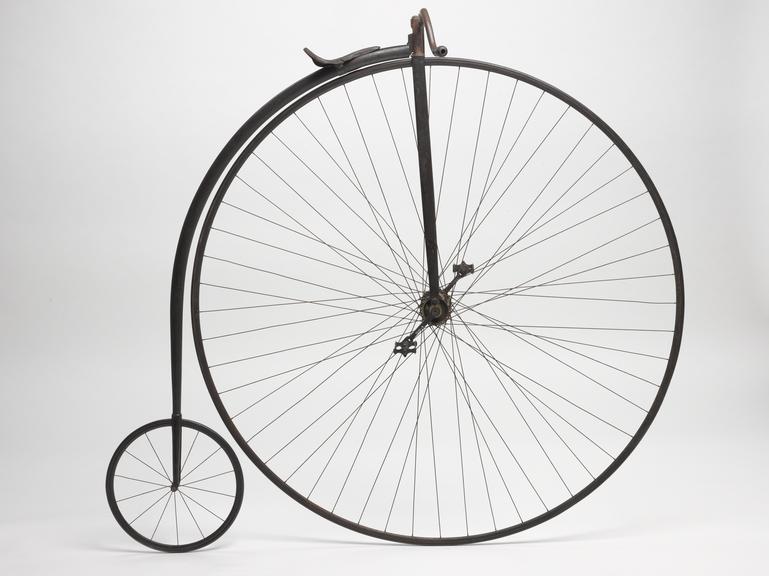
LicenseRudge Ordinary bicycle of 1884, lightened for racing purposes
Science Museum Group Collection
© The Board of Trustees of the Science Museum
Rudge Ordinary bicycle of 1884, lightened for racing purposes
Science Museum Group Collection
© The Board of Trustees of the Science Museum
Rudge Ordinary bicycle of 1884, lightened for racing purposes
Science Museum Group Collection
© The Board of Trustees of the Science Museum
This Rudge ordinary/penny farthing bicycle was built in 1884 by the Rudge Cycle Company in Coventry.
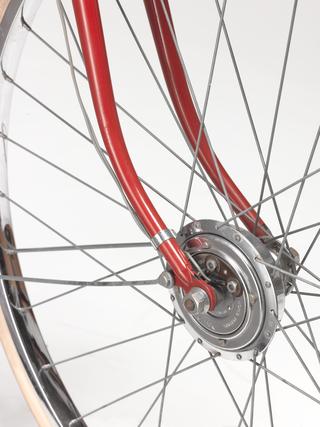
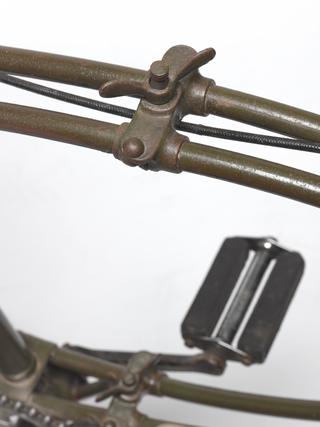
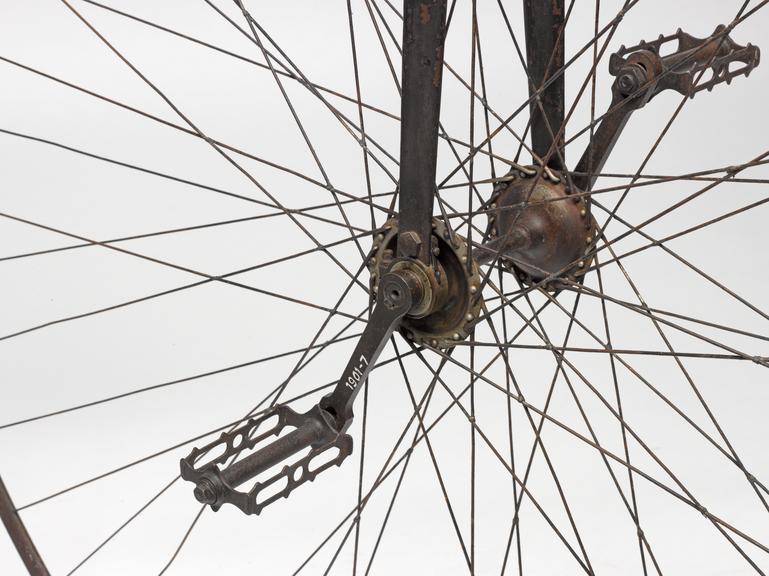
The bicycle has a high seat and pedals directly driving the hub of the front wheel. The saddle and handlebars are located directly on top of the very large front wheel, with a single curved backbone tube connecting the front forks and handlebars to the small rear wheel.
The 57.75-inch diameter front wheel is tangent spoked with solid rubber tyres, with rat-trap pattern pedals. The rear wheel is 16.25 inches in diameter and also has thin rubber tyres.
Richard 'Dick' Howell, a prominent 19th century racer from Wolverhampton, used this bicycle for racing. The Rudge Cycling Company built it to be especially lightweight for that purpose.
The ‘ordinary’ bicycle, such as this one, was the most popular design of bicycle for most of the 19th century from their initial development in the 1850s. The term 'ordinary' emerged in the 1880s and 1890s in order to distinguish them from the lower and heavier 'safety' bicycle designs which became competitive in the late 1880s.
In the UK, ordinaries were also commonly called 'penny farthings' as their large and small wheel design was often compared to the relative sizes of pennies and farthing coins.
Safety bicycles struggled to compete with the cheap price, simplicity and lightweight design of ordinaries. This was until the late 1880s when a combination of novel innovations in safety bicycle design alongside new methods of mass production made safety bicycles competitive in both price and accessibility. By the beginning of the 20th century, the safety bicycle had replaced the ordinary/penny farthing as the popular two-wheel design.