
Humber Pattern 'Safety' Bicycle
- maker:
- Humber and Co.
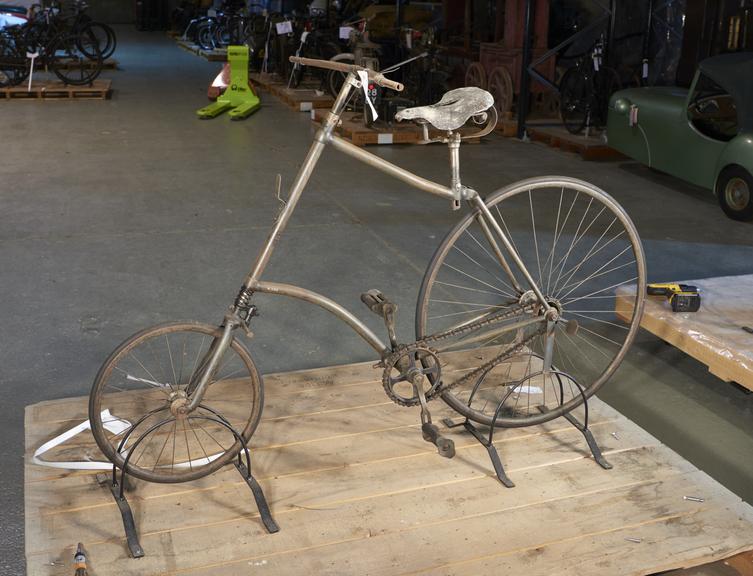
This Humber 'roadster' Safety Bicycle was built between 1885 and 1888 by Humber and Company Limited in Coventry.
The bicycle has a short diamond frame design with a cee-spring and helical spring saddle (saddle re-made by Brooks in 1961). The small front wheel is directly steered via a steering column attached to handlebars. The larger rear wheel is connected to the adjustable rubber pedals through a chain drive. Both wheels have radial spokes and have solid rubber tyres.
An important development in the history of modern bicycles is the diamond or 'safety' frame. Early bicycles such as penny farthings had frames consisting of a single tube or bar, which could bend and warp under stress.
Diamond frames were developed alongside other features as part of a general interest in designing safer and easier to ride versions of bicycles in the late 19th century.
This design of diamond frame was patented in 1884 by Mr Thomas Humber. Diamond frames are now considered a ubiquitous feature of modern bicycles, and even motorcycles. The other notable feature of this Humber roadster is that its front wheel is smaller than its rear wheel, an idea which, unlike the diamond frame, did not catch on.
Details
- Category:
- Road Transport
- Object Number:
- 1901-8
- Materials:
- steel (metal), rubber (unidentified) and leather
- Measurements:
-
overall: 1240 mm x 830 mm x 1780 mm, 19.5 kg
overall (estimate): 1000 x 2000 x 500 mm
- type:
- bicycle
- credit:
- Rudge-Whitworth Ltd.
Related Objects