
Otto Dicycle made by the Birmingham Small Arms Co
- Made:
- 1879-1881 in Small Heath
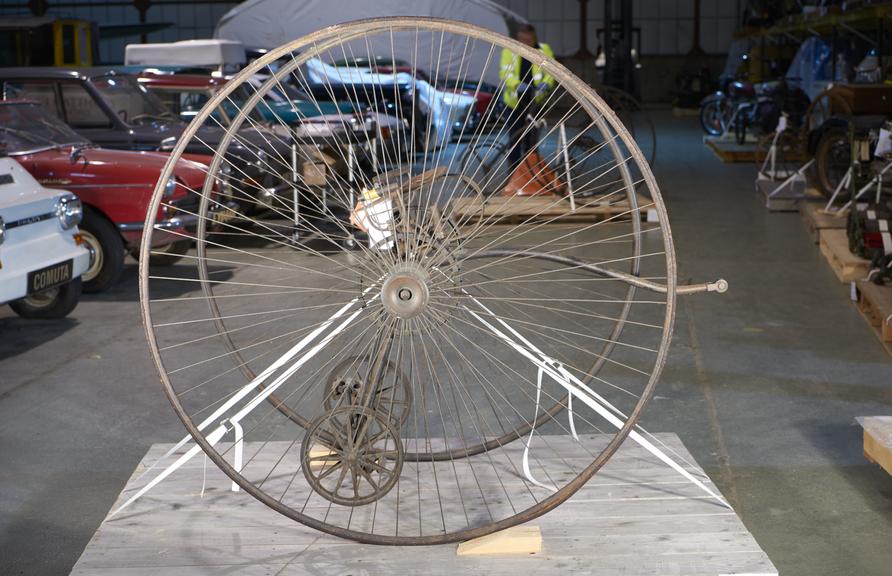
This Otto Dicycle was made between 1879 and 1881 by Birmingham Small Arms Company in Birmingham for Lord Sherbrooke. It was made in accordance with the patent filed by Mr. E. Otto in 1879.
The machine has two large road wheels, both loose on a straight axle which supports the saddle and the entire framing, but from the back of the frame projects a bar carrying a small rubber-tyred roller, which prevents the frame and rider from swinging too far backward, and also can be used as a trailing brake.
Projecting downward in front of the axle are two telescopic rods which support the bearings of a double-throw crankshaft provided with pedals by which the shaft is rotated.
On each side of the rider is a steering handle fixed to the axle and connected with the crankshaft bearings in such a way that enables the machine to be indirectly steered. The driving wheels are 56 in. diam., and are 32 in. apart at their tyres, which are of solid rubber; the crank radius is 6 inches and the total weight of the machine is 95 lb.
Ordinary bicycles reached the height of their popularity in the late 1870s and early 1880s, with their success limited by their unstable and dangerous design. Whilst some attempted to refine the design to improve safety, other abandoned the idea of the ordinary altogether in lieu of tricycles, quadricycles and other creative machines.
The Otto Dicycle was one such machine and was built by BSA to the specifications of Mr. Otto’s original 1879 patent. This unusual dicycle design has side-by-side wheels instead of the typical front and rear wheel arrangement. Balance was maintained by a roller at the rear, and the machine used a pedal and crank drive system.
The Otto Dicycle experienced a brief period of popularity between 1879 and 1881, before its production was ceased when bicycle manufacturers faced the introduction of the game-changing safety bicycle form, complete with rear wheel chain drive, sturdy diamond frame layout, balanced wheel size, and central saddle position.
Details
- Category:
- Road Transport
- Object Number:
- 1901-14
- Materials:
- iron, steel (metal), rubber (unidentified) and leather
- Measurements:
-
overall: 1540 mm x 1080 mm x 1750 mm, 45.5 kg
- type:
- cycles
- credit:
- Sherbrooke
Related Objects