 This image is released under a CC BY-NC-SA 4.0
Licence
This image is released under a CC BY-NC-SA 4.0
Licence
License this image for commercial use at Science and Society Picture Library
License
Science Museum Group
© The Board of Trustees of the Science Museum
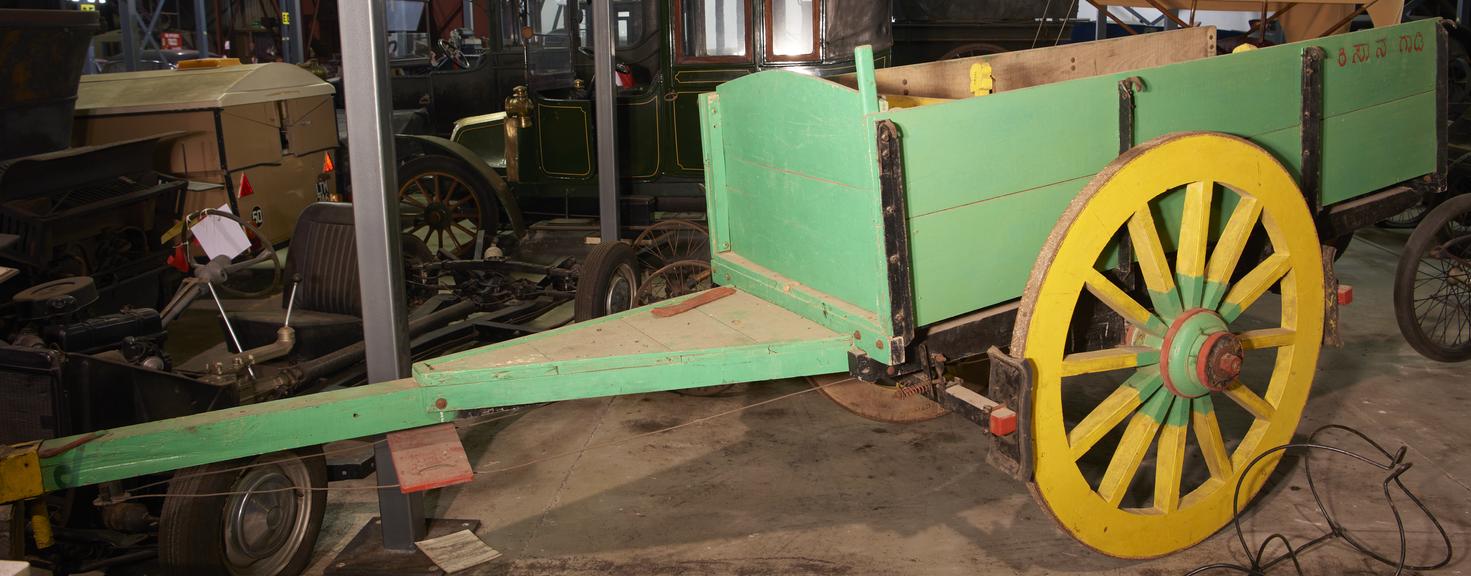
This Kisaan (meaning farmer) bullock cart was built in 1982 by the Institute of Management in Bengaluru (previously known as Bangalore), India.
This two-wheeled bullock-cart has a green-painted wide steel and wood frame with yellow-painted wooden wheels with rubber rims and a wide yoke which is drawn by two animals. The cart has brakes, and shock-absorbing spring suspension and roller bearings in the wheel hubs for smoother movement.
This improved bullock cart is a research prototype for a modernised animal-drawn vehicle, designed by the Indian Institute of Management.
In India, animal drawn and motorised vehicles have been operated alongside each other as both commercial and personal transport. In the early 1980s, there were around 500,000 motor trucks transporting goods long distances, but for every truck there were also 35 animal-driven carts operating shorter distances between farms, fields, and markets.[AW1.1][AW1.2]
Bullock carts (sometimes called bullock carriages when they are transporting people) are one of the oldest types of carts in history, with their generally simple design being traced back 3000 years. Mostly unchanged across this history, bullock carts are cheap, tough, effective and easy to build and repair.
In modern history, many new designs of bullock carts have been developed to include new features. This example is a result of experimentation and trials in villages in and around the Bengaluru (previously known as Bangalore) and Mandya Districts, Karnataka. Its key improvements are its wider and sturdier yoke, its shock-absorbing springs and the inclusion of roller bearings in the wheel hub. These improvements ease the load on the driver and the animals.
Details
- Category:
- Road Transport
- Object Number:
- 1982-1361
- Materials:
- wood (unidentified), paint, rubber (unidentified) and steel (metal)
- Measurements:
-
overall: 1570 mm x 1370 mm x 4400 mm,
- type:
- cart
- credit:
- Indian Institute of Management, Bangalore