Horse drawn cart

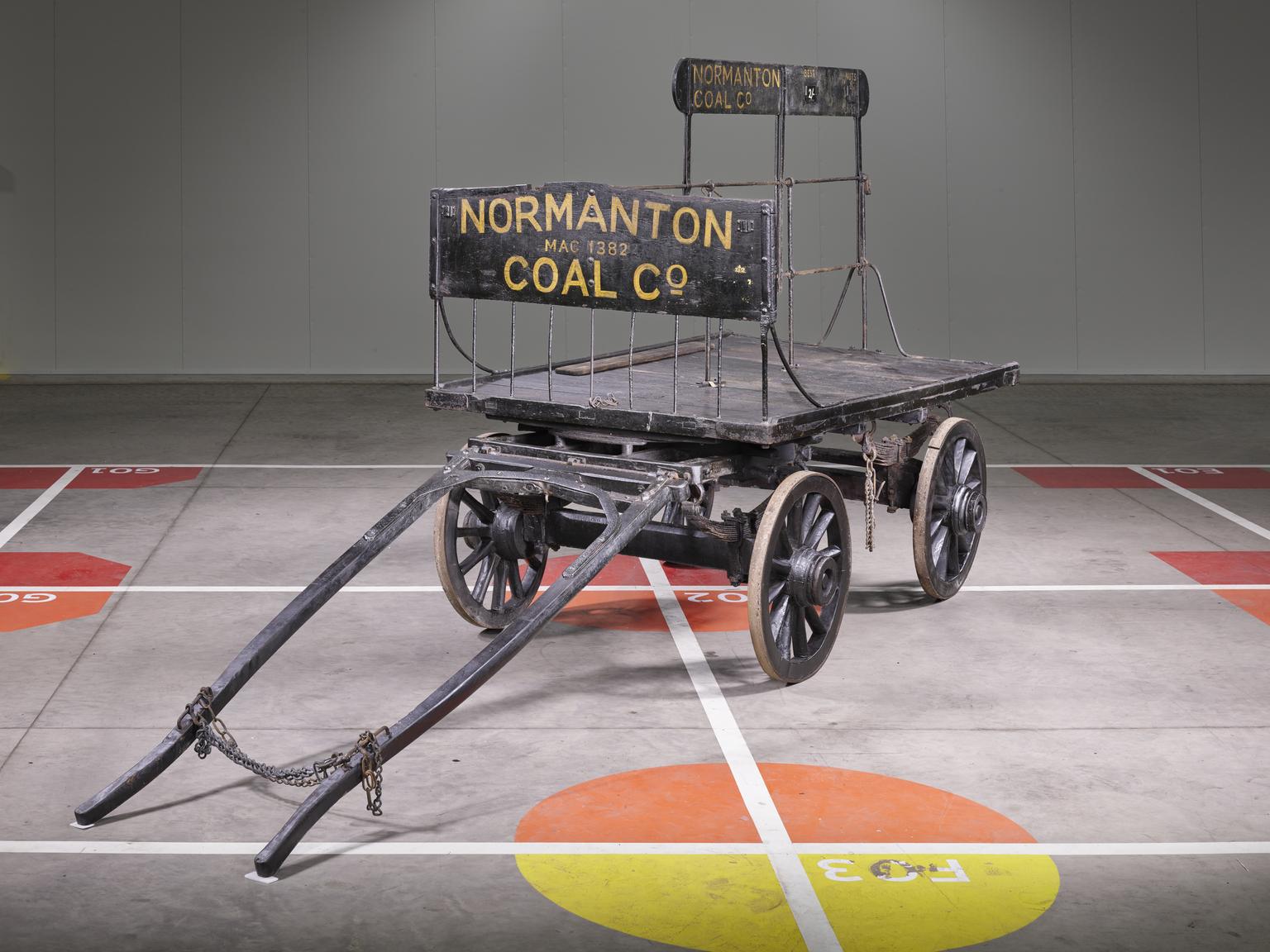
This Horse drawn cart was built in the early 20th century by William Rundle Wheelright in Battersea, London.

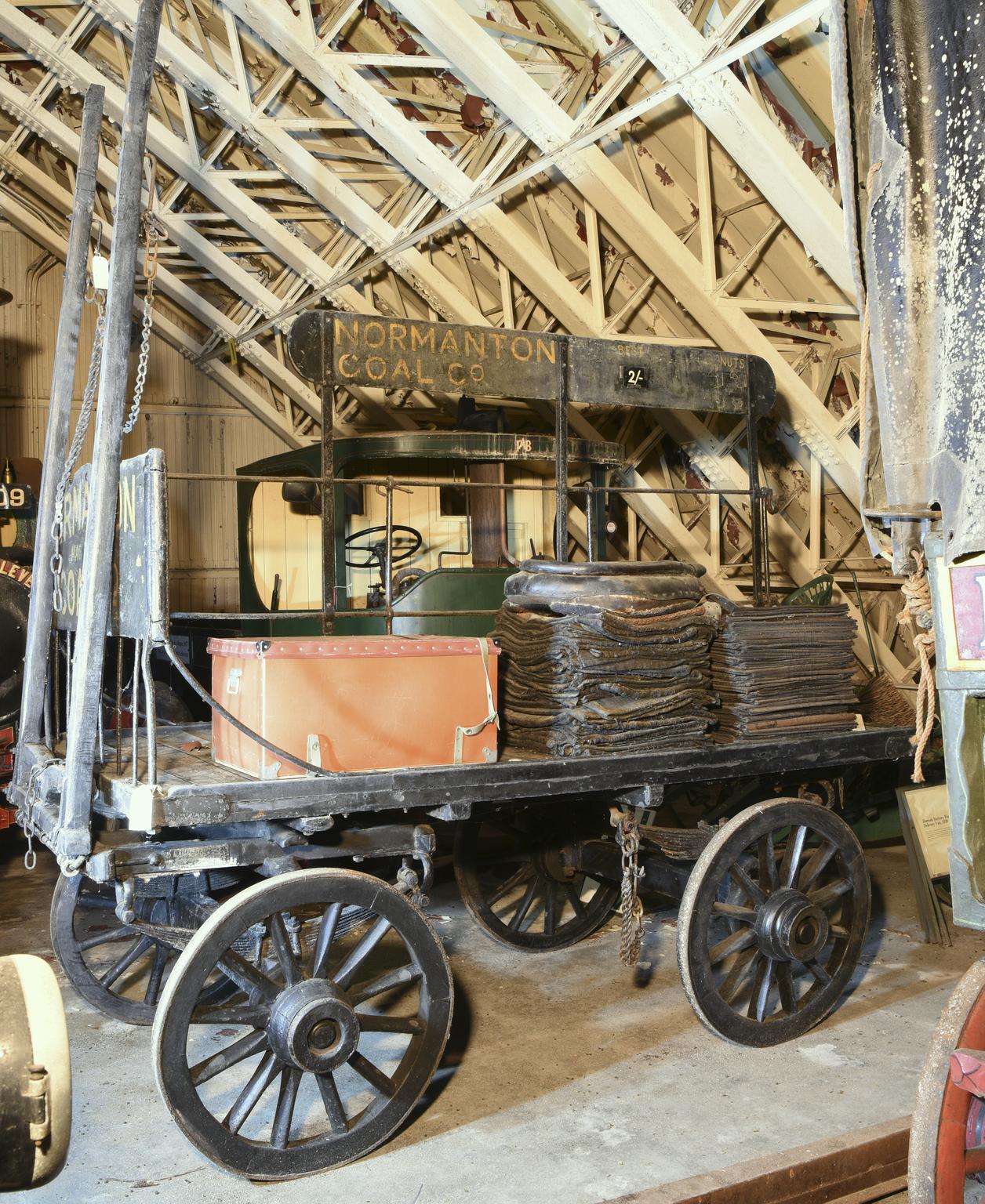
This cart has four wheels with a wide open flat top body design. It has a very simple layout, lacking brakes and steering mechanisms, and is built to be drawn by a single horse, which was led on foot. Included with this cart are two contemporary oil lamps, harness for a horse, two 1cwt coalsacks with cards identifying high and low grades of coal. There is also a set of scales, runners, and tare weights.

This horse drawn cart would have also been referred to as a coal trolley, the driver being called the ‘trolleyman’. These vehicles were most often family owned and operated, with a father and son duo running a set route, called a trolley round, delivering coal to houses much like a newspaper or dairy delivery route. Most runs were five miles in length, but often run twice or three times a day depending on the season.

Coal was usually stored at depots next to train stations, which was then transported on carts and trolley to individuals. Coal trolleys would carry two types of coal, ‘best coal’ for dining room fires which burned cleaner, and a low-grade coal for the kitchens one.

This cart would have cost around £30 in around 1910 and has a two-ton carrying capacity, and by law was required to carry a dedicated scale and weight set for people to check the weight of the coalsacks. This cart was owned and operated by

the Normanton Coal Company based at Stewart Lane Goods Station, and was used on a trolley round in Lavender Hill, London between 1930 and 1972.

Details

Category:
Road Transport
Object Number:
1974-69
type:
cart
credit:
A&H Betts Ltd.

Parts

Horse drawn cart and exhibition part

This Horse drawn cart was built in the early 20th century by William Rundle Wheelright in Battersea, London.

This cart has four wheels with a wide open flat top body design. It has a very simple layout, lacking brakes and steering mechanisms, and is built to be drawn by a single horse, which was led on foot. Included with this cart are two contemporary oil lamps, harness for a horse, two 1cwt coalsacks with cards identifying high and low grades of coal. There is also a set of scales, runners, and tare weights.

More

This horse drawn cart would have also been referred to as a coal trolley, the driver being called the ‘trolleyman’. These vehicles were most often family owned and operated, with a father and son duo running a set route, called a trolley round, delivering coal to houses much like a newspaper or dairy delivery route. Most runs were five miles in length, but often run twice or three times a day depending on the season.

Coal was usually stored at depots next to train stations, which was then transported on carts and trolley to individuals. Coal trolleys would carry two types of coal, ‘best coal’ for dining room fires which burned cleaner, and a low-grade coal for the kitchens one.

This cart would have cost around £30 in around 1910 and has a two-ton carrying capacity, and by law was required to carry a dedicated scale and weight set for people to check the weight of the coalsacks. This cart was owned and operated by

the Normanton Coal Company based at Stewart Lane Goods Station, and was used on a trolley round in Lavender Hill, London between 1930 and 1972.

Measurements:
overall: 3470 mm x 1700 mm x 3050 mm,
Object Number:
1974-69 Pt1
type:
cart
Image ©
The Board of Trustees of the Science Museum
Harness for coal cart

Harness for coal cart

Harness for coal cart

More

This horse drawn cart would have also been referred to as a coal trolley, the driver being called the ‘trolleyman’. These vehicles were most often family owned and operated, with a father and son duo running a set route, called a trolley round, delivering coal to houses much like a newspaper or dairy delivery route. Most runs were five miles in length, but often run twice or three times a day depending on the season.

Coal was usually stored at depots next to train stations, which was then transported on carts and trolley to individuals. Coal trolleys would carry two types of coal, ‘best coal’ for dining room fires which burned cleaner, and a low-grade coal for the kitchens one.

This cart would have cost around £30 in around 1910 and has a two-ton carrying capacity, and by law was required to carry a dedicated scale and weight set for people to check the weight of the coalsacks. This cart was owned and operated by

the Normanton Coal Company based at Stewart Lane Goods Station, and was used on a trolley round in Lavender Hill, London between 1930 and 1972.

Measurements:
overall: 620 mm x 600 mm x 1230 mm,
Object Number:
1974-69 Pt2
type:
harness
Three lamps for horse drawn cart

Three lamps for horse drawn cart

Three lamps for cart

More

This horse drawn cart would have also been referred to as a coal trolley, the driver being called the ‘trolleyman’. These vehicles were most often family owned and operated, with a father and son duo running a set route, called a trolley round, delivering coal to houses much like a newspaper or dairy delivery route. Most runs were five miles in length, but often run twice or three times a day depending on the season.

Coal was usually stored at depots next to train stations, which was then transported on carts and trolley to individuals. Coal trolleys would carry two types of coal, ‘best coal’ for dining room fires which burned cleaner, and a low-grade coal for the kitchens one.

This cart would have cost around £30 in around 1910 and has a two-ton carrying capacity, and by law was required to carry a dedicated scale and weight set for people to check the weight of the coalsacks. This cart was owned and operated by

the Normanton Coal Company based at Stewart Lane Goods Station, and was used on a trolley round in Lavender Hill, London between 1930 and 1972.

Object Number:
1974-69 Pt3
type:
lamp
Padlock key for lock on Horse drawn cart

Padlock key for lock on Horse drawn cart

Padlock key for lock on Horse drawn cart.

More

This horse drawn cart would have also been referred to as a coal trolley, the driver being called the ‘trolleyman’. These vehicles were most often family owned and operated, with a father and son duo running a set route, called a trolley round, delivering coal to houses much like a newspaper or dairy delivery route. Most runs were five miles in length, but often run twice or three times a day depending on the season.

Coal was usually stored at depots next to train stations, which was then transported on carts and trolley to individuals. Coal trolleys would carry two types of coal, ‘best coal’ for dining room fires which burned cleaner, and a low-grade coal for the kitchens one.

This cart would have cost around £30 in around 1910 and has a two-ton carrying capacity, and by law was required to carry a dedicated scale and weight set for people to check the weight of the coalsacks. This cart was owned and operated by

the Normanton Coal Company based at Stewart Lane Goods Station, and was used on a trolley round in Lavender Hill, London between 1930 and 1972.

Object Number:
1974-69 Pt4
type:
key -hardware
Collar for Horse Drawn Cart

Collar for Horse Drawn Cart

Collar for Horse drawn cart

More

This horse drawn cart would have also been referred to as a coal trolley, the driver being called the ‘trolleyman’. These vehicles were most often family owned and operated, with a father and son duo running a set route, called a trolley round, delivering coal to houses much like a newspaper or dairy delivery route. Most runs were five miles in length, but often run twice or three times a day depending on the season.

Coal was usually stored at depots next to train stations, which was then transported on carts and trolley to individuals. Coal trolleys would carry two types of coal, ‘best coal’ for dining room fires which burned cleaner, and a low-grade coal for the kitchens one.

This cart would have cost around £30 in around 1910 and has a two-ton carrying capacity, and by law was required to carry a dedicated scale and weight set for people to check the weight of the coalsacks. This cart was owned and operated by

the Normanton Coal Company based at Stewart Lane Goods Station, and was used on a trolley round in Lavender Hill, London between 1930 and 1972.

Measurements:
overall: 220 mm x 570 mm x 850 mm,
Materials:
leather and textile
Object Number:
1974-69 Pt5
type:
collar
Two Stacks of Coal Sacks for Horse Drawn Cart

Two Stacks of Coal Sacks for Horse Drawn Cart

Two folded stacks coal sacks for Horse drawn cart. There are fifty of the smaller bags and thirty one of the larger sacks.

More

This horse drawn cart would have also been referred to as a coal trolley, the driver being called the ‘trolleyman’. These vehicles were most often family owned and operated, with a father and son duo running a set route, called a trolley round, delivering coal to houses much like a newspaper or dairy delivery route. Most runs were five miles in length, but often run twice or three times a day depending on the season.

Coal was usually stored at depots next to train stations, which was then transported on carts and trolley to individuals. Coal trolleys would carry two types of coal, ‘best coal’ for dining room fires which burned cleaner, and a low-grade coal for the kitchens one.

This cart would have cost around £30 in around 1910 and has a two-ton carrying capacity, and by law was required to carry a dedicated scale and weight set for people to check the weight of the coalsacks. This cart was owned and operated by

the Normanton Coal Company based at Stewart Lane Goods Station, and was used on a trolley round in Lavender Hill, London between 1930 and 1972.

Measurements:
overall; stack with small sacks: 680 mm x 400 mm x 530 mm,
overall; stack with large sacks: 700 mm x 600 mm x 620 mm,
Materials:
textile and leather
Object Number:
1974-69 Pt6
type:
sacks
Scales with weights for Horse Drawn Cart

Scales with weights for Horse Drawn Cart

Coal scales with 4 varying weights for Horse drawn cart including; 7lb, 4lb, 2lb and 1lb. Attached by a chain and padlock. Embossed text on the object; 'Wm Poupard and son, inventor and maker of improved weighing machines. 7 Blackfriars Road'.

More

This horse drawn cart would have also been referred to as a coal trolley, the driver being called the ‘trolleyman’. These vehicles were most often family owned and operated, with a father and son duo running a set route, called a trolley round, delivering coal to houses much like a newspaper or dairy delivery route. Most runs were five miles in length, but often run twice or three times a day depending on the season.

Coal was usually stored at depots next to train stations, which was then transported on carts and trolley to individuals. Coal trolleys would carry two types of coal, ‘best coal’ for dining room fires which burned cleaner, and a low-grade coal for the kitchens one.

This cart would have cost around £30 in around 1910 and has a two-ton carrying capacity, and by law was required to carry a dedicated scale and weight set for people to check the weight of the coalsacks. This cart was owned and operated by

the Normanton Coal Company based at Stewart Lane Goods Station, and was used on a trolley round in Lavender Hill, London between 1930 and 1972.

Measurements:
overall: 260 mm x 780 mm x 400 mm,
Materials:
metal (unknown) and cast iron
Object Number:
1974-69 Pt7
type:
scales
Weights for Horse drawn cart

Weights for Horse drawn cart

Two 56lb weights for Horse drawn cart

More

This horse drawn cart would have also been referred to as a coal trolley, the driver being called the ‘trolleyman’. These vehicles were most often family owned and operated, with a father and son duo running a set route, called a trolley round, delivering coal to houses much like a newspaper or dairy delivery route. Most runs were five miles in length, but often run twice or three times a day depending on the season.

Coal was usually stored at depots next to train stations, which was then transported on carts and trolley to individuals. Coal trolleys would carry two types of coal, ‘best coal’ for dining room fires which burned cleaner, and a low-grade coal for the kitchens one.

This cart would have cost around £30 in around 1910 and has a two-ton carrying capacity, and by law was required to carry a dedicated scale and weight set for people to check the weight of the coalsacks. This cart was owned and operated by

the Normanton Coal Company based at Stewart Lane Goods Station, and was used on a trolley round in Lavender Hill, London between 1930 and 1972.

Measurements:
overall: 155 mm x 220 mm x 140 mm,
Materials:
cast iron
Object Number:
1974-69 Pt8
type:
weights
Housing and Padding for Horse Drawn Cart

Housing and Padding for Horse Drawn Cart

Housing and padding for Horse drawn cart.

More

This horse drawn cart would have also been referred to as a coal trolley, the driver being called the ‘trolleyman’. These vehicles were most often family owned and operated, with a father and son duo running a set route, called a trolley round, delivering coal to houses much like a newspaper or dairy delivery route. Most runs were five miles in length, but often run twice or three times a day depending on the season.

Coal was usually stored at depots next to train stations, which was then transported on carts and trolley to individuals. Coal trolleys would carry two types of coal, ‘best coal’ for dining room fires which burned cleaner, and a low-grade coal for the kitchens one.

This cart would have cost around £30 in around 1910 and has a two-ton carrying capacity, and by law was required to carry a dedicated scale and weight set for people to check the weight of the coalsacks. This cart was owned and operated by

the Normanton Coal Company based at Stewart Lane Goods Station, and was used on a trolley round in Lavender Hill, London between 1930 and 1972.

Measurements:
overall (padded item): 130 mm x 510 mm x 440 mm,
overall (leather and wood item): 200 mm x 620 mm x 490 mm,
Materials:
wood (unidentified) , leather , metal (unknown) and textile
Object Number:
1974-69 Pt9
type:
housing
Section of Harness for Horse Drawn Cart

Section of Harness for Horse Drawn Cart

Two wooden struts and metal fixings from harnes for Horse drawn cart, known as Hames and Traces.

More

This horse drawn cart would have also been referred to as a coal trolley, the driver being called the ‘trolleyman’. These vehicles were most often family owned and operated, with a father and son duo running a set route, called a trolley round, delivering coal to houses much like a newspaper or dairy delivery route. Most runs were five miles in length, but often run twice or three times a day depending on the season.

Coal was usually stored at depots next to train stations, which was then transported on carts and trolley to individuals. Coal trolleys would carry two types of coal, ‘best coal’ for dining room fires which burned cleaner, and a low-grade coal for the kitchens one.

This cart would have cost around £30 in around 1910 and has a two-ton carrying capacity, and by law was required to carry a dedicated scale and weight set for people to check the weight of the coalsacks. This cart was owned and operated by

the Normanton Coal Company based at Stewart Lane Goods Station, and was used on a trolley round in Lavender Hill, London between 1930 and 1972.

Measurements:
overall; each (lying down): 60 mm x 940 mm x 27 mm,
Materials:
wood (unidentified) , metal (unknown) and brass (copper, zinc alloy)
Object Number:
1974-69 Pt10
type:
harness
Horse Feed Bag for Horse Drawn Cart

Horse Feed Bag for Horse Drawn Cart

Horse feed bag for Horse drawn cart

More

This horse drawn cart would have also been referred to as a coal trolley, the driver being called the ‘trolleyman’. These vehicles were most often family owned and operated, with a father and son duo running a set route, called a trolley round, delivering coal to houses much like a newspaper or dairy delivery route. Most runs were five miles in length, but often run twice or three times a day depending on the season.

Coal was usually stored at depots next to train stations, which was then transported on carts and trolley to individuals. Coal trolleys would carry two types of coal, ‘best coal’ for dining room fires which burned cleaner, and a low-grade coal for the kitchens one.

This cart would have cost around £30 in around 1910 and has a two-ton carrying capacity, and by law was required to carry a dedicated scale and weight set for people to check the weight of the coalsacks. This cart was owned and operated by

the Normanton Coal Company based at Stewart Lane Goods Station, and was used on a trolley round in Lavender Hill, London between 1930 and 1972.

Measurements:
overall (lying down): 80 mm x 56 mm x 50 mm,
Materials:
textile and leather
Object Number:
1974-69 Pt11
type:
bag