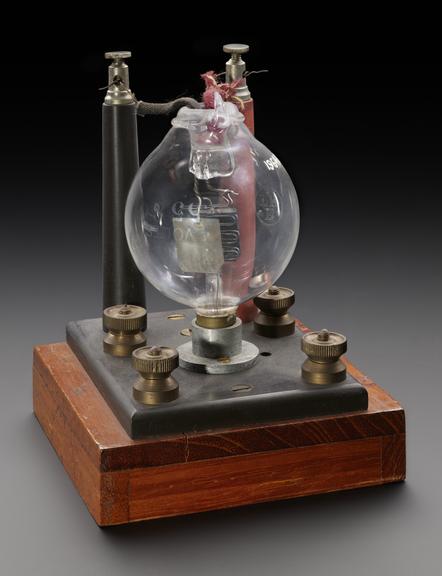
Audion (with spherical bulb), 1906
- Made:
- 1906 in United States
- maker:
- Lee de Forest
 This image is released under a CC BY-NC-SA 4.0
Licence
This image is released under a CC BY-NC-SA 4.0
Licence
License this image for commercial use at Science and Society Picture Library
License
Science Museum Group
© The Board of Trustees of the Science Museum
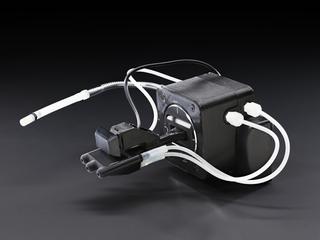
Spherical Audion vacuum tube with mountingc, Lee De Forest, 1906.
Invented in 1906 by Lee de Forest (USA), the Audion vacuum tube, or valve, was the first widely available electronic device that could amplify a signal, and was a game changer in both telephony and radio. The Audion and its successors made long-distance radio broadcast and telephone networks possible, and were at the heart of communications technology until the invention of the transistor in 1947. Although now largely superseded by the transistor, and the integrated circuit, triode valve amplifiers are still used in niche applications such as guitar and hi-fi amplifiers.
Details
- Category:
- Electronic Components
- Object Number:
- 1964-62
- Materials:
- textile covered electrical wires, plastic (unidentified), wood (unidentified), brass (copper, zinc alloy) and glass
- Measurements:
-
overall (estimate): 110 mm x 86 mm x 86 mm, 0.1kg
- type:
- audion
- credit:
- Johnson, A.H.