Transmitter/receiver type TR9D
- Made:
- England
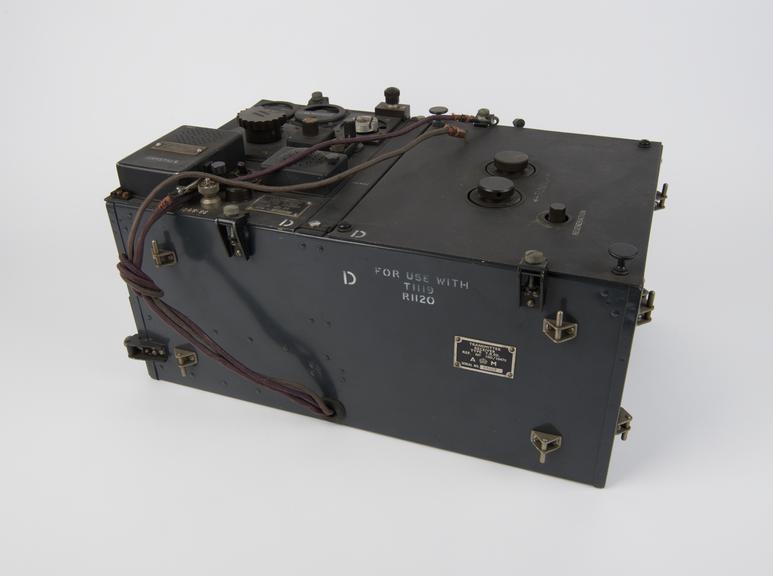
Transmitter/receiver type TR9D (T.1119 and R.1120) as used by the Royal Air Force (RAF) in the early stages of World War Two for airborne communication and direction-finding (location finding).
The TR9D was an AM radio set which operated in lower HF, between 4.3 to 6.6 MHz. It was crystal controlled, and had a range of 5 miles air-to-air, and 35 miles air-to-ground. Power output was around 3 watts. The receiver was regenerative, unlike the more advanced super-heterodyne design used by the Germans during the Battle of Britain. The radio was mounted in the rear of the airplane, with a remote gain control and transmit switch for the pilot.
During World War Two, airborne radio assumed a new importance for Britain’s Royal Air Force. During the 1930s, it became standard practice for defending fighter aircraft to mount a standing patrol across the expected line of approach and altitude of the attacking enemy bombers. However, this would have been far too expensive in terms of money and pilot fatigue and also impractical given the large potential arc of attack. Instead, the RAF used an expanded system of radio control and command originally developed during World War One to communicate and coordinate with fighter squadrons, to provide near real-time intelligence and to enable airborne communication between pilots and with the ground.
The ubiquitous TR9D was a high frequency (HF) set, which allowed for simultaneous radio telephony (R/T) communication and direction-finding (location finding, referred to as “Pip-Squeak”). The transmitter/receiver set was connected to a wire antenna (aerial) loosely slung between a rigid mast projecting vertically above the rear fuselage and the top of the rudder. There were problems with poor quality of reception, interference, and a single channel for communication – the TR9D was upgraded to have two channels but the second channel was used for direction-finding. The set had a range of five miles air-to-air and 35 miles air-to-ground.
At the time of the Battle of Britain the TR9D was being replaced by a more powerful, four channel VHF equipment known as the TR1133. Due to production difficulties with these new sets, however, the TR9D continued to be used in most aircraft throughout the Battle.
Details
- Category:
- Radio Communication
- Object Number:
- 1948-96
- type:
- transmitter
- credit:
- Air Ministry (Air Historical Branch)
Related Objects

BBC ribbon microphone

Type C crystal radio receiver
