

 This image is released under a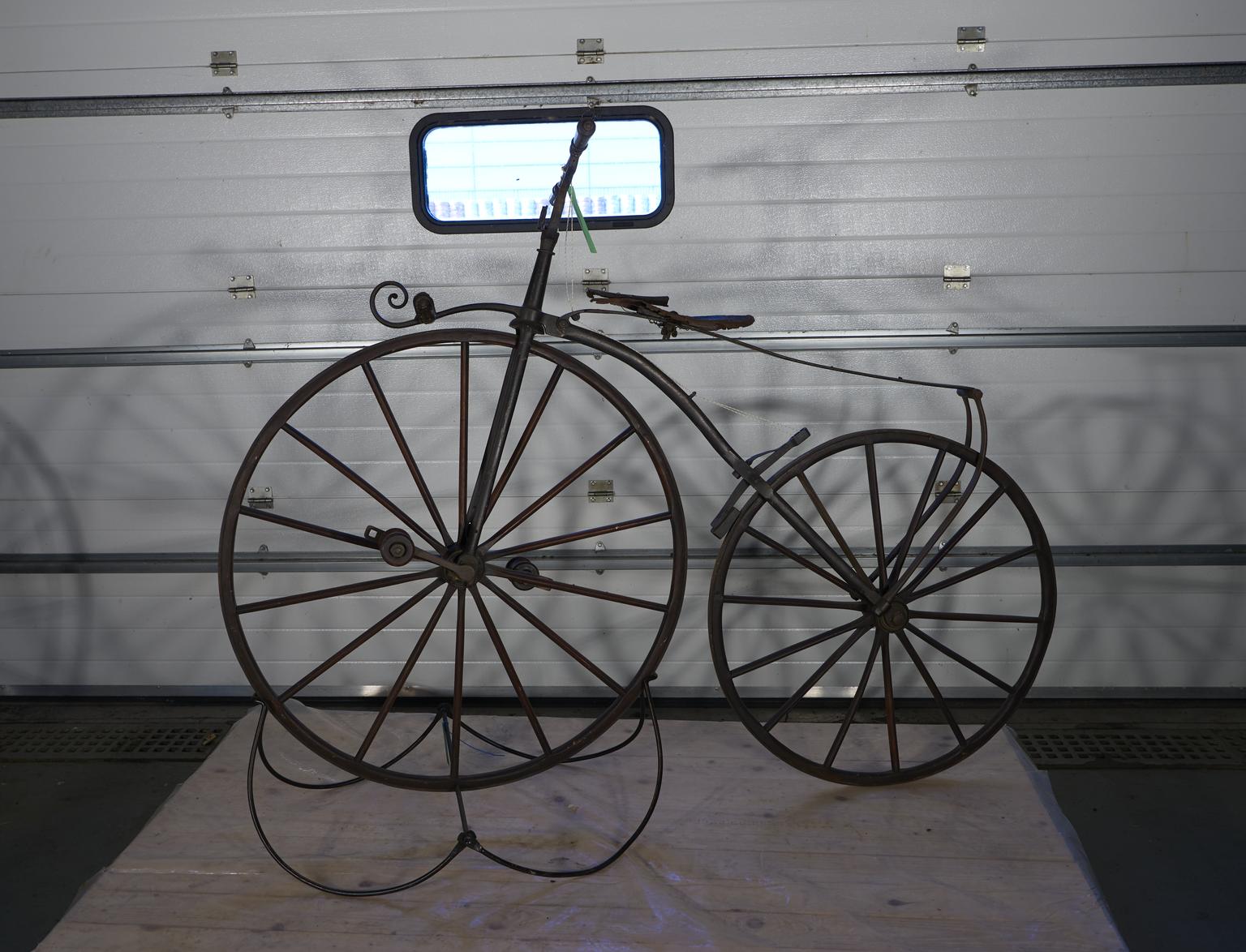
'Boneshaker' Bicycle
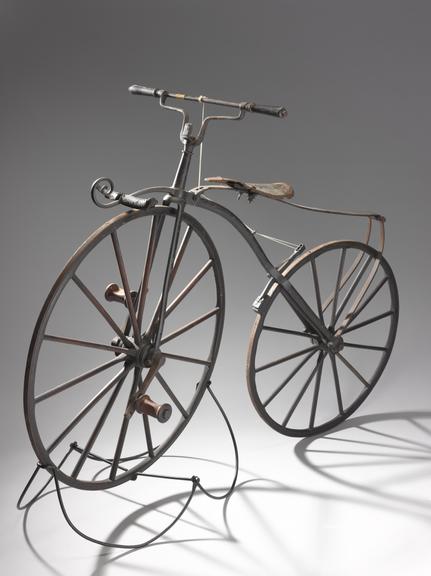
This 'boneshaker' bicycle was built in 1869 by Killingworth William Hedges at the Erith Iron Works, Kent.
The bicycle has a solid wrought iron frame, and adjustable triangle pedals are directly fitted to cranks on the front wheel axle. The rubber padded saddle is mounted on a late spring supported by struts and back wheel bearings.
The handlebars are fitted directly on top of the front fork, with a wooden spoon brake attached to the rear wheel which is controlled by cord via twisting the front handlebar. Leg rests extend from the backbone tube for use when 'coasting'.
The 36-inch diameter front wheel and the 30-inch diameter rear wheels are made of wood and have solid iron tyres.
More
Bicycles are a 19th century invention, though it took decades of trial and error before 'true' bicycle designs emerged.
In 1861 the front- wheel driven pedal bicycle designs were developed by French inventor Pierre Michaux and his son Ernest, which used a crank drive system. This design quickly took off, and they soon became formally known as velocipedes by manufacturers, but as 'boneshakers' by consumers due to their infamously uncomfortable design.
This 'boneshaker' is an exact copy of Michaux’s original 1861 front-wheel drive design, but built in the UK in 1869, complete with front-wheel drive and rigid iron frame and wheels. This makes it one of the first velocipede/boneshakers to be built in the UK, the design only being introduced a year earlier in 1868.
- Measurements:
-
overall: 1370 mm x 720 mm x 1770 mm, 27 kg
- Materials:
- wood (unidentified) , iron , rubber (unidentified) and leather
- Object Number:
- 1900-35 Pt1
- type:
- bicycle
- Image ©
- The Board of Trustees of the Science Museum