Hovercraft SR-N1
- Made:
- 1959 in England, East Cowes and Isle of Wight
- inventor:
- Christopher Sydney Cockerell
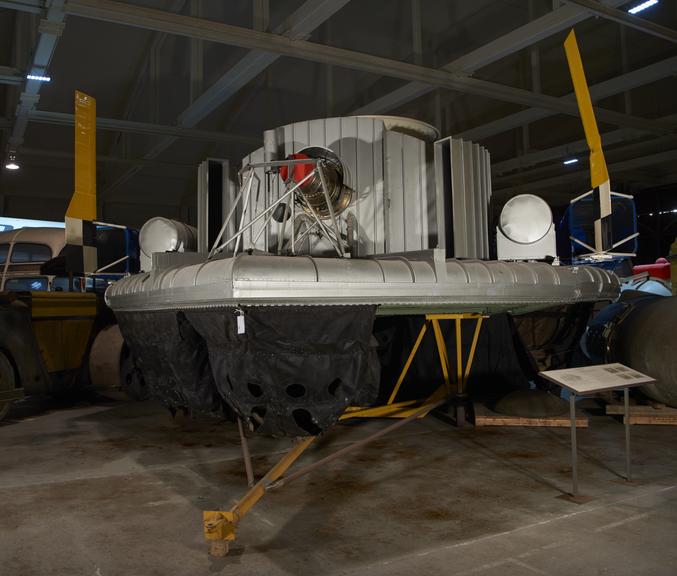
The Saunders-Roe Nautical 1 (SR.N 1) hovercraft was developed by Christopher S. Cockerell in 1959 and made by Saunders-Roe. It is a large metal vehicle with a rubber skirt attached to the bottom, enabling travel across various terrains including water. It was powered by a number of fans and a main engine thruster which forced air into the rubber skirt to create an air cushion. Roughly one third of the air was used to steer the hovercraft.
The SR.N 1 is the world's first working prototype of a hovercraft, creating a never seen before vehicle. This led to much debate as to whether it was a car or a plane, as it could ‘hover’ over a number of terrains such as water, tarmac and gravel.
On June 11th 1959, the SR.N 1 took its first ever public flight with chief test pilot Peter Lamb, off the coast of the Isle of Wight. The following month on the 25th July, the SR.N 1 successfully crossed the Channel from Calais to Dover, taking just over two hours. Later that year, on 18th December 1959, SR.N 1 was piloted by H.R.H Prince Philip, navigating Osborne Bay with guidance from Peter Lamb.
As a prototype, this hovercraft underwent alterations during the period of its use and is preserved in its final experimental configuration.