Carding engine made by Strutts of Belper
1800-1830
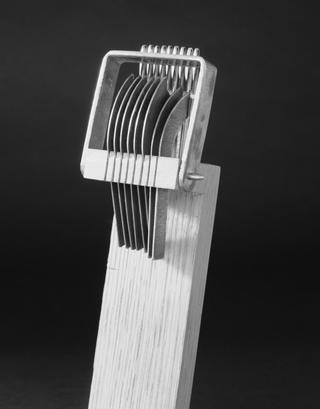
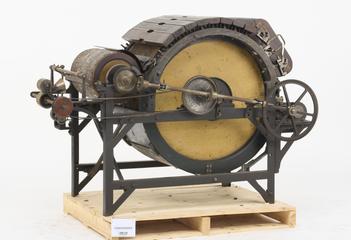
Cotton carding engine, main cylinder cover, hand card for cleaning card flats, waste collection box, card flat, cotton feed box, made by Strutts of Belper, Derbyshire, England, 1800-1830
The purpose of this carding engine, which precedes the draw frame, is to loosen, disentangle and straighten the fibres of cotton before it is spun into thread. This machine, which came from Strutt’s mill in Belper, was constructed between 1800 and 1830 and resembles earlier machines used by Arkwright, except that iron us used instead of wood for the framework.
The cylinders and flats are covered with leather set with bent wire teeth. Cotton is fed in by fluted rollers onto the fast-moving cylinder and carding takes place between it and the first and third small rollers. The second clearer roller, which is set close to the third worker roller, strips material retained on the latter’s teeth and returns it to the cylinder Carding then takes place between the cylinder and the flats.
The cotton is finally carried on and transferred to the opposing teeth of the slowly moving doffer, from which it is stripped by a reciprocating comb. The cotton lap is condensed to a sliver in the funnel, through which it is drawn by delivery rollers. The flats are removed from time to time for cleaning. Although a roller has a smaller carding surface than a flat, it has the advantage that it continually returns waste and fly to the main cylinder and so is self-cleaning.
1800-1830
1800-1830
1800-1830
1800-1830
1800-1830
1800-1830