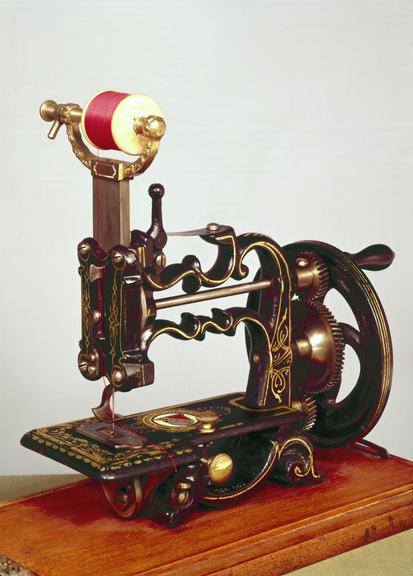
J.Weir's chain stitch sewing machine, model no. 55S of 1872. The machine was called the '55S' because on its introduction it was sold for 55 shillings. This small, inexpensive chain-stitch sewing machine was manufactured in London by James Galloway Weir (b 1839) from 1872, the date of his patent for certain improvements to its design. Weir's improved machine featured a redesigned thread tension device, needle bar, and new spiral gears. The looper used to form the stitch was, however, patented by Frederick W Parker of Sheffield in 1859. Weir sewing machine, 1872. 1872
2 fragments drawloom woven compound tabby (red & yellow), 1 fragment drawloom woven compound tabby (red & yellow), 1 fragment drawloom woven compound tabby (red & blue on yellow), 1 fragment fine drawloomwoven compound tabby (red & yellow), 4 fragments drawloom woven compound tabby diamond lattice (red & yellow), 1 fragment drawloom woven red & yellow compound tabby, 1 fragment compound tabby (green &yellow), 1 fragmentary border, red field, blue, red & white decoration 2 fragments drawloom woven compound tabby (red & yellow)
Microelite miniature sewing machine, type 801, serial no. 3410, by Saitama Sewing Machine Co. Ltd., in original carrying case, with foot control and accessories such as bobbin case, 4 bobbins, needles and screw driver. Microelite miniature sewing machine
Large embroidered tablecloth, two embroidered veils and smaller samples of work Large embroidered tablecloth
One circular hose knitting machine with ribbing attachment. Around 1900. One circular hose knitting machine
Industrial hosiery knitting machine of unknown provenance, early 20th century Industrial hosiery knitting machine of unknown provenance