Bobbin frame from Silk Doubling Machine Spindle
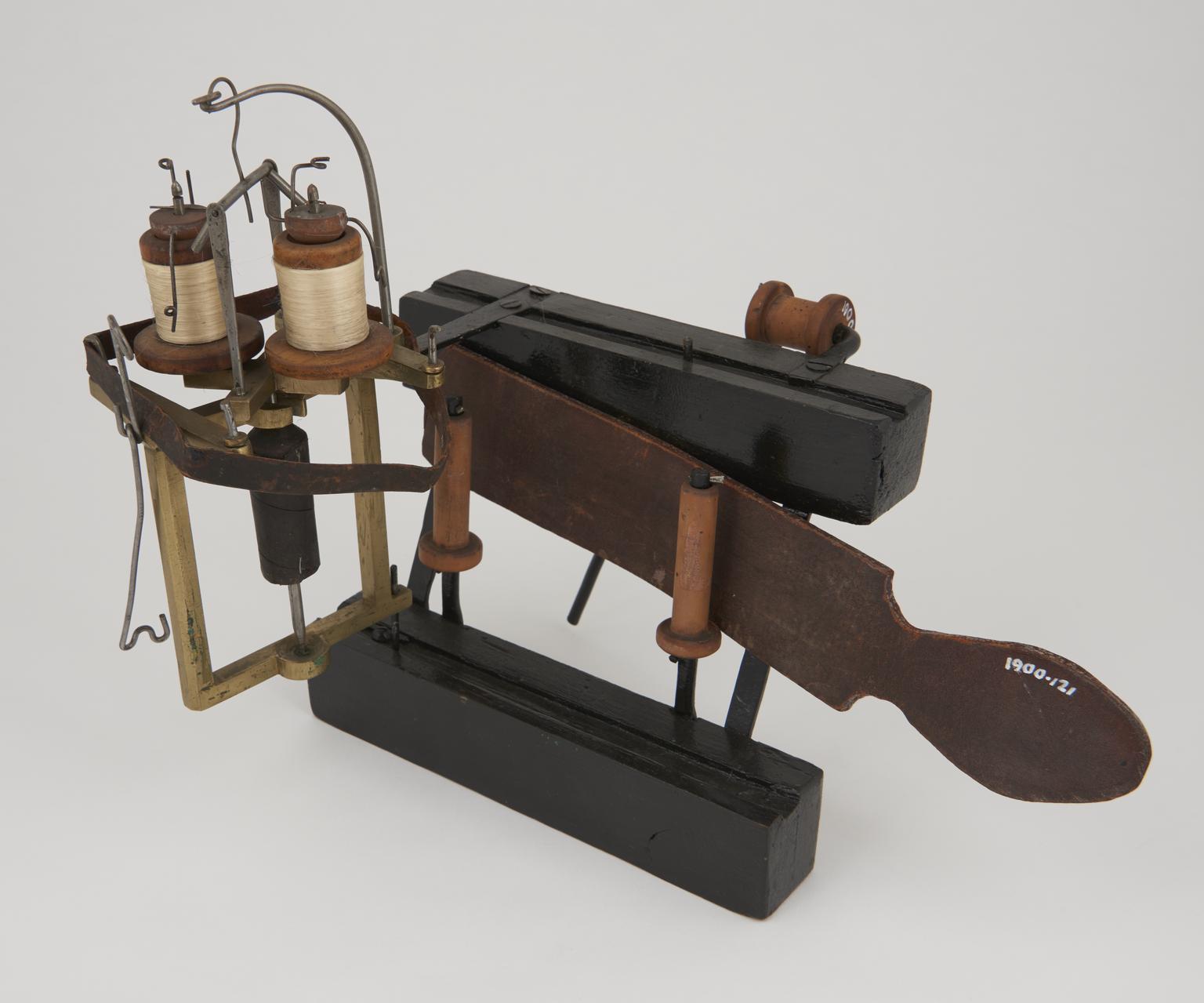
Bobbin frame and two bobbins wound with silk thread forming the top section of Spindle from a silk doubling machine, used at Eaton and Co’s Mill, Glemsford, England. c. 1880-1900.
Spindle from a silk doubling machine, used at Eaton and Co’s Mill, Glemsford, England
This is an element of a silk Spinning-machine formerly used at Messrs. Eaton & Co's mill, Glemsford. Two bobbins, wound with thread, are mounted upon pins on a cross-piece at the top of a rotating spindle, while loosely fitting cap-pieces on the tops of the bobbins carry guides through which the threads are led to a reel above, which is not shown. The threads are thus twisted together, and as the lower parts of the bobbins touch a fixed belt which is stretched in the shape of a square, each thread separately receives a twist in a direction opposite to that of the combined thread, forming the material known as organzine. The spindle rotates in a hinged frame and carries a pulley which is kept in contact with a driving belt by the action of a weight. In the event of one thread breaking, the winding of a single thread on the reel is prevented by a device consisting of a hook, which is mounted on a pivoted frame and is kept in a vertical position by passing the threads on opposite sides of it. If one thread breaks, the hook takes up a horizontal position owing to the action of centrifugal force and prevents the rotation of the thread guides, with the result that the remaining thread is broken. The complete machine included a number of these elements, all of which were driven by one belt.
Bobbin frame and two bobbins wound with silk thread forming the top section of Spindle from a silk doubling machine, used at Eaton and Co’s Mill, Glemsford, England. c. 1880-1900.