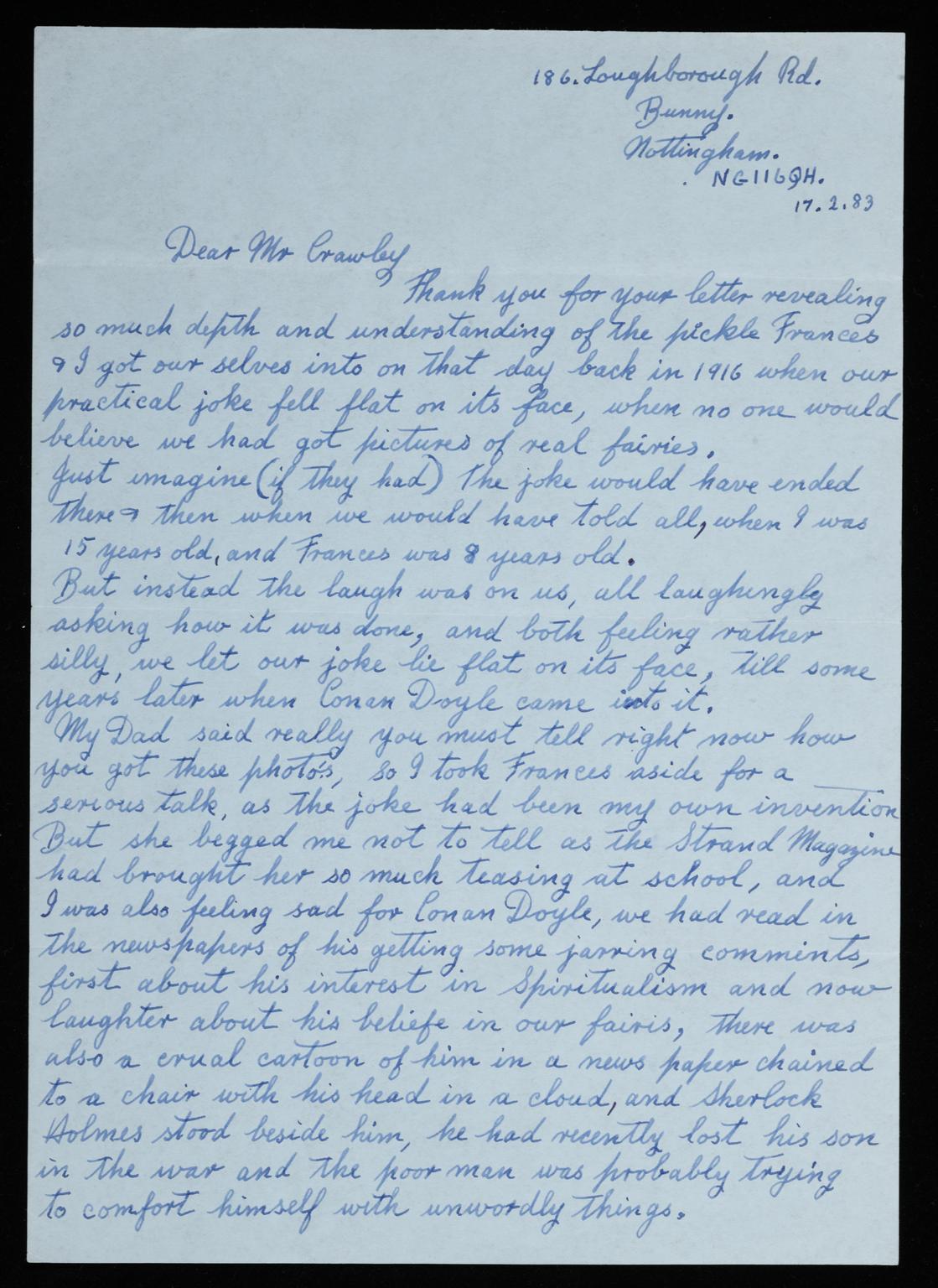
Nine-page manuscript letter from Elsie Hill (nee Wright) to Geoffrey Crawley

Made:
1983-02-17 in Nottingham
maker:
Elsie Wright

Nine-page manuscript letter from Elsie Hill (nee Wright) to Geoffrey Crawley, 17 February 1983.

In 1917, with the First World War raging in Europe, a young girl explained away her muddy shoes by saying she had been playing with the fairies. Her disbelieving family were astonished when she and her older cousin produced photographs as evidence. The photographs became famous. For some people, they offered a tantalising view of the spirit world, and perhaps a way to reconnect with loved ones who had lost their lives in the war.

Using her father’s Midg camera, Elsie Wright and her cousin Frances Griffiths took photographs of themselves posing with fairies. Two years later, Elsie’s mother went to a talk about ‘fairy life’ and shared the photographs with the fascinated presenter. The photos were included in a display a few months later, attracting the attention of the famous writer Sir Arthur Conan Doyle. Some people did not believe that young girls could fake such convincing photographs, and concluded that the pictures must be real. The fairy photos taken by Elsie Wright and Frances Griffiths fascinated people who believed in a spirit world. Edward Gardner, a leading spiritualist, had the photographs checked by experts to see if they had been faked. Without clear answers, in 1920 he visited the girls and asked them to take more photographs with a cameras that he gave them.

Over 60 years after the photographs had been taken, Elsie and Frances admitted that they had copied drawings from a book to make fairies on card. Explaining their long silence, Elsie said in this letter ‘[Sir Arthur] had lost his son recently in the war, and I think the poor man was trying to comfort himself … we will wait till they die of old age and then we will tell.’

Details

Category:
Printed Materials & Ephemera
Object Number:
1998-5148
Materials:
paper (fibre product)
Measurements:
overall (each page): 297 mm x 210 mm
type:
letter
credit:
National Media Museum, Bradford

Parts

First page of manuscript letter from Elsie Hill (nee Wright) to Geoffrey Crawley

First page of manuscript letter from Elsie Hill (nee Wright) to Geoffrey Crawley

First page of nine-page manuscript letter from Elsie Hill (nee Wright) to Geoffrey Crawley, 17 February 1983.

More

In 1917, with the First World War raging in Europe, a young girl explained away her muddy shoes by saying she had been playing with the fairies. Her disbelieving family were astonished when she and her older cousin produced photographs as evidence. The photographs became famous. For some people, they offered a tantalising view of the spirit world, and perhaps a way to reconnect with loved ones who had lost their lives in the war.

Using her father’s Midg camera, Elsie Wright and her cousin Frances Griffiths took photographs of themselves posing with fairies. Two years later, Elsie’s mother went to a talk about ‘fairy life’ and shared the photographs with the fascinated presenter. The photos were included in a display a few months later, attracting the attention of the famous writer Sir Arthur Conan Doyle. Some people did not believe that young girls could fake such convincing photographs, and concluded that the pictures must be real. The fairy photos taken by Elsie Wright and Frances Griffiths fascinated people who believed in a spirit world. Edward Gardner, a leading spiritualist, had the photographs checked by experts to see if they had been faked. Without clear answers, in 1920 he visited the girls and asked them to take more photographs with a cameras that he gave them.

Over 60 years after the photographs had been taken, Elsie and Frances admitted that they had copied drawings from a book to make fairies on card. Explaining their long silence, Elsie said in this letter ‘[Sir Arthur] had lost his son recently in the war, and I think the poor man was trying to comfort himself … we will wait till they die of old age and then we will tell.’

Measurements:
overall: 297 mm x 210 mm
Materials:
paper (fibre product)
Object Number:
1998-5148/1
type:
letter
Image ©
The Board of Trustees of the Science Museum
Second page of manuscript letter from Elsie Hill (nee Wright) to Geoffrey Crawley

Second page of manuscript letter from Elsie Hill (nee Wright) to Geoffrey Crawley

Second page of nine-page manuscript letter from Elsie Hill (nee Wright) to Geoffrey Crawley, 17 February 1983.

More

In 1917, with the First World War raging in Europe, a young girl explained away her muddy shoes by saying she had been playing with the fairies. Her disbelieving family were astonished when she and her older cousin produced photographs as evidence. The photographs became famous. For some people, they offered a tantalising view of the spirit world, and perhaps a way to reconnect with loved ones who had lost their lives in the war.

Using her father’s Midg camera, Elsie Wright and her cousin Frances Griffiths took photographs of themselves posing with fairies. Two years later, Elsie’s mother went to a talk about ‘fairy life’ and shared the photographs with the fascinated presenter. The photos were included in a display a few months later, attracting the attention of the famous writer Sir Arthur Conan Doyle. Some people did not believe that young girls could fake such convincing photographs, and concluded that the pictures must be real. The fairy photos taken by Elsie Wright and Frances Griffiths fascinated people who believed in a spirit world. Edward Gardner, a leading spiritualist, had the photographs checked by experts to see if they had been faked. Without clear answers, in 1920 he visited the girls and asked them to take more photographs with a cameras that he gave them.

Over 60 years after the photographs had been taken, Elsie and Frances admitted that they had copied drawings from a book to make fairies on card. Explaining their long silence, Elsie said in this letter ‘[Sir Arthur] had lost his son recently in the war, and I think the poor man was trying to comfort himself … we will wait till they die of old age and then we will tell.’

Measurements:
overall: 297 mm x 210 mm
Materials:
paper (fibre product)
Object Number:
1998-5148/2
type:
letter
Image ©
The Board of Trustees of the Science Museum
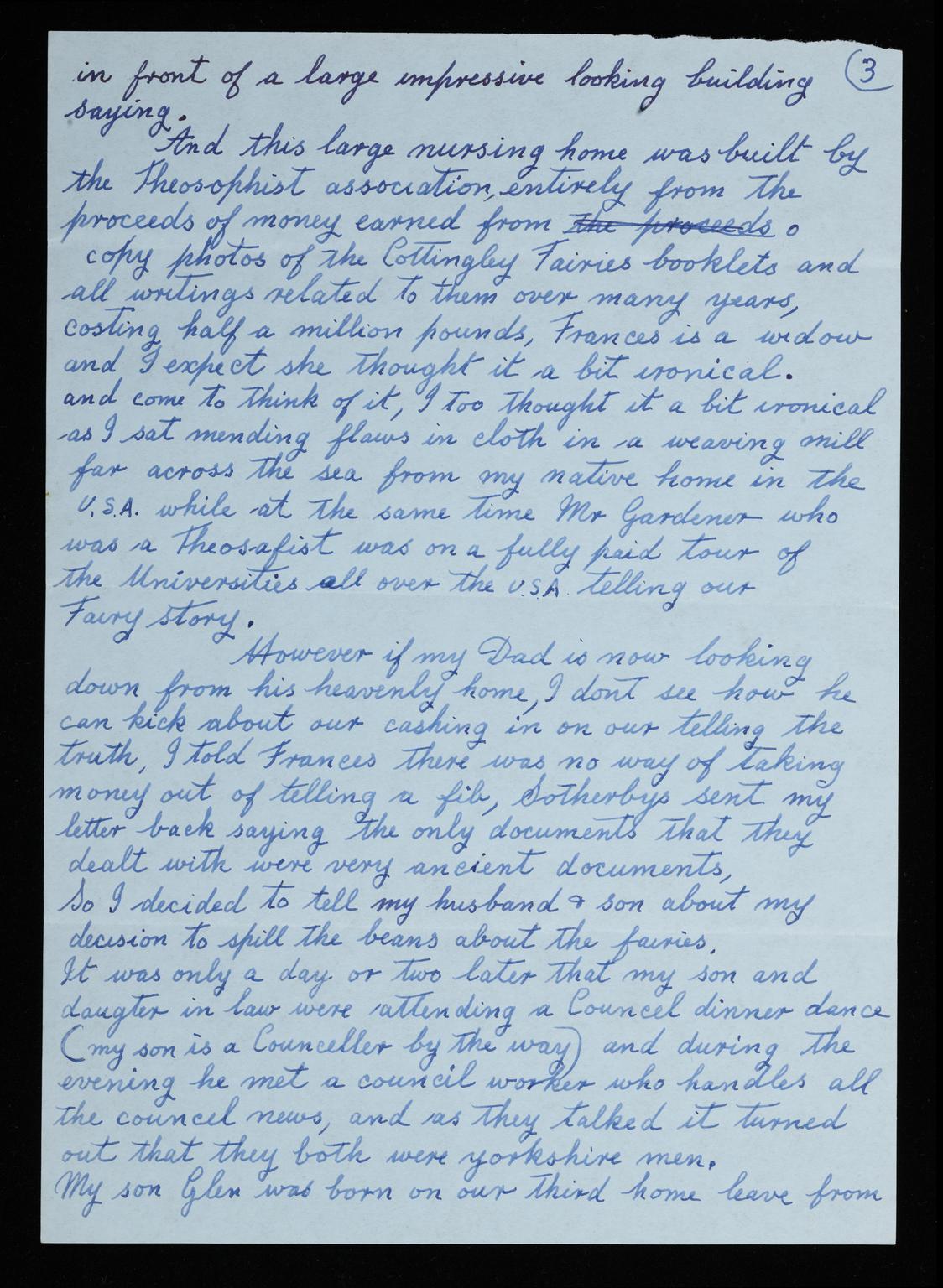
Third page of manuscript letter from Elsie Hill (nee Wright) to Geoffrey Crawley

Third page of manuscript letter from Elsie Hill (nee Wright) to Geoffrey Crawley

Third page of nine-page manuscript letter from Elsie Hill (nee Wright) to Geoffrey Crawley, 17 February 1983.

More

In 1917, with the First World War raging in Europe, a young girl explained away her muddy shoes by saying she had been playing with the fairies. Her disbelieving family were astonished when she and her older cousin produced photographs as evidence. The photographs became famous. For some people, they offered a tantalising view of the spirit world, and perhaps a way to reconnect with loved ones who had lost their lives in the war.

Using her father’s Midg camera, Elsie Wright and her cousin Frances Griffiths took photographs of themselves posing with fairies. Two years later, Elsie’s mother went to a talk about ‘fairy life’ and shared the photographs with the fascinated presenter. The photos were included in a display a few months later, attracting the attention of the famous writer Sir Arthur Conan Doyle. Some people did not believe that young girls could fake such convincing photographs, and concluded that the pictures must be real. The fairy photos taken by Elsie Wright and Frances Griffiths fascinated people who believed in a spirit world. Edward Gardner, a leading spiritualist, had the photographs checked by experts to see if they had been faked. Without clear answers, in 1920 he visited the girls and asked them to take more photographs with a cameras that he gave them.

Over 60 years after the photographs had been taken, Elsie and Frances admitted that they had copied drawings from a book to make fairies on card. Explaining their long silence, Elsie said in this letter ‘[Sir Arthur] had lost his son recently in the war, and I think the poor man was trying to comfort himself … we will wait till they die of old age and then we will tell.’

Measurements:
overall: 297 mm x 210 mm
Materials:
paper (fibre product)
Object Number:
1998-5148/3
type:
letter
Image ©
The Board of Trustees of the Science Museum
Fourth page of manuscript letter from Elsie Hill (nee Wright) to Geoffrey Crawley

Fourth page of manuscript letter from Elsie Hill (nee Wright) to Geoffrey Crawley

Fourth page of nine-page manuscript letter from Elsie Hill (nee Wright) to Geoffrey Crawley, 17 February 1983.

More

In 1917, with the First World War raging in Europe, a young girl explained away her muddy shoes by saying she had been playing with the fairies. Her disbelieving family were astonished when she and her older cousin produced photographs as evidence. The photographs became famous. For some people, they offered a tantalising view of the spirit world, and perhaps a way to reconnect with loved ones who had lost their lives in the war.

Using her father’s Midg camera, Elsie Wright and her cousin Frances Griffiths took photographs of themselves posing with fairies. Two years later, Elsie’s mother went to a talk about ‘fairy life’ and shared the photographs with the fascinated presenter. The photos were included in a display a few months later, attracting the attention of the famous writer Sir Arthur Conan Doyle. Some people did not believe that young girls could fake such convincing photographs, and concluded that the pictures must be real. The fairy photos taken by Elsie Wright and Frances Griffiths fascinated people who believed in a spirit world. Edward Gardner, a leading spiritualist, had the photographs checked by experts to see if they had been faked. Without clear answers, in 1920 he visited the girls and asked them to take more photographs with a cameras that he gave them.

Over 60 years after the photographs had been taken, Elsie and Frances admitted that they had copied drawings from a book to make fairies on card. Explaining their long silence, Elsie said in this letter ‘[Sir Arthur] had lost his son recently in the war, and I think the poor man was trying to comfort himself … we will wait till they die of old age and then we will tell.’

Measurements:
overall: 297 mm x 210 mm
Materials:
paper (fibre product)
Object Number:
1998-5148/4
type:
letter
Image ©
The Board of Trustees of the Science Museum
Fifth page of manuscript letter from Elsie Hill (nee Wright) to Geoffrey Crawley

Fifth page of manuscript letter from Elsie Hill (nee Wright) to Geoffrey Crawley

Fifth page of nine-page manuscript letter from Elsie Hill (nee Wright) to Geoffrey Crawley, 17 February 1983.

More

In 1917, with the First World War raging in Europe, a young girl explained away her muddy shoes by saying she had been playing with the fairies. Her disbelieving family were astonished when she and her older cousin produced photographs as evidence. The photographs became famous. For some people, they offered a tantalising view of the spirit world, and perhaps a way to reconnect with loved ones who had lost their lives in the war.

Using her father’s Midg camera, Elsie Wright and her cousin Frances Griffiths took photographs of themselves posing with fairies. Two years later, Elsie’s mother went to a talk about ‘fairy life’ and shared the photographs with the fascinated presenter. The photos were included in a display a few months later, attracting the attention of the famous writer Sir Arthur Conan Doyle. Some people did not believe that young girls could fake such convincing photographs, and concluded that the pictures must be real. The fairy photos taken by Elsie Wright and Frances Griffiths fascinated people who believed in a spirit world. Edward Gardner, a leading spiritualist, had the photographs checked by experts to see if they had been faked. Without clear answers, in 1920 he visited the girls and asked them to take more photographs with a cameras that he gave them.

Over 60 years after the photographs had been taken, Elsie and Frances admitted that they had copied drawings from a book to make fairies on card. Explaining their long silence, Elsie said in this letter ‘[Sir Arthur] had lost his son recently in the war, and I think the poor man was trying to comfort himself … we will wait till they die of old age and then we will tell.’

Measurements:
overall: 297 mm x 210 mm
Materials:
paper (fibre product)
Object Number:
1998-5148/5
type:
letter
Image ©
The Board of Trustees of the Science Museum
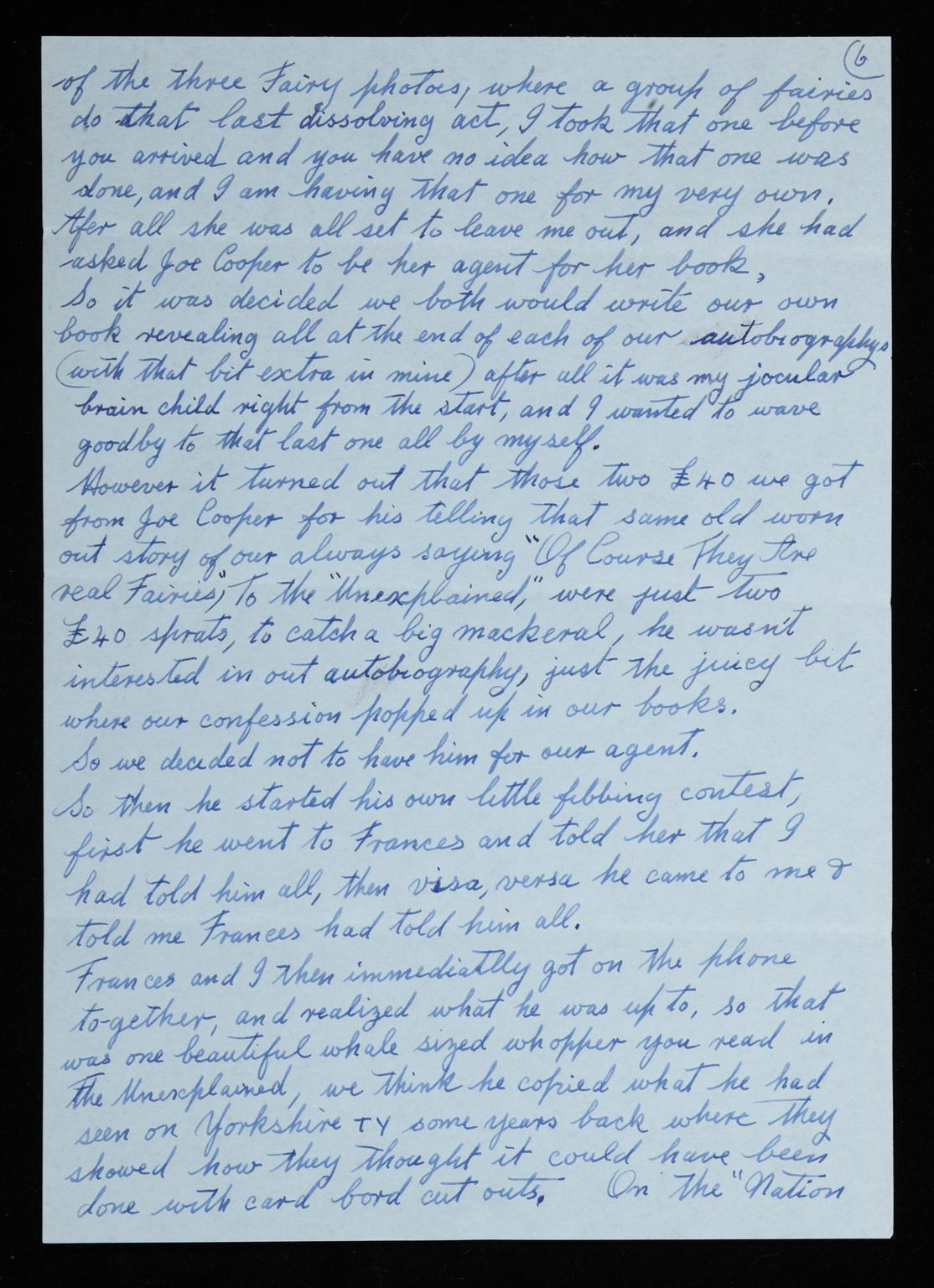
Sixth page of manuscript letter from Elsie Hill (nee Wright) to Geoffrey Crawley

Sixth page of manuscript letter from Elsie Hill (nee Wright) to Geoffrey Crawley

Sixth page of nine-page manuscript letter from Elsie Hill (nee Wright) to Geoffrey Crawley, 17 February 1983.

More

In 1917, with the First World War raging in Europe, a young girl explained away her muddy shoes by saying she had been playing with the fairies. Her disbelieving family were astonished when she and her older cousin produced photographs as evidence. The photographs became famous. For some people, they offered a tantalising view of the spirit world, and perhaps a way to reconnect with loved ones who had lost their lives in the war.

Using her father’s Midg camera, Elsie Wright and her cousin Frances Griffiths took photographs of themselves posing with fairies. Two years later, Elsie’s mother went to a talk about ‘fairy life’ and shared the photographs with the fascinated presenter. The photos were included in a display a few months later, attracting the attention of the famous writer Sir Arthur Conan Doyle. Some people did not believe that young girls could fake such convincing photographs, and concluded that the pictures must be real. The fairy photos taken by Elsie Wright and Frances Griffiths fascinated people who believed in a spirit world. Edward Gardner, a leading spiritualist, had the photographs checked by experts to see if they had been faked. Without clear answers, in 1920 he visited the girls and asked them to take more photographs with a cameras that he gave them.

Over 60 years after the photographs had been taken, Elsie and Frances admitted that they had copied drawings from a book to make fairies on card. Explaining their long silence, Elsie said in this letter ‘[Sir Arthur] had lost his son recently in the war, and I think the poor man was trying to comfort himself … we will wait till they die of old age and then we will tell.’

Measurements:
overall: 297 mm x 210 mm
Materials:
paper (fibre product)
Object Number:
1998-5148/6
type:
letter
Image ©
The Board of Trustees of the Science Museum
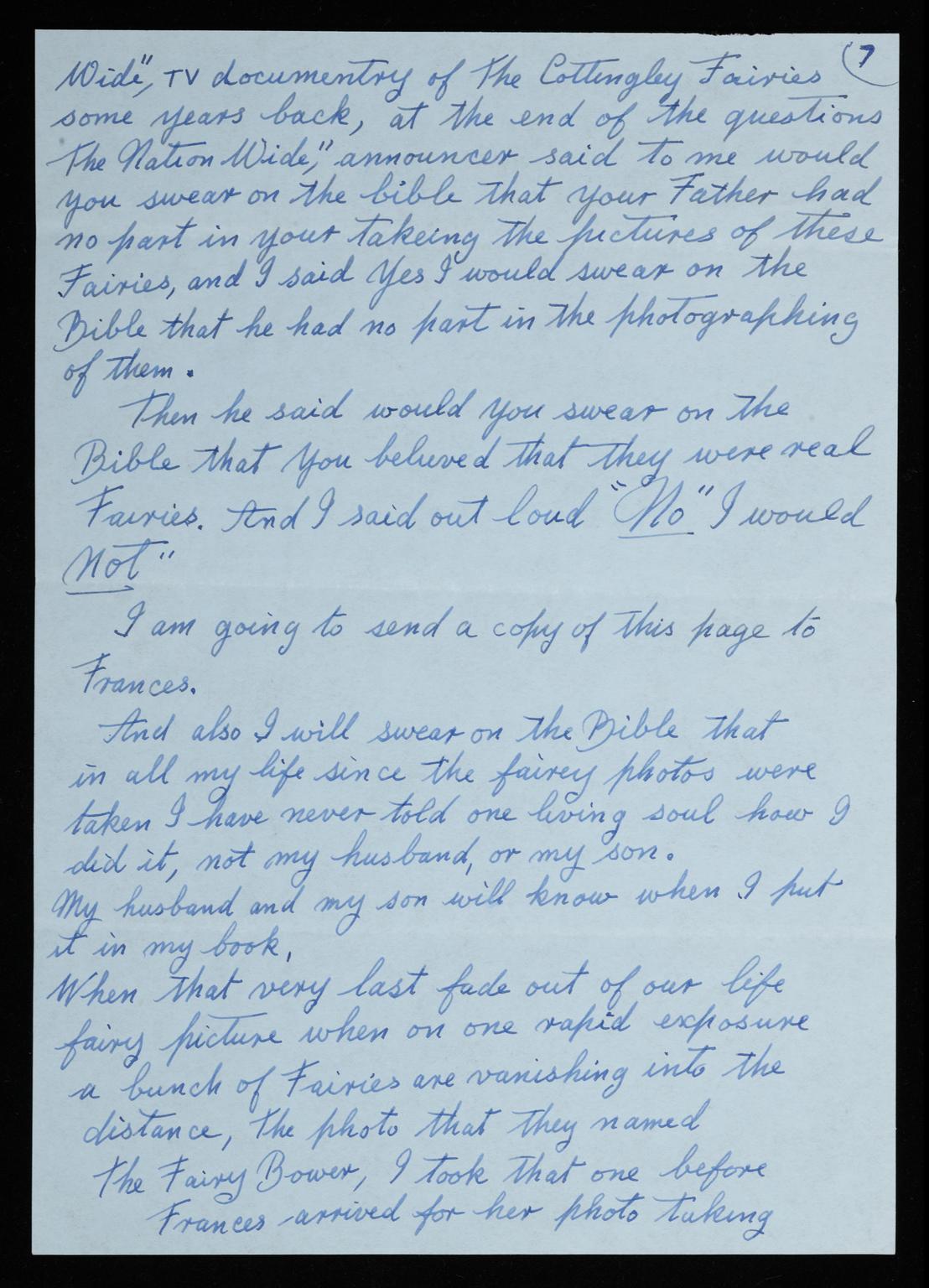
Seventh page of manuscript letter from Elsie Hill (nee Wright) to Geoffrey Crawley

Seventh page of manuscript letter from Elsie Hill (nee Wright) to Geoffrey Crawley

Seventh page of nine-page manuscript letter from Elsie Hill (nee Wright) to Geoffrey Crawley, 17 February 1983.

More

In 1917, with the First World War raging in Europe, a young girl explained away her muddy shoes by saying she had been playing with the fairies. Her disbelieving family were astonished when she and her older cousin produced photographs as evidence. The photographs became famous. For some people, they offered a tantalising view of the spirit world, and perhaps a way to reconnect with loved ones who had lost their lives in the war.

Using her father’s Midg camera, Elsie Wright and her cousin Frances Griffiths took photographs of themselves posing with fairies. Two years later, Elsie’s mother went to a talk about ‘fairy life’ and shared the photographs with the fascinated presenter. The photos were included in a display a few months later, attracting the attention of the famous writer Sir Arthur Conan Doyle. Some people did not believe that young girls could fake such convincing photographs, and concluded that the pictures must be real. The fairy photos taken by Elsie Wright and Frances Griffiths fascinated people who believed in a spirit world. Edward Gardner, a leading spiritualist, had the photographs checked by experts to see if they had been faked. Without clear answers, in 1920 he visited the girls and asked them to take more photographs with a cameras that he gave them.

Over 60 years after the photographs had been taken, Elsie and Frances admitted that they had copied drawings from a book to make fairies on card. Explaining their long silence, Elsie said in this letter ‘[Sir Arthur] had lost his son recently in the war, and I think the poor man was trying to comfort himself … we will wait till they die of old age and then we will tell.’

Measurements:
overall: 297 mm x 210 mm
Materials:
paper (fibre product)
Object Number:
1998-5148/7
type:
letter
Image ©
The Board of Trustees of the Science Museum
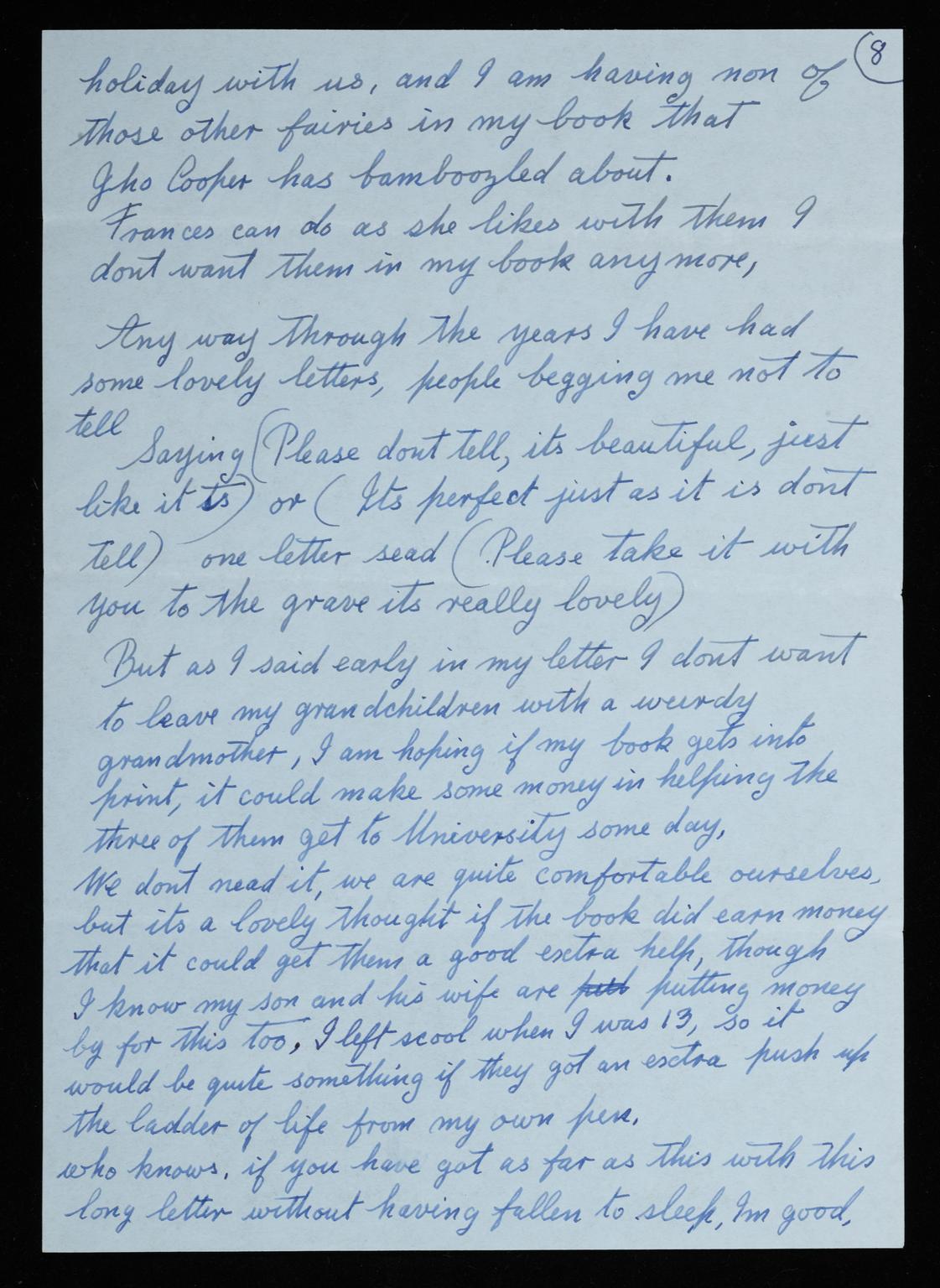
Eighth page of manuscript letter from Elsie Hill (nee Wright) to Geoffrey Crawley

Eighth page of manuscript letter from Elsie Hill (nee Wright) to Geoffrey Crawley

Eighth page of nine-page manuscript letter from Elsie Hill (nee Wright) to Geoffrey Crawley, 17 February 1983.

More

In 1917, with the First World War raging in Europe, a young girl explained away her muddy shoes by saying she had been playing with the fairies. Her disbelieving family were astonished when she and her older cousin produced photographs as evidence. The photographs became famous. For some people, they offered a tantalising view of the spirit world, and perhaps a way to reconnect with loved ones who had lost their lives in the war.

Using her father’s Midg camera, Elsie Wright and her cousin Frances Griffiths took photographs of themselves posing with fairies. Two years later, Elsie’s mother went to a talk about ‘fairy life’ and shared the photographs with the fascinated presenter. The photos were included in a display a few months later, attracting the attention of the famous writer Sir Arthur Conan Doyle. Some people did not believe that young girls could fake such convincing photographs, and concluded that the pictures must be real. The fairy photos taken by Elsie Wright and Frances Griffiths fascinated people who believed in a spirit world. Edward Gardner, a leading spiritualist, had the photographs checked by experts to see if they had been faked. Without clear answers, in 1920 he visited the girls and asked them to take more photographs with a cameras that he gave them.

Over 60 years after the photographs had been taken, Elsie and Frances admitted that they had copied drawings from a book to make fairies on card. Explaining their long silence, Elsie said in this letter ‘[Sir Arthur] had lost his son recently in the war, and I think the poor man was trying to comfort himself … we will wait till they die of old age and then we will tell.’

Measurements:
overall: 297 mm x 210 mm
Materials:
paper (fibre product)
Object Number:
1998-5148/8
type:
letter
Image ©
The Board of Trustees of the Science Museum
Ninth page of manuscript letter from Elsie Hill (nee Wright) to Geoffrey Crawley

Ninth page of manuscript letter from Elsie Hill (nee Wright) to Geoffrey Crawley

Ninth page of nine-page manuscript letter from Elsie Hill (nee Wright) to Geoffrey Crawley, 17 February 1983.

More

In 1917, with the First World War raging in Europe, a young girl explained away her muddy shoes by saying she had been playing with the fairies. Her disbelieving family were astonished when she and her older cousin produced photographs as evidence. The photographs became famous. For some people, they offered a tantalising view of the spirit world, and perhaps a way to reconnect with loved ones who had lost their lives in the war.

Using her father’s Midg camera, Elsie Wright and her cousin Frances Griffiths took photographs of themselves posing with fairies. Two years later, Elsie’s mother went to a talk about ‘fairy life’ and shared the photographs with the fascinated presenter. The photos were included in a display a few months later, attracting the attention of the famous writer Sir Arthur Conan Doyle. Some people did not believe that young girls could fake such convincing photographs, and concluded that the pictures must be real. The fairy photos taken by Elsie Wright and Frances Griffiths fascinated people who believed in a spirit world. Edward Gardner, a leading spiritualist, had the photographs checked by experts to see if they had been faked. Without clear answers, in 1920 he visited the girls and asked them to take more photographs with a cameras that he gave them.

Over 60 years after the photographs had been taken, Elsie and Frances admitted that they had copied drawings from a book to make fairies on card. Explaining their long silence, Elsie said in this letter ‘[Sir Arthur] had lost his son recently in the war, and I think the poor man was trying to comfort himself … we will wait till they die of old age and then we will tell.’

Measurements:
overall: 297 mm x 210 mm
Materials:
paper (fibre product)
Object Number:
1998-5148/9
type:
letter
Image ©
The Board of Trustees of the Science Museum