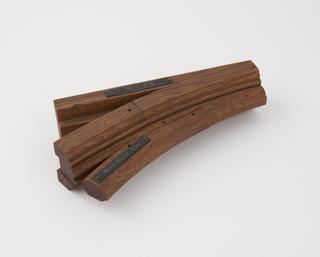
Ironwork from Wm. Strutt's cotton mills
- maker:
- William Strutt
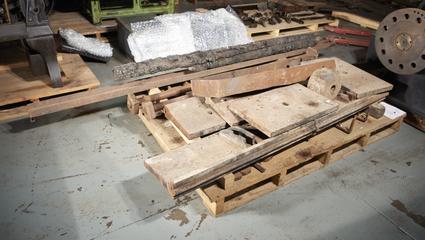
Ironwork from William Strutt's (1756-1830) Cotton Mills (South Mill) at Belper, Derbyshire, 1811-12, (two columns, one beam, three tie-rods). Strutt set about finding an answer to the problem of timber-floored buildings; his mill was the most technically advanced building of its time, incorporating an iron frame and brick arches to make it 'fire proof'.
William Strutt, a civil engineer, architect and entrepreneur in cotton, is well known for being an early pioneer and promoter of fire-resistant building design. William Strutt was inspired to improve the safety of buildings after seeing his father's old mill burn down. He applied these ideas to his own buildings. This material are examples of how he redesigned cotton mills, avoiding the use of timber and other flammable materials. Instead using cast ironwork, bricks, and ceramics.
This ironwork was taken from William Strutt's rebuild of his father's old mill, later called the South Mill, in Belper, which was constructed between 1811-1812, making this one of the first fire-proof building designs in the world. William Strutt's would continue to improve his buidlign designs over the next 30 years, contructing increasingly impressive fireproof buildings on his Belper estate, laying the foundations of modern building design and illustrating the popularisation of metal framework in building construction later seen in Victorian dockyards, rail stations, and factories.
Of Strutt's original mill sites, only the North Mill in Belper remains, and is now a World Heritage Site.
Details
- Category:
- Building Construction
- Object Number:
- 1962-150
- Materials:
- iron
- Measurements:
-
overall: 280 mm x 3700 mm x 700 mm,
overall (Tie-rods / each): 3045 mm x 135 mm x 20 mm,
overall (beam): 3640 mm x 340 mm x 140 mm,
overall (Columns - each): 3080 mm x 195 mm x 195 mm,
- type:
- ironwork
- credit:
- English Sewing Cotton Co. Ltd.
Related Objects
Model, of Under-Squinted and Tabled Scarf carpentry joint
Model, of Secret Mortice and Tennon carpentry joint
Two Models
Two Models