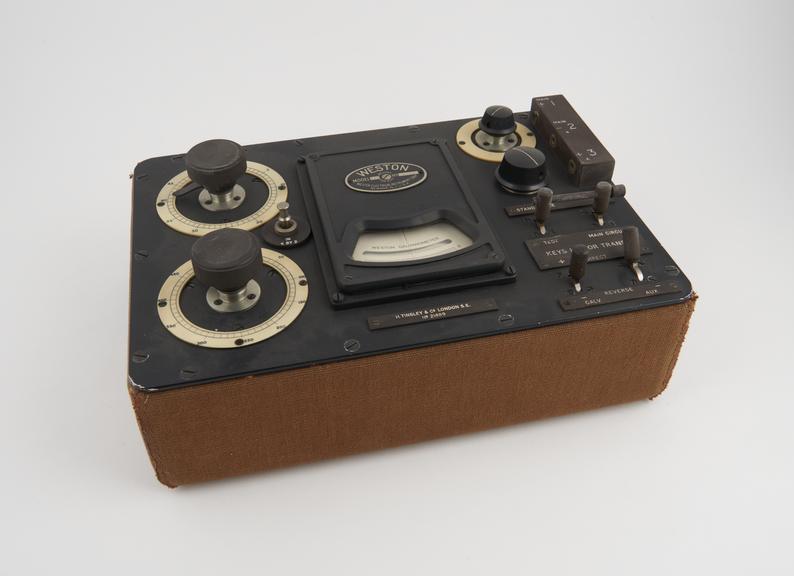
Potentiometer, for spontaneous polarisation measurements
- maker:
- Henry Tinsley and Company
 This image is released under a CC BY-NC-SA 4.0
Licence
This image is released under a CC BY-NC-SA 4.0
Licence
License this image for commercial use at Science and Society Picture Library
License
Science Museum Group
© The Board of Trustees of the Science Museum
This potentiometer was built by Henry Tinsley and Company, a scientific instrument company based in London, in around 1931.
The potentiometer a rectangular device approximately two feet across and a foot and half long. The apparatus is numbered 21489 on a plaque on the front of the device. The left-hand side of the potentiometer has two rotating handles, and the right-hand side has a set of switched and knobs to control the direction of the current and the resistance slider that determines the voltage.
The centre of the device is an installed is an electric adjustable galvanometer which is used to help measure the electrical current, which was produced separately by Weston Electrical Instrument Corporation based in Newark, US.
The electrodes have a wooden shaft which is approximately half a metre long with a rubber handle. Within the shaft is a metal rod to conduction the electricity.
Potentiometers are electronic devices or components characterised by having three terminals, two either end of a resistive element, and a third which can slide up and down that resistive element to determine the voltage in circuits. A common use of potentiometers is in dimmer light switch, using the slider to indirectly control the brightness of lights by increasing or decreasing electrical resistance via the slider.
This also makes potentiometers valuable components in scientific experiments and geophysics surveys where variable and granule control over voltages is requires.
This potentiometer, based on a design from Broughton Edge, was built by Henry Tinsley and Company which has been producing precision scientific instruments since 1904 and was used for precision mineral prospecting in the early 20th century. This was done by exploiting a natural phenomenon in which underground ore deposits produce faint electric currents through electrochemistry which can be detached from the surface.
This potentiometer has two non-polarizing electrodes which would be placed in a small hole in the ground at specific intervals apart. The potentiometer would then be able to measure the electric potential between the electrodes, and from these readings potentially detach ore deposits. The strength of these electrical currents can be precisely measured by an adjustable electric galvanometer, which has been installed in the centre of the potentiometer. This galvanometer has been produced separately by Weston Electrical Instrument Corporation based in Newark, US.