 This image is released under a CC BY-NC-SA 4.0
Licence
This image is released under a CC BY-NC-SA 4.0
Licence
License this image for commercial use at Science and Society Picture Library
License
Science Museum Group
© The Board of Trustees of the Science Museum
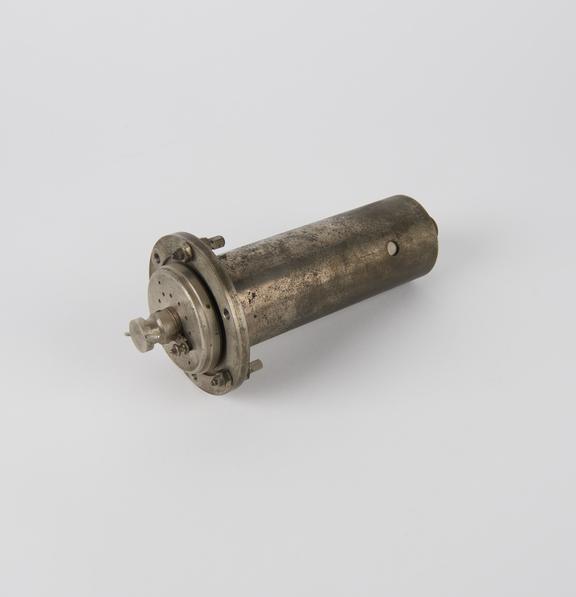
This Holweck-Lejay inverted pendulum gravimeter was built in France in 1934 through a collaboration with French physicist Fernand Holweck, and French geophysicist Pierre Lejay.
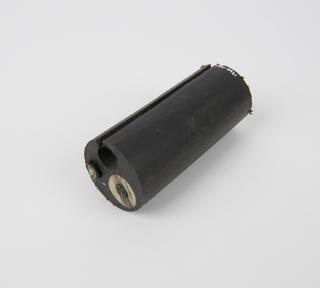
This device is small and cylindrical and is approximately 25cm tall and 10cm in diameter. The outside of the gravimeter is protected and encased by a metal shield casing, with the gravimeter contraption held in place by an adjustable metal clamp and levelling screw at the base of the device.
Internally, the gravimeter sits upright on a spring, with an adjustable mass positioned near the top of the pendulum. Between the gravimeter and the metal shield is also a glass envelope.
A gravity meter, or gravimeter, is an instrument designed to measure and record variations in the earth’s gravitational field in specific locations.
The Holweck-Lejay inverted pendulum gravimeter is a type of dynamic gravimeter. It was designed through a collaboration with French physicist Fernand Holweck, and French geophysicist Pierre Lejay.
The key feature of the Holweck-Lejay design is its pendulum which swings through the combined force of gravity and a counterbalancing spring suspension. The pendulum is very sensitive and will swing differently depending on the local gravity. This design makes this instrument approximately 1000 to 2000 times more sensitive to changes in gravity than other types of gravity pendulums, creating highly precise measurements. The pendulum is very small, and therefore observing the measurements requires the use of a microscope.
Holweck-Lejay gravimeters were primarily used for geodetic research, but the sensitivity of this particular model was so extreme that it couldn’t be used for prospecting or oceanic surveying due to vibrations affecting its measurements.
Details
- Category:
- Geophysics
- Object Number:
- 1953-221
- type:
- gravimeter
- credit:
- Imperial College of Science & Technology
Related Objects
Photograph of Askania Z-beam torsion balance

Record of Gravity Determinations Made By a Dutch Submarine