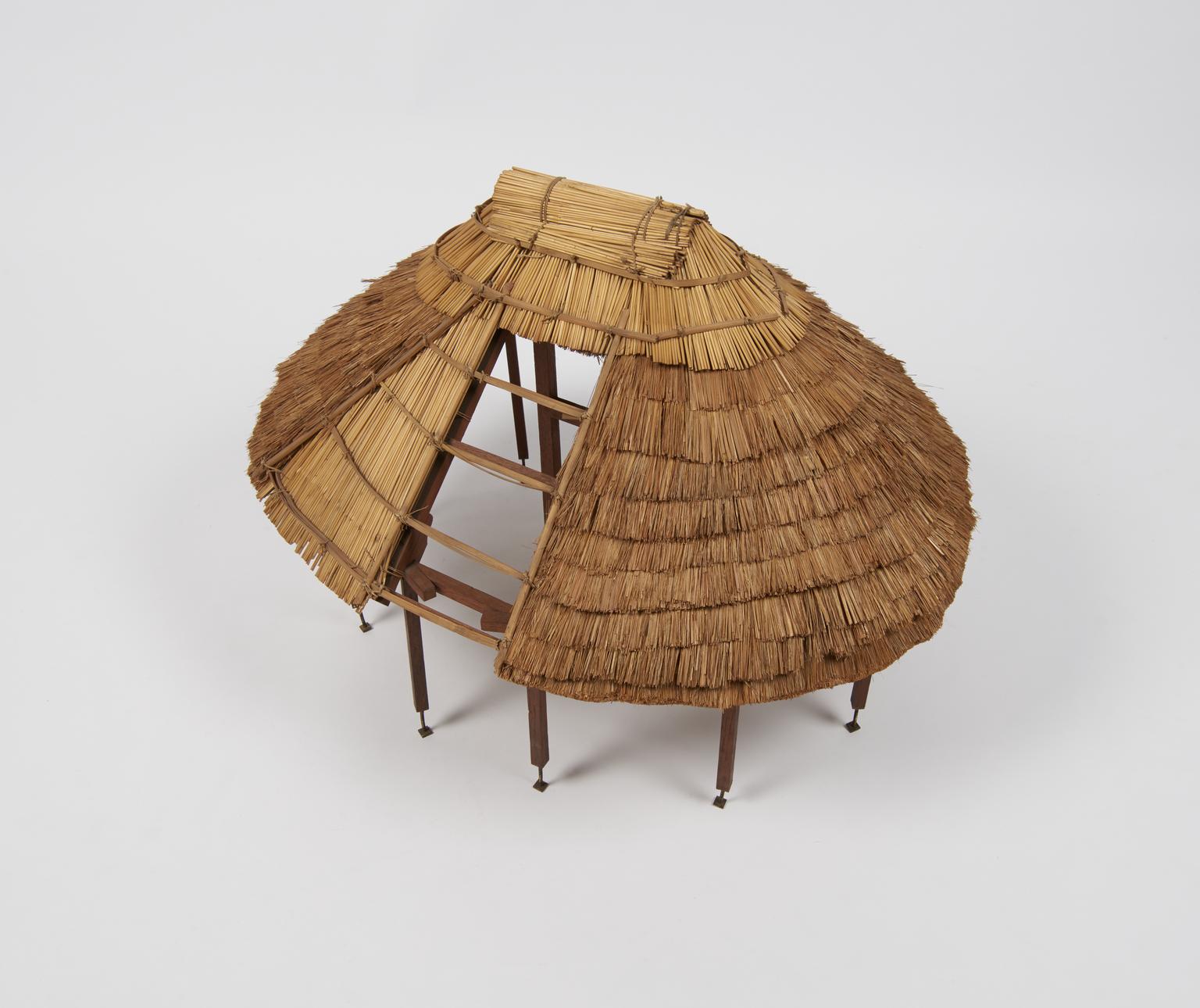
Model of a standard ‘Bengal’ thermometer shed used in India, scale 1:10

Made:
1875-1925 in India
maker:
Unknown

Model of a ‘Bengal’ thatched thermometer shed, scale 1:10, made for the India Meteorological Department, likely in India, 1875–1925. These sheds protected thermometers from sunlight, wind and rain to ensure accurate air temperature readings. The model shows the open sided structure and thatched roof of the shed.

The India Meteorological Department was established in 1875, its first Imperial Meteorological Reporter being the British geologist Henry Francis Blanford. One of the Department’s first priorities was to standardise air temperature measurement across the growing number of meteorological stations in India. Air temperature measurements are sensitive to environmental conditions such as direct sunlight, ventilation and proximity of structures and buildings. To protect the thermometers, a standard shed was designed, with a thatched roof and open sides. Sheds like this model, known as a ‘Bengal’ design, or the similar ‘Madras’ design, were constructed at stations around India and other regions under British imperial rule in south Asia.

In the early 1900s, a different type of thermometer protective structure, the Stevenson screen, was becoming widely adopted across Britain (where it had been designed) and – increasingly – in other countries. To align with these trends, from 1925 the India Meteorological Department began to replace their thermometer sheds with Stevenson screens. Although the intention was to improve the standardisation and comparability of air temperature data worldwide, some evidence from a study in Hong Kong in the 1970s suggested that thatched sheds may have provided a better controlled environment for thermometers in tropical regions than Stevenson screens. The accuracy of historical meteorological records continues to be an important field of research today for climate scientists studying the rate and scale of global heating.

Details

Category:
Meteorology
Object Number:
1926-324
Materials:
wood (unidentified) and straw
type:
model
credit:
Survey of India

Parts

Model of a standard ‘Bengal’ thermometer shed used in India, scale 1:10

Model of a standard ‘Bengal’ thermometer shed used in India, scale 1:10

Model of a ‘Bengal’ thatched thermometer shed, scale 1:10, made for the India Meteorological Department, likely in India, 1875–1925. These sheds protected thermometers from sunlight, wind and rain to ensure accurate air temperature readings. The model shows the open sided structure and thatched roof of the shed.

More

The India Meteorological Department was established in 1875, its first Imperial Meteorological Reporter being the British geologist Henry Francis Blanford. One of the Department’s first priorities was to standardise air temperature measurement across the growing number of meteorological stations in India. Air temperature measurements are sensitive to environmental conditions such as direct sunlight, ventilation and proximity of structures and buildings. To protect the thermometers, a standard shed was designed, with a thatched roof and open sides. Sheds like this model, known as a ‘Bengal’ design, or the similar ‘Madras’ design, were constructed at stations around India and other regions under British imperial rule in south Asia.

In the early 1900s, a different type of thermometer protective structure, the Stevenson screen, was becoming widely adopted across Britain (where it had been designed) and – increasingly – in other countries. To align with these trends, from 1925 the India Meteorological Department began to replace their thermometer sheds with Stevenson screens. Although the intention was to improve the standardisation and comparability of air temperature data worldwide, some evidence from a study in Hong Kong in the 1970s suggested that thatched sheds may have provided a better controlled environment for thermometers in tropical regions than Stevenson screens. The accuracy of historical meteorological records continues to be an important field of research today for climate scientists studying the rate and scale of global heating.

Measurements:
overall: 440 mm x 620 mm x 500 mm,
Materials:
wood (unidentified) and straw
Object Number:
1926-324/1
type:
model - representation
Image ©
The Board of Trustees of the Science Museum
Component, possibly representing ventilation pipe, from model of a ‘Bengal’ thatched thermometer shed, scale 1:10, made for the India Meteorological Department, likely in India, 1875–1925. These sheds protected thermometers from sunlight, wind and rain to ensure accurate air temperature readings. The model shows the open sided structure and thatched roof of the shed.

Component from model of a ‘Bengal’ thermometer shed, scale 1:10

Component, possibly representing ventilation pipe, from model of a ‘Bengal’ thatched thermometer shed, scale 1:10, made for the India Meteorological Department, likely in India, 1875–1925. These sheds protected thermometers from sunlight, wind and rain to ensure accurate air temperature readings. The model shows the open sided structure and thatched roof of the shed.

More

The India Meteorological Department was established in 1875, its first Imperial Meteorological Reporter being the British geologist Henry Francis Blanford. One of the Department’s first priorities was to standardise air temperature measurement across the growing number of meteorological stations in India. Air temperature measurements are sensitive to environmental conditions such as direct sunlight, ventilation and proximity of structures and buildings. To protect the thermometers, a standard shed was designed, with a thatched roof and open sides. Sheds like this model, known as a ‘Bengal’ design, or the similar ‘Madras’ design, were constructed at stations around India and other regions under British imperial rule in south Asia.

In the early 1900s, a different type of thermometer protective structure, the Stevenson screen, was becoming widely adopted across Britain (where it had been designed) and – increasingly – in other countries. To align with these trends, from 1925 the India Meteorological Department began to replace their thermometer sheds with Stevenson screens. Although the intention was to improve the standardisation and comparability of air temperature data worldwide, some evidence from a study in Hong Kong in the 1970s suggested that thatched sheds may have provided a better controlled environment for thermometers in tropical regions than Stevenson screens. The accuracy of historical meteorological records continues to be an important field of research today for climate scientists studying the rate and scale of global heating.

Measurements:
overall: 115 mm 30 mm,
Object Number:
1926-324/2
type:
model - representation