Photothermograph used at Radcliffe Observatory, Oxford

Photothermograph commissioned by the Meteorological Committee of the Royal Society, some design specifications attributed to Francis Ronalds, made in England, UK, 1867. Installed and operated at Radcliffe Observatory, Oxford.

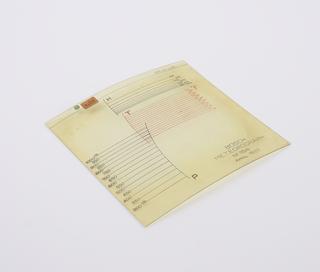
The photothermograph was an instrument designed for meteorological observatories that enabled a continuous photographic record of external wet and dry bulb temperatures to be taken, providing readings of atmospheric temperature and humidity.

The thermometers had a modified design so that they had an additional mercury column above the main mercury stem, separated by a small air gap; the long bent stems meant this air gap was indoors. Light from the gas lamps was focussed on the thermometer stems in the region of the air gap by a system of lenses and mirrors. The light passing through the air gap was focussed on the photographically sensitive paper of the recording drum, with the wet bulb recording below the dry bulb. A shutter blocked the light for four minutes every two hours, leaving time marks on the record.

The thermometers themselves were installed in an external louvred enclosure, similar to a Stevenson screen, which protected them from direct sunlight, wind and rain. Standard wet and dry bulb thermometers were also installed in the enclosure, providing readings that could be compared with that of the photographic record.
Details

Category:
Meteorology
Object Number:
1926-938
Materials:
brass, wood, slate, glass and mercury
Measurements:
overall (approx): 143 x 122 x 130 cm
type:
thermograph
credit:
Meteorological Office, South Kensington

Parts

Part of photothermograph used at Radcliffe Observatory, Oxford

Part of photothermograph used at Radcliffe Observatory, Oxford

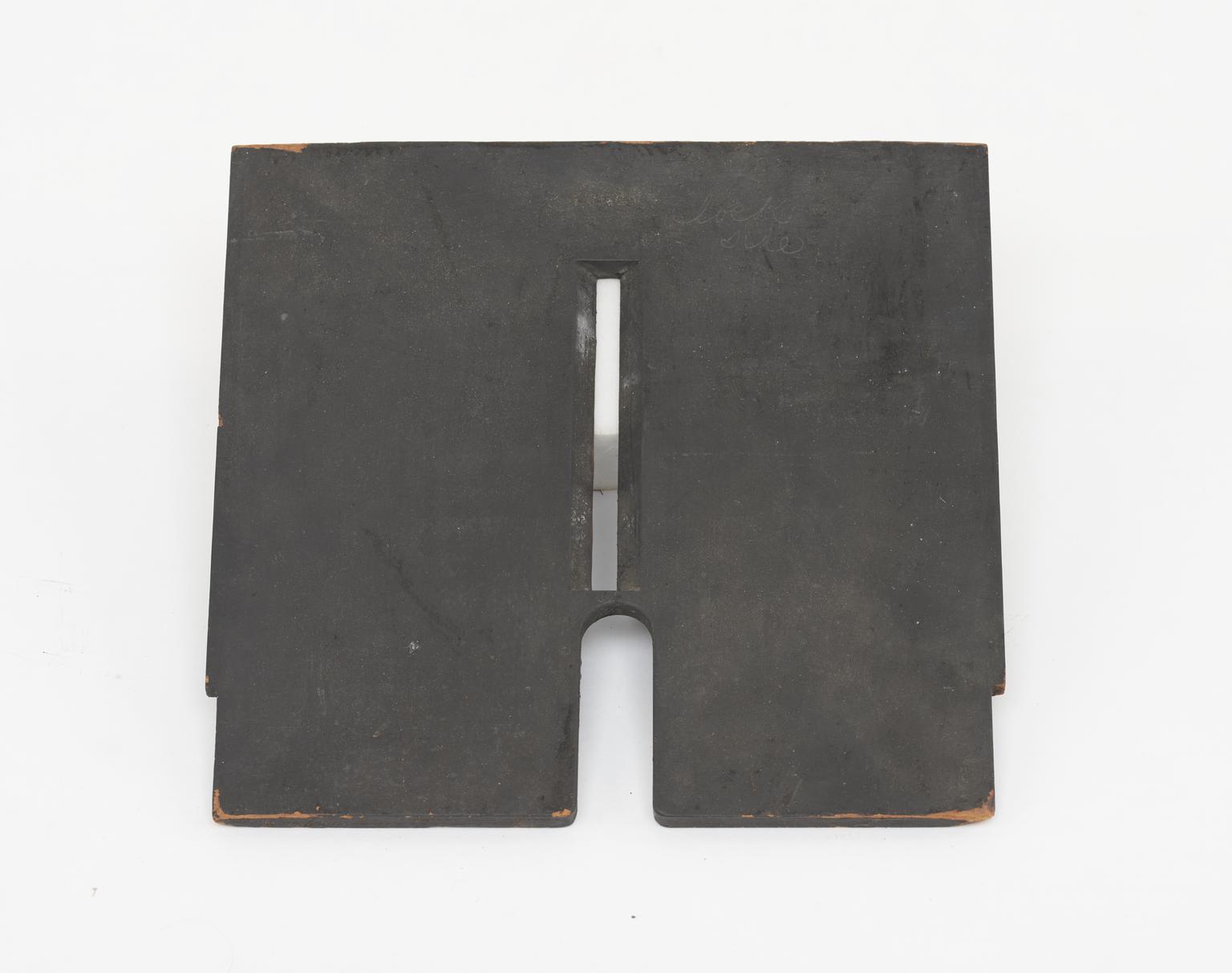
Part - photothermograph - wooden plate with slit and rounded notch.

More

The photothermograph was an instrument designed for meteorological observatories that enabled a continuous photographic record of external wet and dry bulb temperatures to be taken, providing readings of atmospheric temperature and humidity.

The thermometers had a modified design so that they had an additional mercury column above the main mercury stem, separated by a small air gap; the long bent stems meant this air gap was indoors. Light from the gas lamps was focussed on the thermometer stems in the region of the air gap by a system of lenses and mirrors. The light passing through the air gap was focussed on the photographically sensitive paper of the recording drum, with the wet bulb recording below the dry bulb. A shutter blocked the light for four minutes every two hours, leaving time marks on the record.

The thermometers themselves were installed in an external louvred enclosure, similar to a Stevenson screen, which protected them from direct sunlight, wind and rain. Standard wet and dry bulb thermometers were also installed in the enclosure, providing readings that could be compared with that of the photographic record.

Measurements:
overall: 268 mm x 272 mm x 7 mm,
Materials:
wood
Object Number:
1926-938 Pt1
type:
component
Image ©
The Board of Trustees of the Science Museum
Components of photothermograph used at Radcliffe Observatory, Oxford

Components of photothermograph used at Radcliffe Observatory, Oxford

Components, glass and mercury, of photothermograph commissioned by the Meteorological Committee of the Royal Society, some design specifications attributed to Francis Ronalds, made in England, UK, 1867. Installed and operated at Radcliffe Observatory, Oxford.

More

The photothermograph was an instrument designed for meteorological observatories that enabled a continuous photographic record of external wet and dry bulb temperatures to be taken, providing readings of atmospheric temperature and humidity.

The thermometers had a modified design so that they had an additional mercury column above the main mercury stem, separated by a small air gap; the long bent stems meant this air gap was indoors. Light from the gas lamps was focussed on the thermometer stems in the region of the air gap by a system of lenses and mirrors. The light passing through the air gap was focussed on the photographically sensitive paper of the recording drum, with the wet bulb recording below the dry bulb. A shutter blocked the light for four minutes every two hours, leaving time marks on the record.

The thermometers themselves were installed in an external louvred enclosure, similar to a Stevenson screen, which protected them from direct sunlight, wind and rain. Standard wet and dry bulb thermometers were also installed in the enclosure, providing readings that could be compared with that of the photographic record.
Materials:
glass and mercury
Object Number:
1926-938 Pt2
type:
component
Components for photothermograph used at Radcliffe Observatory, Oxford

Components for photothermograph used at Radcliffe Observatory, Oxford

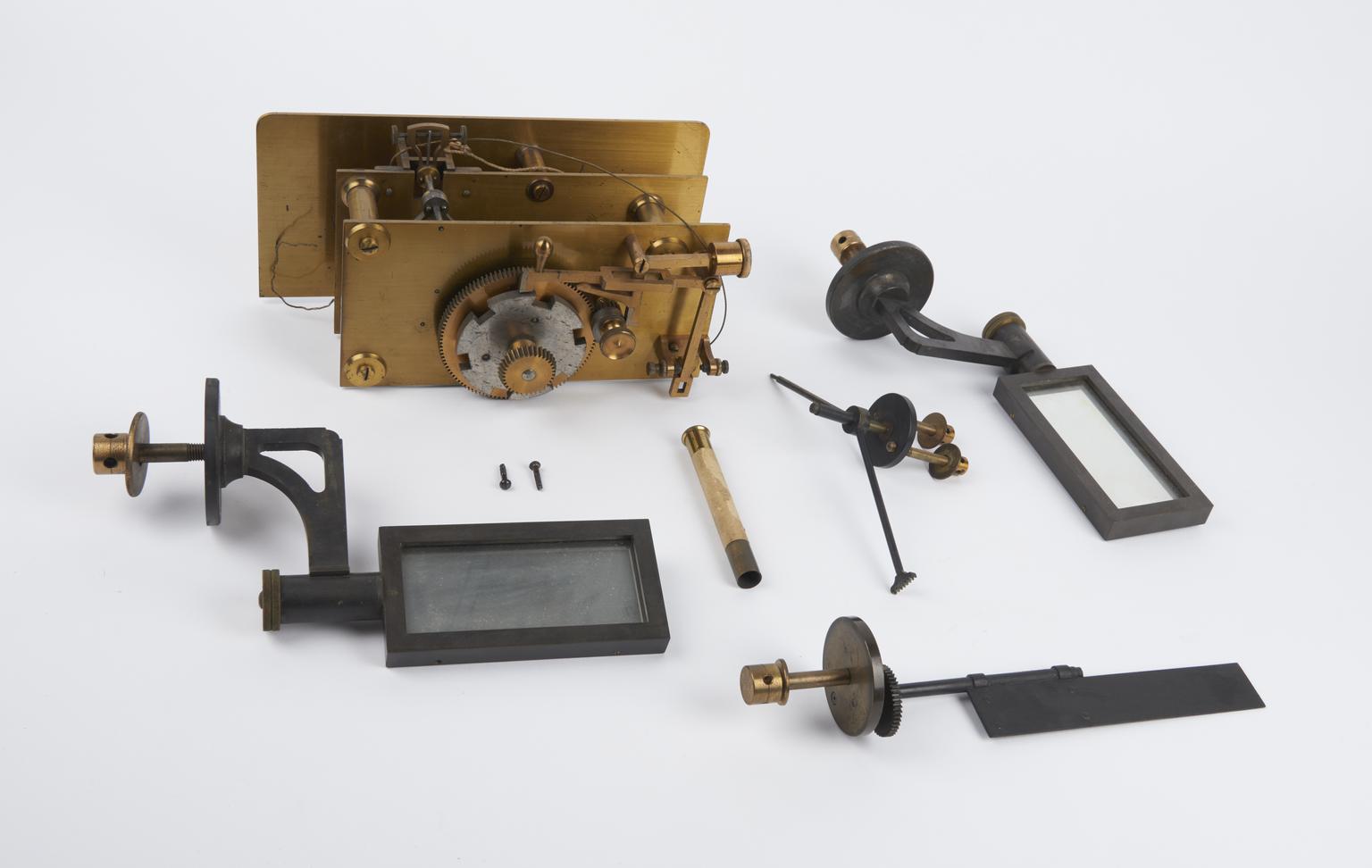
Components of photothermograph commissioned by the Meteorological Committee of the Royal Society, some design specifications attributed to Francis Ronalds, made in England, UK, 1867. Installed and operated at Radcliffe Observatory, Oxford. Labelled as follows:

1 of 6: Clockwork drive for recording drum by R. W. Munro. London, England, UK, 1870.

2 of 6: One of two mirrors that directed light from the condensing lens onto the air gap of one of the thermometers.

3 of 6: Component with gears and arm, part of the shutter mechanism for making time marks on the photographic record.

4 of 6: Shutter that shut off light to the drum every two hours to create a time mark on the record.

5 of 6: Second of two mirrors that directed light from the condensing lens onto the air gap of one of the thermometers.

6 of 6: brass tube, unknown component.

More

The photothermograph was an instrument designed for meteorological observatories that enabled a continuous photographic record of external wet and dry bulb temperatures to be taken, providing readings of atmospheric temperature and humidity.

The thermometers had a modified design so that they had an additional mercury column above the main mercury stem, separated by a small air gap; the long bent stems meant this air gap was indoors. Light from the gas lamps was focussed on the thermometer stems in the region of the air gap by a system of lenses and mirrors. The light passing through the air gap was focussed on the photographically sensitive paper of the recording drum, with the wet bulb recording below the dry bulb. A shutter blocked the light for four minutes every two hours, leaving time marks on the record.

The thermometers themselves were installed in an external louvred enclosure, similar to a Stevenson screen, which protected them from direct sunlight, wind and rain. Standard wet and dry bulb thermometers were also installed in the enclosure, providing readings that could be compared with that of the photographic record.

Materials:
brass and glass
Object Number:
1926-938 Pt2/1
type:
component
Image ©
The Board of Trustees of the Science Museum
Part of:
1926-938 Pt2
Components for photothermograph used at Radcliffe Observatory, Oxford

Components for photothermograph used at Radcliffe Observatory, Oxford

Components of photothermograph commissioned by the Meteorological Committee of the Royal Society, some design specifications attributed to Francis Ronalds, made in England, UK, 1867. Installed and operated at Radcliffe Observatory, Oxford. Labelled as follows:

1 of 2: Two slits, through which light passes between the thermometer air gaps and the respective photographic lens; small brass weight, part of clockwork drive; two unidentified brass bolt components.

2 of 2: Lead weight for clockwork drive

More

The photothermograph was an instrument designed for meteorological observatories that enabled a continuous photographic record of external wet and dry bulb temperatures to be taken, providing readings of atmospheric temperature and humidity.

The thermometers had a modified design so that they had an additional mercury column above the main mercury stem, separated by a small air gap; the long bent stems meant this air gap was indoors. Light from the gas lamps was focussed on the thermometer stems in the region of the air gap by a system of lenses and mirrors. The light passing through the air gap was focussed on the photographically sensitive paper of the recording drum, with the wet bulb recording below the dry bulb. A shutter blocked the light for four minutes every two hours, leaving time marks on the record.

The thermometers themselves were installed in an external louvred enclosure, similar to a Stevenson screen, which protected them from direct sunlight, wind and rain. Standard wet and dry bulb thermometers were also installed in the enclosure, providing readings that could be compared with that of the photographic record.

Materials:
metal (unknown) and glass
Object Number:
1926-938 Pt2/2
type:
component
Image ©
The Board of Trustees of the Science Museum
Part of:
1926-938 Pt2
Components of Photothermograph used at Radcliffe Observatory, Oxford

Components of Photothermograph used at Radcliffe Observatory, Oxford

Components of photothermograph commissioned by the Meteorological Committee of the Royal Society, some design specifications attributed to Francis Ronalds, made in England, UK, 1867. Installed and operated at Radcliffe Observatory, Oxford. Labelled as follows:

1 of 6: One of two condenser lenses for focussing light from lamp. Has 2 small punchmarks on underside of base.

2 of 6: Second of two condenser lenses for focussing light from lamp. Has 4 small punchmarks on underside of base.

3 of 6: Gas lamp, one of two.

4 of 6: Gas lamp, second of two

5 of 6: Projection or photographic lens, one of two, J H Dallmeyer, London, no. 18607. Inscribed T (for ‘thermograph’) on underside of base.

6 of 6: Projection or photographic lens, second of two. Signed J H Dallmeyer, London, no 18606. Inscribed T on underside of base.

More

The photothermograph was an instrument designed for meteorological observatories that enabled a continuous photographic record of external wet and dry bulb temperatures to be taken, providing readings of atmospheric temperature and humidity.

The thermometers had a modified design so that they had an additional mercury column above the main mercury stem, separated by a small air gap; the long bent stems meant this air gap was indoors. Light from the gas lamps was focussed on the thermometer stems in the region of the air gap by a system of lenses and mirrors. The light passing through the air gap was focussed on the photographically sensitive paper of the recording drum, with the wet bulb recording below the dry bulb. A shutter blocked the light for four minutes every two hours, leaving time marks on the record.

The thermometers themselves were installed in an external louvred enclosure, similar to a Stevenson screen, which protected them from direct sunlight, wind and rain. Standard wet and dry bulb thermometers were also installed in the enclosure, providing readings that could be compared with that of the photographic record.
Materials:
metal (unknown) and glass
Object Number:
1926-938 Pt2/3
type:
component
Image ©
The Board of Trustees of the Science Museum
Part of:
1926-938 Pt2
Components of photothermograph used at Radcliffe Observatory, Oxford

Components of photothermograph used at Radcliffe Observatory, Oxford

Components of photothermograph commissioned by the Meteorological Committee of the Royal Society, some design specifications attributed to Francis Ronalds, made in England, UK, 1867. Installed and operated at Radcliffe Observatory, Oxford.

More

The photothermograph was an instrument designed for meteorological observatories that enabled a continuous photographic record of external wet and dry bulb temperatures to be taken, providing readings of atmospheric temperature and humidity.

The thermometers had a modified design so that they had an additional mercury column above the main mercury stem, separated by a small air gap; the long bent stems meant this air gap was indoors. Light from the gas lamps was focussed on the thermometer stems in the region of the air gap by a system of lenses and mirrors. The light passing through the air gap was focussed on the photographically sensitive paper of the recording drum, with the wet bulb recording below the dry bulb. A shutter blocked the light for four minutes every two hours, leaving time marks on the record.

The thermometers themselves were installed in an external louvred enclosure, similar to a Stevenson screen, which protected them from direct sunlight, wind and rain. Standard wet and dry bulb thermometers were also installed in the enclosure, providing readings that could be compared with that of the photographic record.

Materials:
glass and mercury
Object Number:
1926-938 Pt3
type:
components
Slide rest for thermometers from photothermograph used at Radcliffe Observatory, Oxford

Slide rest for thermometers from photothermograph used at Radcliffe Observatory, Oxford

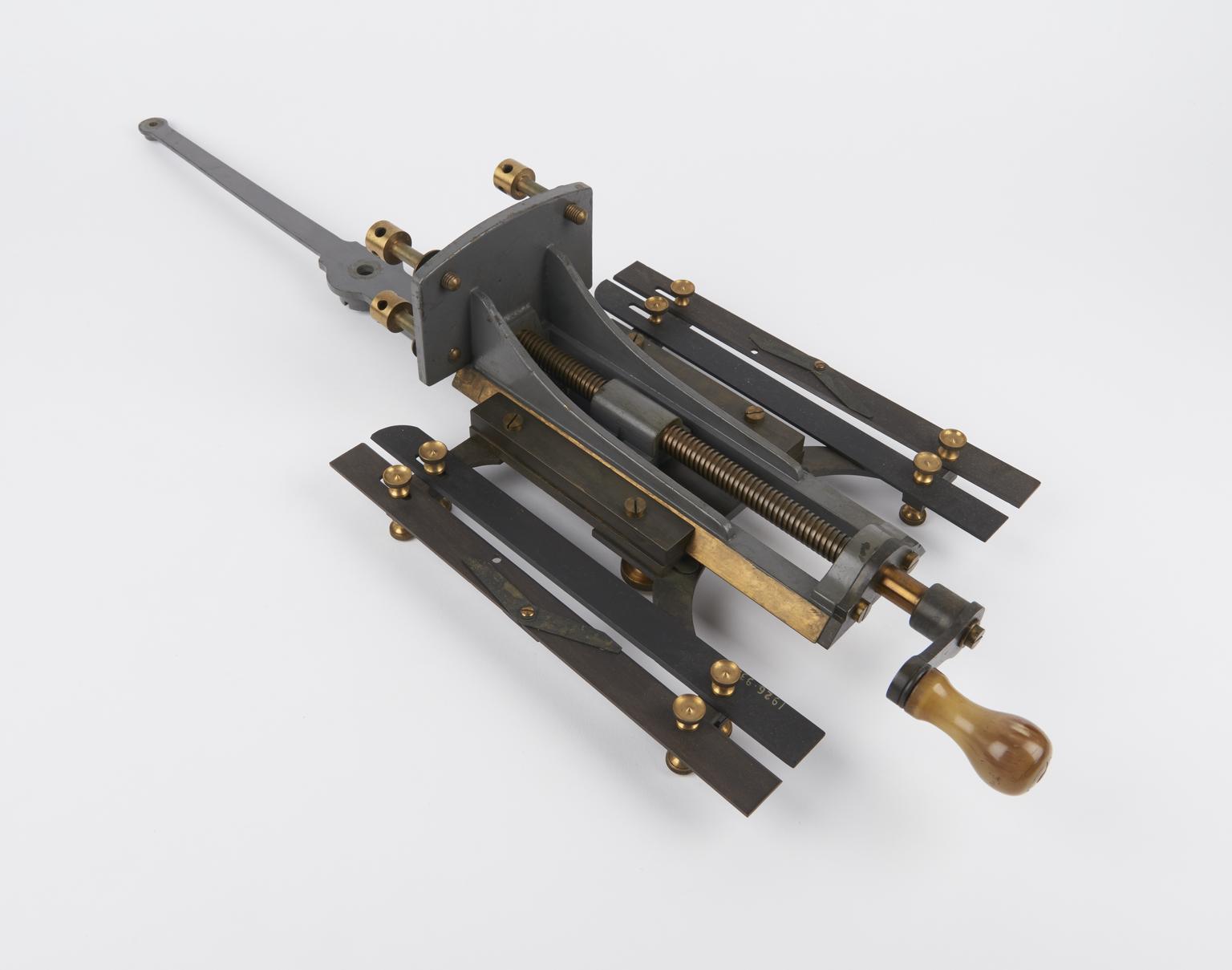
Slide rest for vertical adjustment of thermometers, part of photothermograph commissioned by the Meteorological Committee of the Royal Society, some design specifications attributed to Francis Ronalds, made in England, UK, 1867. Installed and operated at Radcliffe Observatory, Oxford.

More

The photothermograph was an instrument designed for meteorological observatories that enabled a continuous photographic record of external wet and dry bulb temperatures to be taken, providing readings of atmospheric temperature and humidity.

The thermometers had a modified design so that they had an additional mercury column above the main mercury stem, separated by a small air gap; the long bent stems meant this air gap was indoors. Light from the gas lamps was focussed on the thermometer stems in the region of the air gap by a system of lenses and mirrors. The light passing through the air gap was focussed on the photographically sensitive paper of the recording drum, with the wet bulb recording below the dry bulb. A shutter blocked the light for four minutes every two hours, leaving time marks on the record.

The thermometers themselves were installed in an external louvred enclosure, similar to a Stevenson screen, which protected them from direct sunlight, wind and rain. Standard wet and dry bulb thermometers were also installed in the enclosure, providing readings that could be compared with that of the photographic record.
Materials:
brass (copper, zinc alloy) and wood (unidentified)
Object Number:
1926-938 Pt3/1
type:
component
Image ©
The Board of Trustees of the Science Museum
Part of:
1926-938 Pt3
Recording drum from photothermograph used at Radcliffe Observatory, Oxford

Recording drum from photothermograph used at Radcliffe Observatory, Oxford

Recording drum, part of photothermograph commissioned by the Meteorological Committee of the Royal Society, some design specifications attributed to Francis Ronalds, made in England, UK, 1867. Installed and operated at Radcliffe Observatory, Oxford.

More

The photothermograph was an instrument designed for meteorological observatories that enabled a continuous photographic record of external wet and dry bulb temperatures to be taken, providing readings of atmospheric temperature and humidity.

The thermometers had a modified design so that they had an additional mercury column above the main mercury stem, separated by a small air gap; the long bent stems meant this air gap was indoors. Light from the gas lamps was focussed on the thermometer stems in the region of the air gap by a system of lenses and mirrors. The light passing through the air gap was focussed on the photographically sensitive paper of the recording drum, with the wet bulb recording below the dry bulb. A shutter blocked the light for four minutes every two hours, leaving time marks on the record.

The thermometers themselves were installed in an external louvred enclosure, similar to a Stevenson screen, which protected them from direct sunlight, wind and rain. Standard wet and dry bulb thermometers were also installed in the enclosure, providing readings that could be compared with that of the photographic record.
Materials:
brass (copper, zinc alloy)
Object Number:
1926-938 Pt3/2
type:
component
Image ©
The Board of Trustees of the Science Museum
Part of:
1926-938 Pt3
Recording drum

Recording drum

Recording drum, attributed to photothermograph commissioned by the Meteorological Committee of the Royal Society, some design specifications attributed to Francis Ronalds, made in England, UK, 1867. Installed and operated at Radcliffe Observatory, Oxford.

More

The photothermograph was an instrument designed for meteorological observatories that enabled a continuous photographic record of external wet and dry bulb temperatures to be taken, providing readings of atmospheric temperature and humidity.

The thermometers had a modified design so that they had an additional mercury column above the main mercury stem, separated by a small air gap; the long bent stems meant this air gap was indoors. Light from the gas lamps was focussed on the thermometer stems in the region of the air gap by a system of lenses and mirrors. The light passing through the air gap was focussed on the photographically sensitive paper of the recording drum, with the wet bulb recording below the dry bulb. A shutter blocked the light for four minutes every two hours, leaving time marks on the record.

The thermometers themselves were installed in an external louvred enclosure, similar to a Stevenson screen, which protected them from direct sunlight, wind and rain. Standard wet and dry bulb thermometers were also installed in the enclosure, providing readings that could be compared with that of the photographic record.
Object Number:
1926-938 Pt3/3
type:
component
Image ©
The Board of Trustees of the Science Museum
Part of:
1926-938 Pt3
Water tank from photothermograph used at Radcliffe Observatory, Oxford

Water tank from photothermograph used at Radcliffe Observatory, Oxford

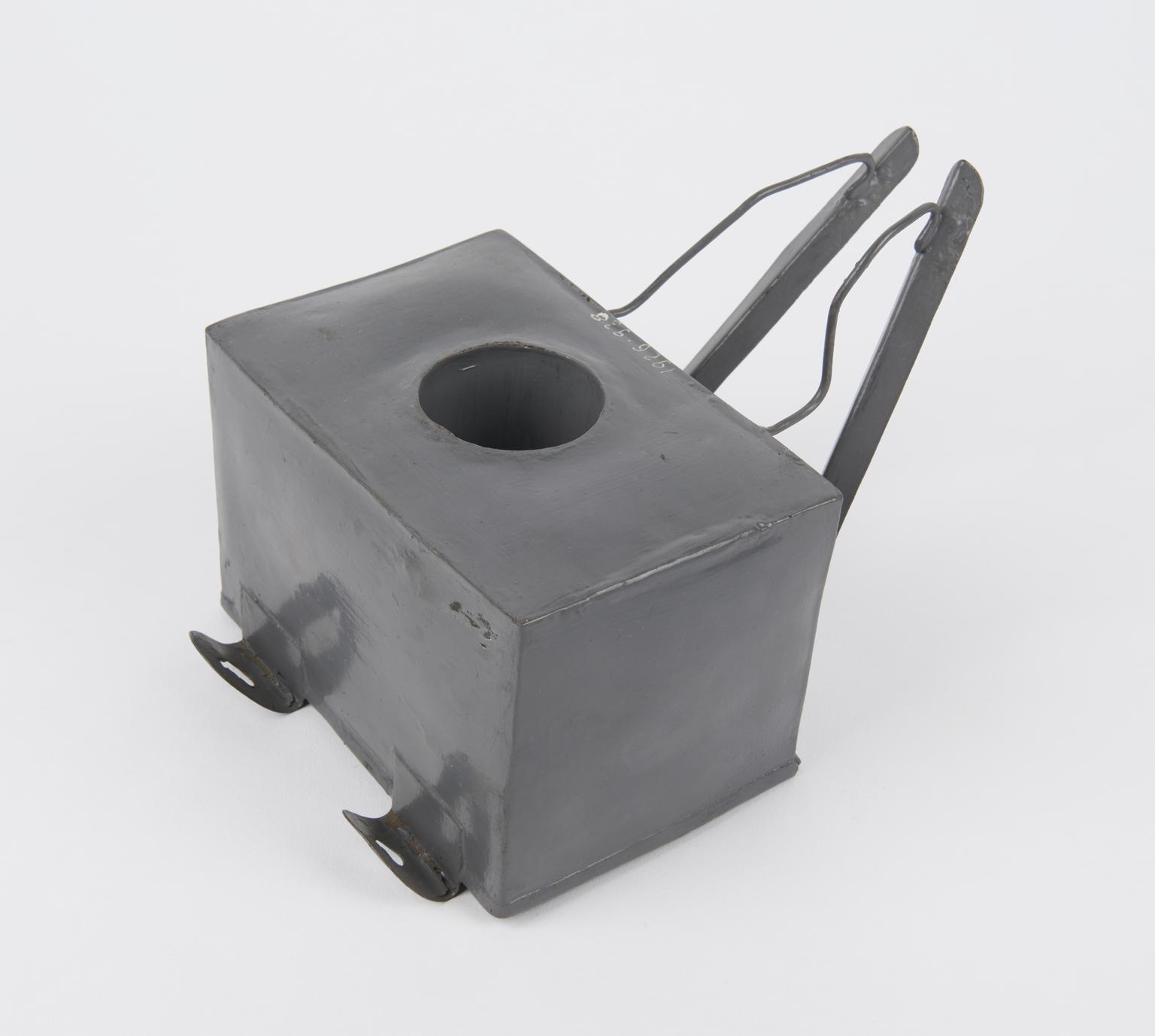
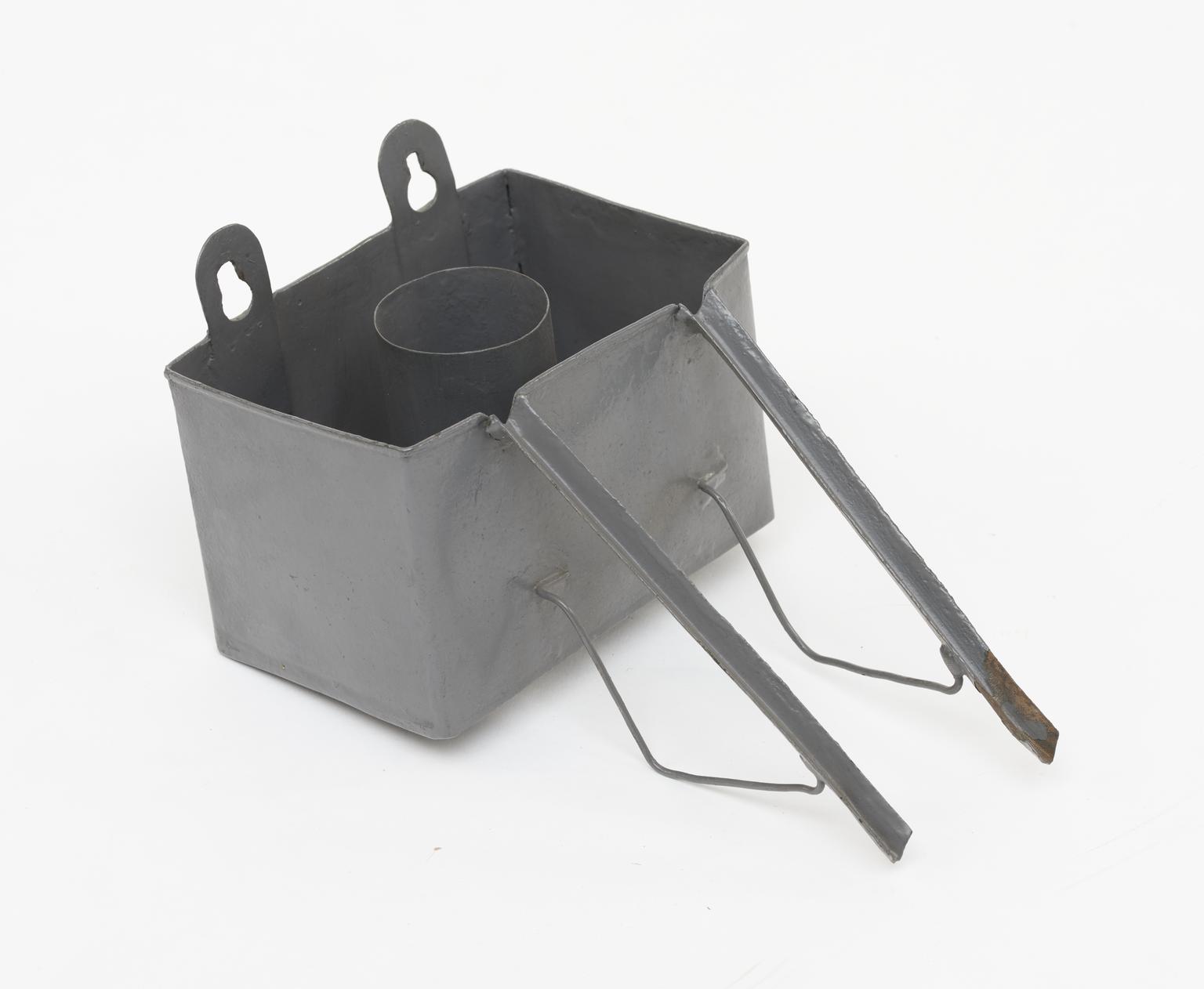
Water tank with holders for wicks to supply water to wet bulb thermometers. Part of photothermograph commissioned by the Meteorological Committee of the Royal Society, some design specifications attributed to Francis Ronalds, made in England, UK, 1867. Installed and operated at Radcliffe Observatory, Oxford.

More

The photothermograph was an instrument designed for meteorological observatories that enabled a continuous photographic record of external wet and dry bulb temperatures to be taken, providing readings of atmospheric temperature and humidity.

The thermometers had a modified design so that they had an additional mercury column above the main mercury stem, separated by a small air gap; the long bent stems meant this air gap was indoors. Light from the gas lamps was focussed on the thermometer stems in the region of the air gap by a system of lenses and mirrors. The light passing through the air gap was focussed on the photographically sensitive paper of the recording drum, with the wet bulb recording below the dry bulb. A shutter blocked the light for four minutes every two hours, leaving time marks on the record.

The thermometers themselves were installed in an external louvred enclosure, similar to a Stevenson screen, which protected them from direct sunlight, wind and rain. Standard wet and dry bulb thermometers were also installed in the enclosure, providing readings that could be compared with that of the photographic record.
Materials:
metal (unknown)
Object Number:
1926-938 Pt3/4
type:
components
Image ©
The Board of Trustees of the Science Museum
Part of:
1926-938 Pt3
Thermometer support from photothermograph used at Radcliffe Observatory, Oxford

Thermometer support from photothermograph used at Radcliffe Observatory, Oxford

Support for thermometers housed within louvred screen. Part of photothermograph commissioned by the Meteorological Committee of the Royal Society, some design specifications attributed to Francis Ronalds, made in England, UK, 1867. Installed and operated at Radcliffe Observatory, Oxford.

More

The photothermograph was an instrument designed for meteorological observatories that enabled a continuous photographic record of external wet and dry bulb temperatures to be taken, providing readings of atmospheric temperature and humidity.

The thermometers had a modified design so that they had an additional mercury column above the main mercury stem, separated by a small air gap; the long bent stems meant this air gap was indoors. Light from the gas lamps was focussed on the thermometer stems in the region of the air gap by a system of lenses and mirrors. The light passing through the air gap was focussed on the photographically sensitive paper of the recording drum, with the wet bulb recording below the dry bulb. A shutter blocked the light for four minutes every two hours, leaving time marks on the record.

The thermometers themselves were installed in an external louvred enclosure, similar to a Stevenson screen, which protected them from direct sunlight, wind and rain. Standard wet and dry bulb thermometers were also installed in the enclosure, providing readings that could be compared with that of the photographic record.
Materials:
metal (unknown)
Object Number:
1926-938 Pt3/5
type:
components
Image ©
The Board of Trustees of the Science Museum
Part of:
1926-938 Pt3
Weight for Ronalds' photographic thermograph

Weight for Ronalds' photographic thermograph

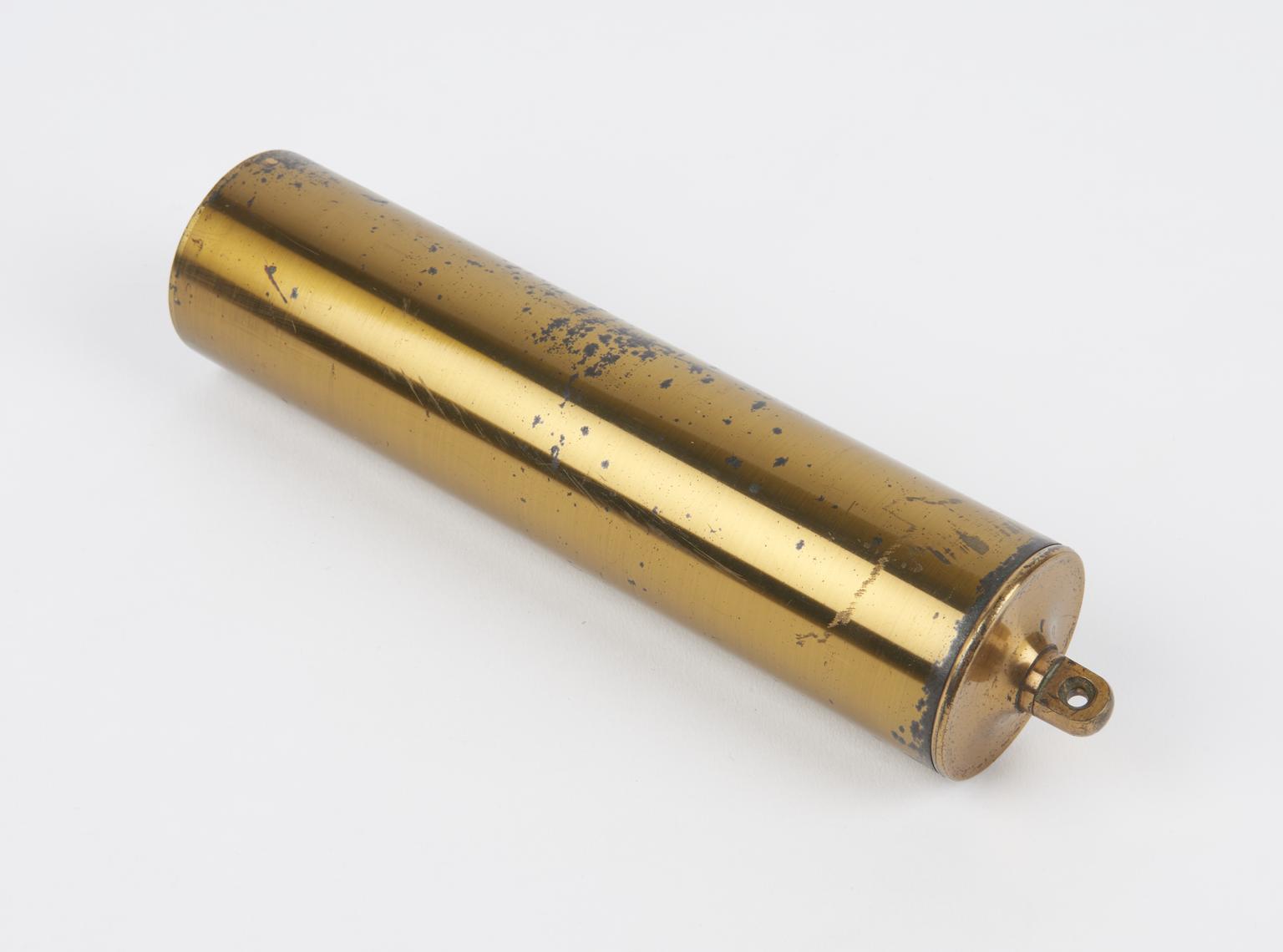
Pendulum weight for clockwork drive. Part of photothermograph commissioned by the Meteorological Committee of the Royal Society, some design specifications attributed to Francis Ronalds, made in England, UK, 1867. Installed and operated at Radcliffe Observatory, Oxford.

More

The photothermograph was an instrument designed for meteorological observatories that enabled a continuous photographic record of external wet and dry bulb temperatures to be taken, providing readings of atmospheric temperature and humidity.

The thermometers had a modified design so that they had an additional mercury column above the main mercury stem, separated by a small air gap; the long bent stems meant this air gap was indoors. Light from the gas lamps was focussed on the thermometer stems in the region of the air gap by a system of lenses and mirrors. The light passing through the air gap was focussed on the photographically sensitive paper of the recording drum, with the wet bulb recording below the dry bulb. A shutter blocked the light for four minutes every two hours, leaving time marks on the record.

The thermometers themselves were installed in an external louvred enclosure, similar to a Stevenson screen, which protected them from direct sunlight, wind and rain. Standard wet and dry bulb thermometers were also installed in the enclosure, providing readings that could be compared with that of the photographic record.
Materials:
brass and lead
Object Number:
1926-938 Pt3/6
type:
weight
Image ©
The Board of Trustees of the Science Museum
Part of:
1926-938 Pt3
Water tank from photothermograph used at Radcliffe Observatory, Oxford

Water tank from photothermograph used at Radcliffe Observatory, Oxford

Water tank with holders for wicks to supply water to wet bulb thermometers. Part of photothermograph commissioned by the Meteorological Committee of the Royal Society, some design specifications attributed to Francis Ronalds, made in England, UK, 1867. Installed and operated at Radcliffe Observatory, Oxford.

More

The photothermograph was an instrument designed for meteorological observatories that enabled a continuous photographic record of external wet and dry bulb temperatures to be taken, providing readings of atmospheric temperature and humidity.

The thermometers had a modified design so that they had an additional mercury column above the main mercury stem, separated by a small air gap; the long bent stems meant this air gap was indoors. Light from the gas lamps was focussed on the thermometer stems in the region of the air gap by a system of lenses and mirrors. The light passing through the air gap was focussed on the photographically sensitive paper of the recording drum, with the wet bulb recording below the dry bulb. A shutter blocked the light for four minutes every two hours, leaving time marks on the record.

The thermometers themselves were installed in an external louvred enclosure, similar to a Stevenson screen, which protected them from direct sunlight, wind and rain. Standard wet and dry bulb thermometers were also installed in the enclosure, providing readings that could be compared with that of the photographic record.
Measurements:
overall: 137 mm x 160 mm x 246 mm,
Object Number:
1926-938 Pt3/7
type:
components
Image ©
The Board of Trustees of the Science Museum
Part of:
1926-938 Pt3
Gas lamp chimneys from photothermograph used at Radcliffe Observatory, Oxford

Gas lamp chimneys from photothermograph used at Radcliffe Observatory, Oxford

Two covers or chimneys for gas lamps. Part of photothermograph commissioned by the Meteorological Committee of the Royal Society, some design specifications attributed to Francis Ronalds, made in England, UK, 1867. Installed and operated at Radcliffe Observatory, Oxford.

More

The photothermograph was an instrument designed for meteorological observatories that enabled a continuous photographic record of external wet and dry bulb temperatures to be taken, providing readings of atmospheric temperature and humidity.

The thermometers had a modified design so that they had an additional mercury column above the main mercury stem, separated by a small air gap; the long bent stems meant this air gap was indoors. Light from the gas lamps was focussed on the thermometer stems in the region of the air gap by a system of lenses and mirrors. The light passing through the air gap was focussed on the photographically sensitive paper of the recording drum, with the wet bulb recording below the dry bulb. A shutter blocked the light for four minutes every two hours, leaving time marks on the record.

The thermometers themselves were installed in an external louvred enclosure, similar to a Stevenson screen, which protected them from direct sunlight, wind and rain. Standard wet and dry bulb thermometers were also installed in the enclosure, providing readings that could be compared with that of the photographic record.

Object Number:
1926-938 Pt4
type:
component
Gas lamp chimney from photothermograph used at Radcliffe Observatory, Oxford

Gas lamp chimney from photothermograph used at Radcliffe Observatory, Oxford

Cover, or chimney, for a gas lamp, with screens protruding from the base of the chimney set at an angle from one another. Label on box identifies object as being for left side of assembled object. Part of photothermograph commissioned by the Meteorological Committee of the Royal Society, some design specifications attributed to Francis Ronalds, made in England, UK, 1867. Installed and operated at Radcliffe Observatory, Oxford.

More

The photothermograph was an instrument designed for meteorological observatories that enabled a continuous photographic record of external wet and dry bulb temperatures to be taken, providing readings of atmospheric temperature and humidity.

The thermometers had a modified design so that they had an additional mercury column above the main mercury stem, separated by a small air gap; the long bent stems meant this air gap was indoors. Light from the gas lamps was focussed on the thermometer stems in the region of the air gap by a system of lenses and mirrors. The light passing through the air gap was focussed on the photographically sensitive paper of the recording drum, with the wet bulb recording below the dry bulb. A shutter blocked the light for four minutes every two hours, leaving time marks on the record.

The thermometers themselves were installed in an external louvred enclosure, similar to a Stevenson screen, which protected them from direct sunlight, wind and rain. Standard wet and dry bulb thermometers were also installed in the enclosure, providing readings that could be compared with that of the photographic record.
Object Number:
1926-938 Pt4/1
type:
component
Part of:
1926-938 Pt4
Gas lamp chimney from photothermograph used at Radcliffe Observatory, Oxford

Gas lamp chimney from photothermograph used at Radcliffe Observatory, Oxford

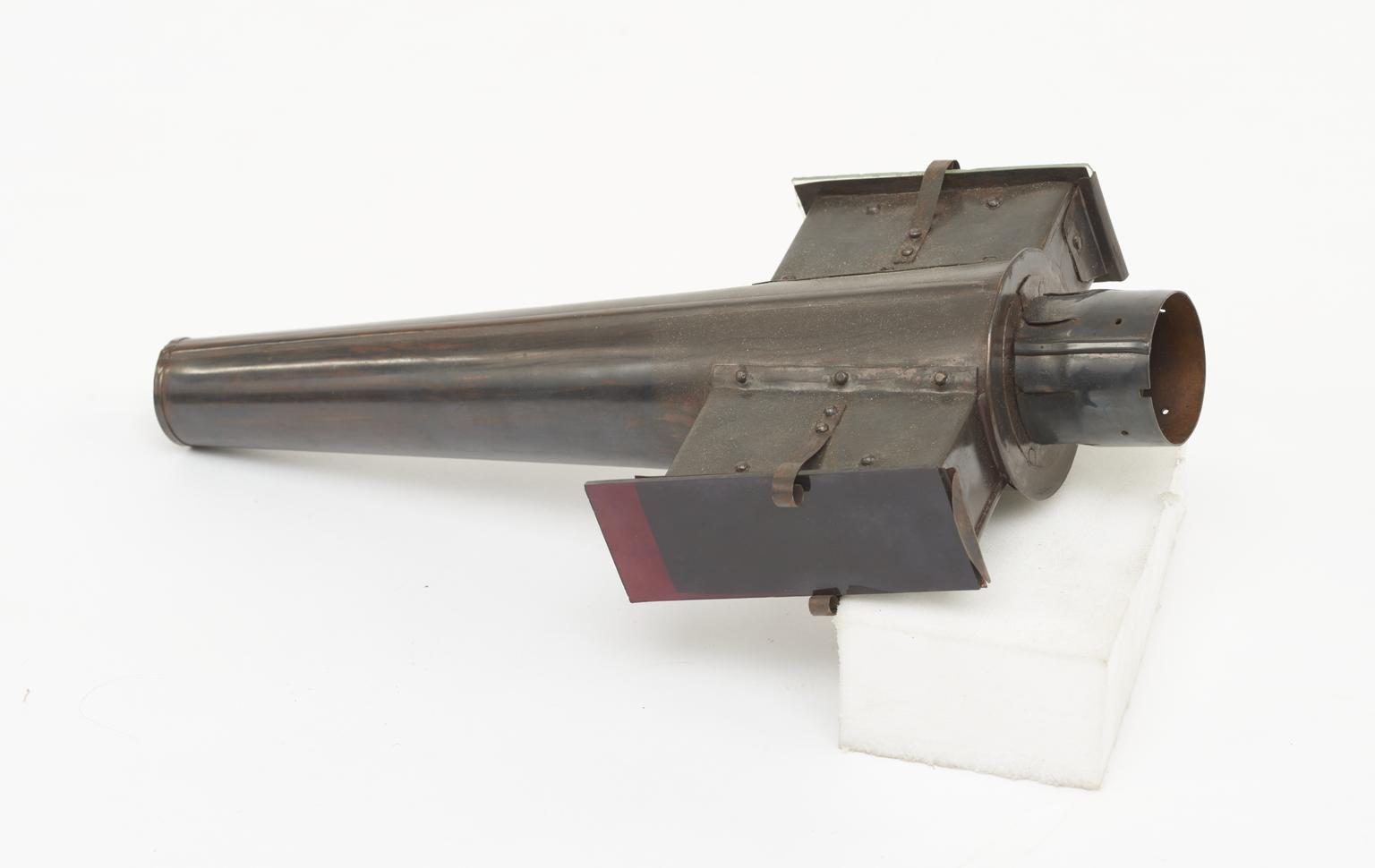
copper gas lamp chimney with red and clear glass screens protruding opposite one another from base. Part of photothermograph commissioned by the Meteorological Committee of the Royal Society, some design specifications attributed to Francis Ronalds, made in England, UK, 1867. Installed and operated at Radcliffe Observatory, Oxford.

More

The photothermograph was an instrument designed for meteorological observatories that enabled a continuous photographic record of external wet and dry bulb temperatures to be taken, providing readings of atmospheric temperature and humidity.

The thermometers had a modified design so that they had an additional mercury column above the main mercury stem, separated by a small air gap; the long bent stems meant this air gap was indoors. Light from the gas lamps was focussed on the thermometer stems in the region of the air gap by a system of lenses and mirrors. The light passing through the air gap was focussed on the photographically sensitive paper of the recording drum, with the wet bulb recording below the dry bulb. A shutter blocked the light for four minutes every two hours, leaving time marks on the record.

The thermometers themselves were installed in an external louvred enclosure, similar to a Stevenson screen, which protected them from direct sunlight, wind and rain. Standard wet and dry bulb thermometers were also installed in the enclosure, providing readings that could be compared with that of the photographic record.
Measurements:
overall: 354 mm x 157 mm x 79 mm,
Object Number:
1926-938 Pt4/2
type:
component
Image ©
The Board of Trustees of the Science Museum
Part of:
1926-938 Pt4
Thermometers from photothermograph used at Radcliffe Observatory, Oxford

Thermometers from photothermograph used at Radcliffe Observatory, Oxford

Wet and dry bulb thermometers. Parts of photothermograph commissioned by the Meteorological Committee of the Royal Society, some design specifications attributed to Francis Ronalds, made in England, UK, 1867. Installed and operated at Radcliffe Observatory, Oxford.

More

The photothermograph was an instrument designed for meteorological observatories that enabled a continuous photographic record of external wet and dry bulb temperatures to be taken, providing readings of atmospheric temperature and humidity.

The thermometers had a modified design so that they had an additional mercury column above the main mercury stem, separated by a small air gap; the long bent stems meant this air gap was indoors. Light from the gas lamps was focussed on the thermometer stems in the region of the air gap by a system of lenses and mirrors. The light passing through the air gap was focussed on the photographically sensitive paper of the recording drum, with the wet bulb recording below the dry bulb. A shutter blocked the light for four minutes every two hours, leaving time marks on the record.

The thermometers themselves were installed in an external louvred enclosure, similar to a Stevenson screen, which protected them from direct sunlight, wind and rain. Standard wet and dry bulb thermometers were also installed in the enclosure, providing readings that could be compared with that of the photographic record.
Materials:
glass
Object Number:
1926-938 Pt5
type:
thermometers
Standard thermometer from photothermograph used at Radcliffe Observatory, Oxford

Standard thermometer from photothermograph used at Radcliffe Observatory, Oxford

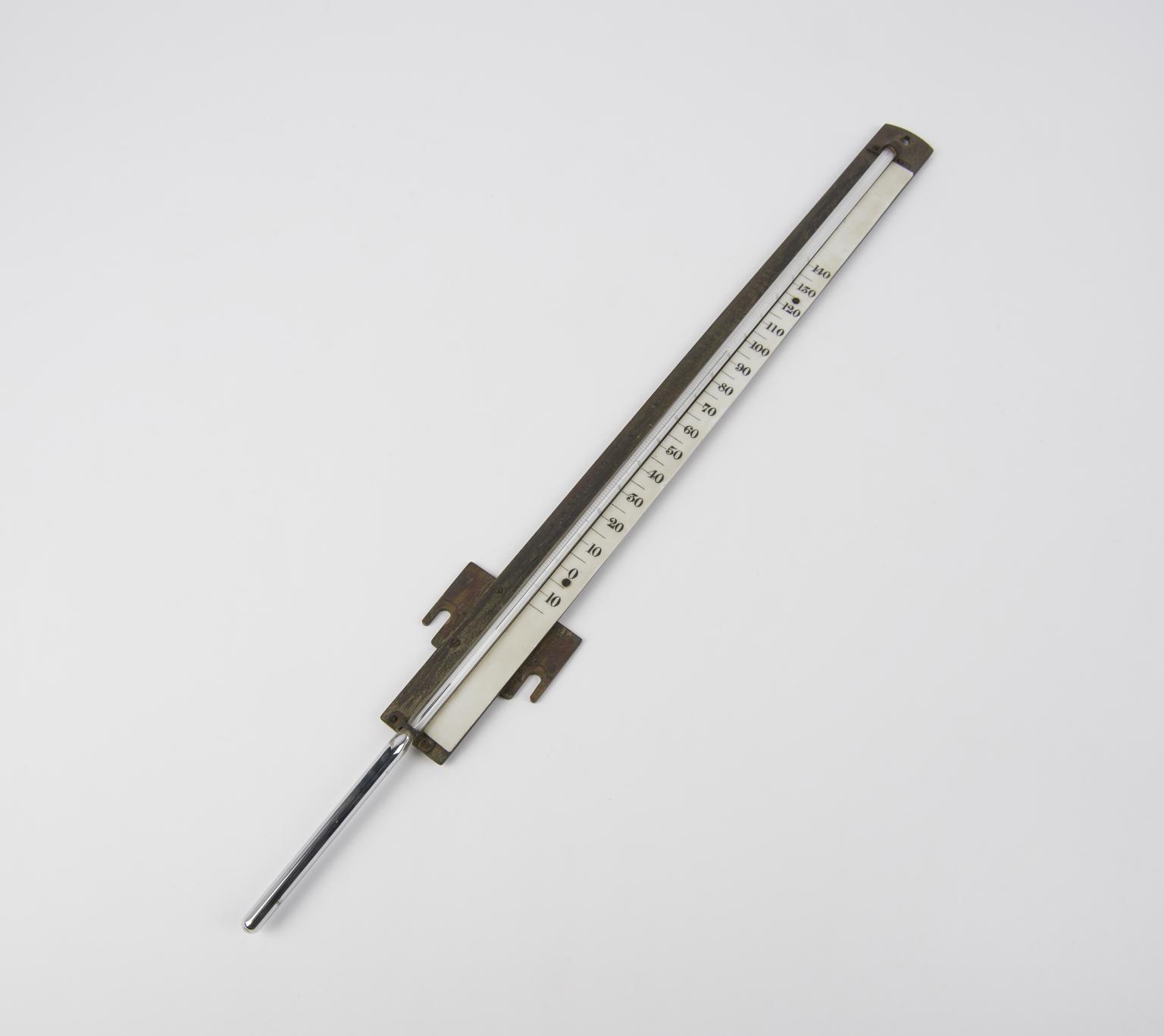
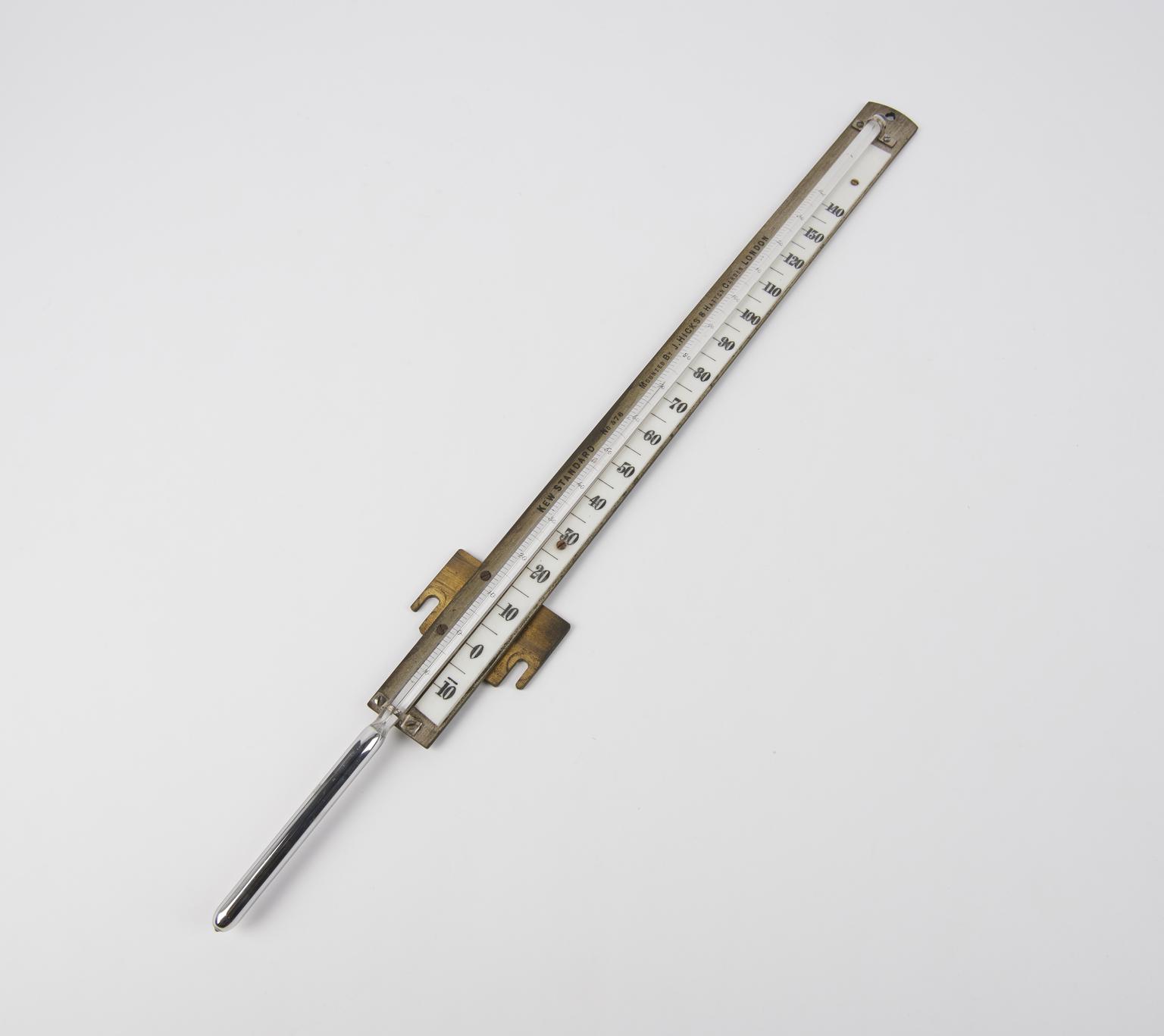
Standard Kew pattern mercury in glass thermometer, -10 to 140 degrees Fahrenheit, with mount and hooks, James Hicks, Hatton Garden, London, UK.

More

The photothermograph was an instrument designed for meteorological observatories that enabled a continuous photographic record of external wet and dry bulb temperatures to be taken, providing readings of atmospheric temperature and humidity.

The thermometers had a modified design so that they had an additional mercury column above the main mercury stem, separated by a small air gap; the long bent stems meant this air gap was indoors. Light from the gas lamps was focussed on the thermometer stems in the region of the air gap by a system of lenses and mirrors. The light passing through the air gap was focussed on the photographically sensitive paper of the recording drum, with the wet bulb recording below the dry bulb. A shutter blocked the light for four minutes every two hours, leaving time marks on the record.

The thermometers themselves were installed in an external louvred enclosure, similar to a Stevenson screen, which protected them from direct sunlight, wind and rain. Standard wet and dry bulb thermometers were also installed in the enclosure, providing readings that could be compared with that of the photographic record.
Materials:
glass and mercury
Object Number:
1926-938 Pt5/1
type:
thermometers
Image ©
The Board of Trustees of the Science Museum
Part of:
1926-938 Pt5
Standard thermometer from photothermograph used at Radcliffe Observatory, Oxford

Standard thermometer from photothermograph used at Radcliffe Observatory, Oxford

Standard Kew pattern mercury in glass thermometer, -10 to 140 degrees Fahrenheit, with mount and hooks, James Hicks, Hatton Garden, London, UK. Part of photothermograph commissioned by the Meteorological Committee of the Royal Society, some design specifications attributed to Francis Ronalds, made in England, UK, 1867. Installed and operated at Radcliffe Observatory, Oxford.

More

The photothermograph was an instrument designed for meteorological observatories that enabled a continuous photographic record of external wet and dry bulb temperatures to be taken, providing readings of atmospheric temperature and humidity.

The thermometers had a modified design so that they had an additional mercury column above the main mercury stem, separated by a small air gap; the long bent stems meant this air gap was indoors. Light from the gas lamps was focussed on the thermometer stems in the region of the air gap by a system of lenses and mirrors. The light passing through the air gap was focussed on the photographically sensitive paper of the recording drum, with the wet bulb recording below the dry bulb. A shutter blocked the light for four minutes every two hours, leaving time marks on the record.

The thermometers themselves were installed in an external louvred enclosure, similar to a Stevenson screen, which protected them from direct sunlight, wind and rain. Standard wet and dry bulb thermometers were also installed in the enclosure, providing readings that could be compared with that of the photographic record.
Materials:
glass and mercury
Object Number:
1926-938 Pt5/2
type:
thermometers
Image ©
The Board of Trustees of the Science Museum
Part of:
1926-938 Pt5
Bespoke thermometer from photothermograph used at Radcliffe Observatory, Oxford

Bespoke thermometer from photothermograph used at Radcliffe Observatory, Oxford

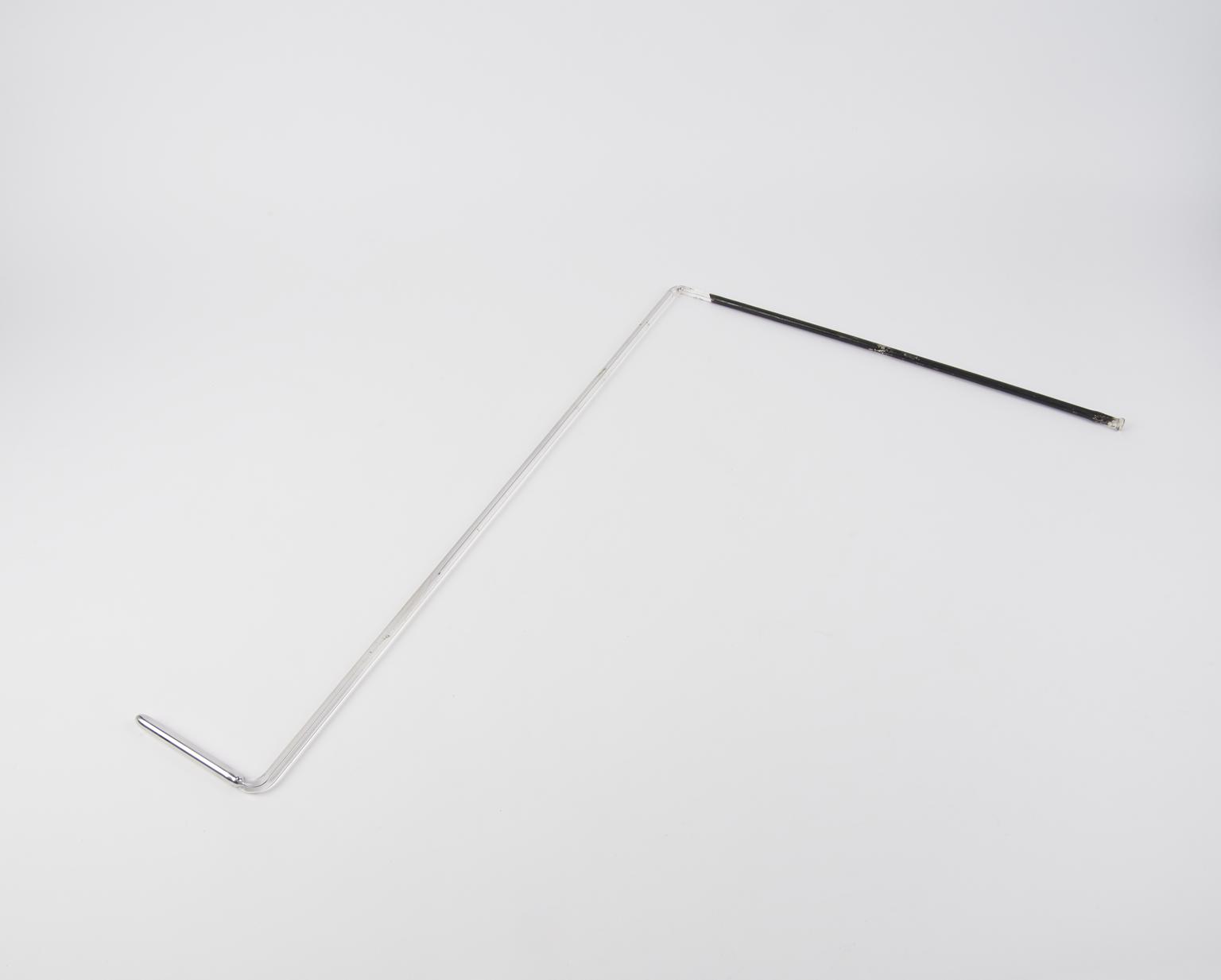
Modified mercury in glass thermometer with extended and bent stem. Part of photothermograph commissioned by the Meteorological Committee of the Royal Society, some design specifications attributed to Francis Ronalds, made in England, UK, 1867. Installed and operated at Radcliffe Observatory, Oxford.

More

The photothermograph was an instrument designed for meteorological observatories that enabled a continuous photographic record of external wet and dry bulb temperatures to be taken, providing readings of atmospheric temperature and humidity.

The thermometers had a modified design so that they had an additional mercury column above the main mercury stem, separated by a small air gap; the long bent stems meant this air gap was indoors. Light from the gas lamps was focussed on the thermometer stems in the region of the air gap by a system of lenses and mirrors. The light passing through the air gap was focussed on the photographically sensitive paper of the recording drum, with the wet bulb recording below the dry bulb. A shutter blocked the light for four minutes every two hours, leaving time marks on the record.

The thermometers themselves were installed in an external louvred enclosure, similar to a Stevenson screen, which protected them from direct sunlight, wind and rain. Standard wet and dry bulb thermometers were also installed in the enclosure, providing readings that could be compared with that of the photographic record.
Materials:
glass and mercury
Object Number:
1926-938 Pt5/3
type:
thermometers
Image ©
The Board of Trustees of the Science Museum
Part of:
1926-938 Pt5
Bespoke thermometer from photothermograph used at Radcliffe Observatory, Oxford

Bespoke thermometer from photothermograph used at Radcliffe Observatory, Oxford

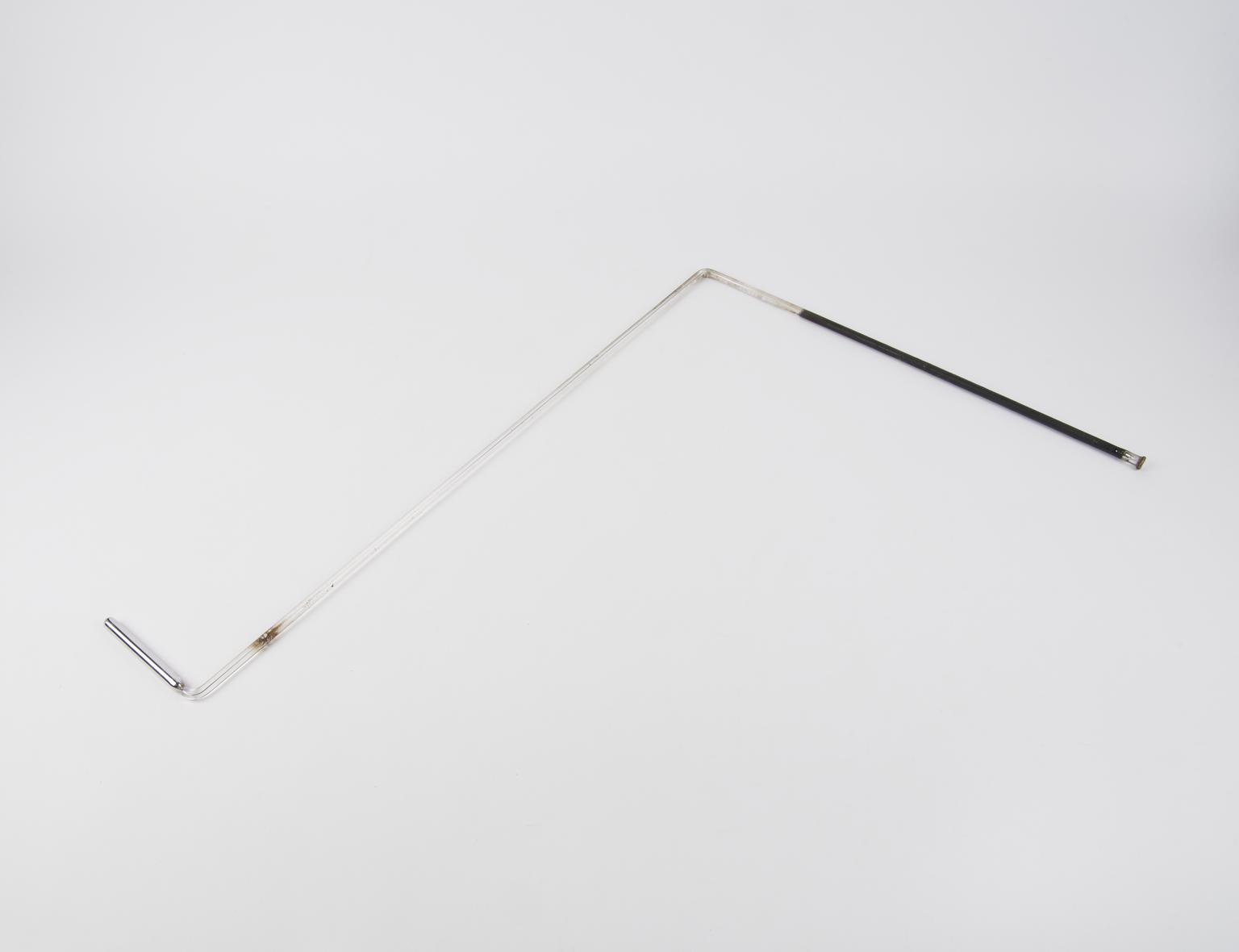
Modified mercury in glass thermometer with extended and bent stem. Part of photothermograph commissioned by the Meteorological Committee of the Royal Society, some design specifications attributed to Francis Ronalds, made in England, UK, 1867. Installed and operated at Radcliffe Observatory, Oxford.

More

The photothermograph was an instrument designed for meteorological observatories that enabled a continuous photographic record of external wet and dry bulb temperatures to be taken, providing readings of atmospheric temperature and humidity.

The thermometers had a modified design so that they had an additional mercury column above the main mercury stem, separated by a small air gap; the long bent stems meant this air gap was indoors. Light from the gas lamps was focussed on the thermometer stems in the region of the air gap by a system of lenses and mirrors. The light passing through the air gap was focussed on the photographically sensitive paper of the recording drum, with the wet bulb recording below the dry bulb. A shutter blocked the light for four minutes every two hours, leaving time marks on the record.

The thermometers themselves were installed in an external louvred enclosure, similar to a Stevenson screen, which protected them from direct sunlight, wind and rain. Standard wet and dry bulb thermometers were also installed in the enclosure, providing readings that could be compared with that of the photographic record.
Materials:
glass and mercury
Object Number:
1926-938 Pt5/4
type:
thermometers
Image ©
The Board of Trustees of the Science Museum
Part of:
1926-938 Pt5
Wooden cover for photographic components of photothermograph used at Radcliffe Observatory, Oxford

Wooden cover for photographic components of photothermograph used at Radcliffe Observatory, Oxford

Wooden cover for photographic components of photothermograph, marked 29/23/2. Part of photothermograph commissioned by the Meteorological Committee of the Royal Society, some design specifications attributed to Francis Ronalds, made in England, UK, 1867. Installed and operated at Radcliffe Observatory, Oxford.

More

The photothermograph was an instrument designed for meteorological observatories that enabled a continuous photographic record of external wet and dry bulb temperatures to be taken, providing readings of atmospheric temperature and humidity.

The thermometers had a modified design so that they had an additional mercury column above the main mercury stem, separated by a small air gap; the long bent stems meant this air gap was indoors. Light from the gas lamps was focussed on the thermometer stems in the region of the air gap by a system of lenses and mirrors. The light passing through the air gap was focussed on the photographically sensitive paper of the recording drum, with the wet bulb recording below the dry bulb. A shutter blocked the light for four minutes every two hours, leaving time marks on the record.

The thermometers themselves were installed in an external louvred enclosure, similar to a Stevenson screen, which protected them from direct sunlight, wind and rain. Standard wet and dry bulb thermometers were also installed in the enclosure, providing readings that could be compared with that of the photographic record.
Materials:
mahogany (wood)
Object Number:
1926-938/6
type:
box
Image ©
The Board of Trustees of the Science Museum
Fragment of wooden cover from photothermograph used at Radcliffe Observatory, Oxford

Fragment of wooden cover from photothermograph used at Radcliffe Observatory, Oxford

Fragment of wooden cover from photothermograph commissioned by the Meteorological Committee of the Royal Society, some design specifications attributed to Francis Ronalds, made in England, UK, 1867. Installed and operated at Radcliffe Observatory, Oxford.

More

The photothermograph was an instrument designed for meteorological observatories that enabled a continuous photographic record of external wet and dry bulb temperatures to be taken, providing readings of atmospheric temperature and humidity.

The thermometers had a modified design so that they had an additional mercury column above the main mercury stem, separated by a small air gap; the long bent stems meant this air gap was indoors. Light from the gas lamps was focussed on the thermometer stems in the region of the air gap by a system of lenses and mirrors. The light passing through the air gap was focussed on the photographically sensitive paper of the recording drum, with the wet bulb recording below the dry bulb. A shutter blocked the light for four minutes every two hours, leaving time marks on the record.

The thermometers themselves were installed in an external louvred enclosure, similar to a Stevenson screen, which protected them from direct sunlight, wind and rain. Standard wet and dry bulb thermometers were also installed in the enclosure, providing readings that could be compared with that of the photographic record.

Materials:
mahogany
Object Number:
1926-938/7
type:
wood
Image ©
The Board of Trustees of the Science Museum
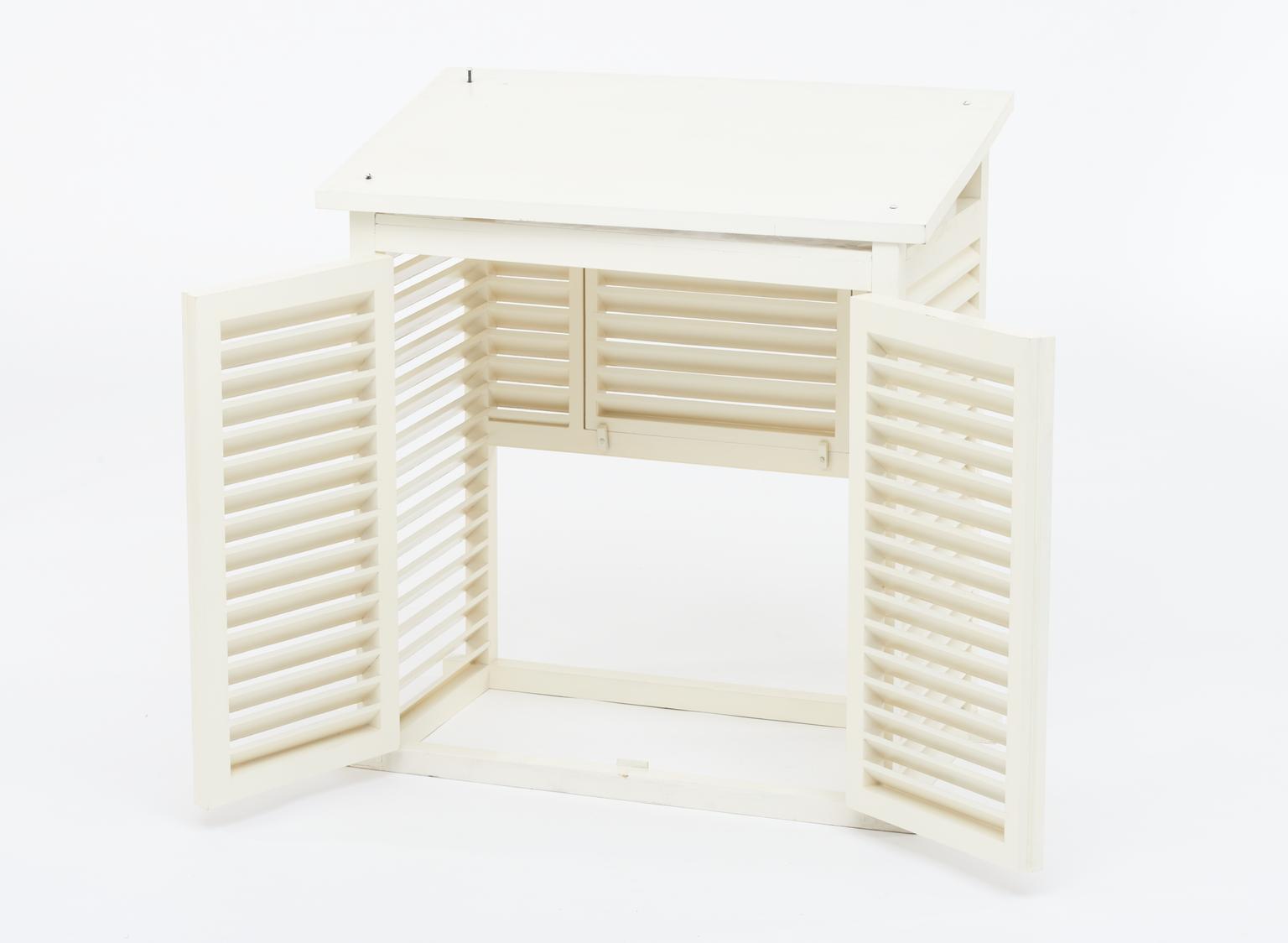
Cabinet for the Cabinet for the Radcliffe Observatory Photothermograph

Cabinet for the Cabinet for the Radcliffe Observatory Photothermograph

Cabinet for the Radcliffe Observatory Photothermograph, louvre or Stevenson screen design.

More

The photothermograph was an instrument designed for meteorological observatories that enabled a continuous photographic record of external wet and dry bulb temperatures to be taken, providing readings of atmospheric temperature and humidity.

The thermometers had a modified design so that they had an additional mercury column above the main mercury stem, separated by a small air gap; the long bent stems meant this air gap was indoors. Light from the gas lamps was focussed on the thermometer stems in the region of the air gap by a system of lenses and mirrors. The light passing through the air gap was focussed on the photographically sensitive paper of the recording drum, with the wet bulb recording below the dry bulb. A shutter blocked the light for four minutes every two hours, leaving time marks on the record.

The thermometers themselves were installed in an external louvred enclosure, similar to a Stevenson screen, which protected them from direct sunlight, wind and rain. Standard wet and dry bulb thermometers were also installed in the enclosure, providing readings that could be compared with that of the photographic record.

Measurements:
overall: 800 mm x 730 mm x 450 mm,
Materials:
wood (unidentified)
Object Number:
1926-938 Pt9
type:
cabinet
Image ©
The Board of Trustees of the Science Museum
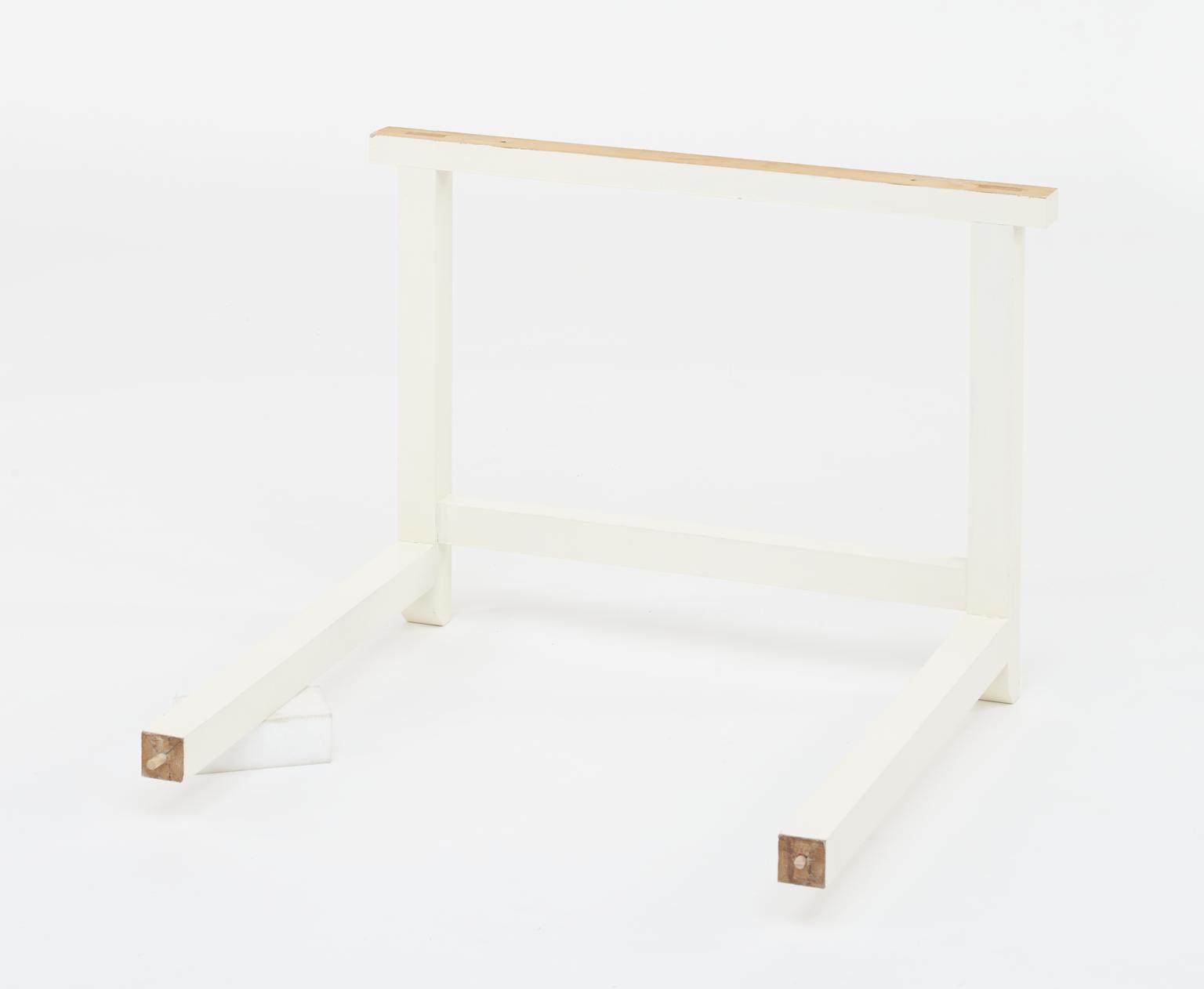
Support Frame for the Radcliffe Observatory Photothermograph Cabinet.

Support Frame for the Radcliffe Observatory Photothermograph Cabinet.

Support frame for the Radcliffe Observatory Photothermograph cabinet.

More

The photothermograph was an instrument designed for meteorological observatories that enabled a continuous photographic record of external wet and dry bulb temperatures to be taken, providing readings of atmospheric temperature and humidity.

The thermometers had a modified design so that they had an additional mercury column above the main mercury stem, separated by a small air gap; the long bent stems meant this air gap was indoors. Light from the gas lamps was focussed on the thermometer stems in the region of the air gap by a system of lenses and mirrors. The light passing through the air gap was focussed on the photographically sensitive paper of the recording drum, with the wet bulb recording below the dry bulb. A shutter blocked the light for four minutes every two hours, leaving time marks on the record.

The thermometers themselves were installed in an external louvred enclosure, similar to a Stevenson screen, which protected them from direct sunlight, wind and rain. Standard wet and dry bulb thermometers were also installed in the enclosure, providing readings that could be compared with that of the photographic record.

Measurements:
overall: 540 mm x 740 mm x 660 mm,
Materials:
wood (unidentified)
Object Number:
1926-938 Pt10
type:
frame
Image ©
The Board of Trustees of the Science Museum
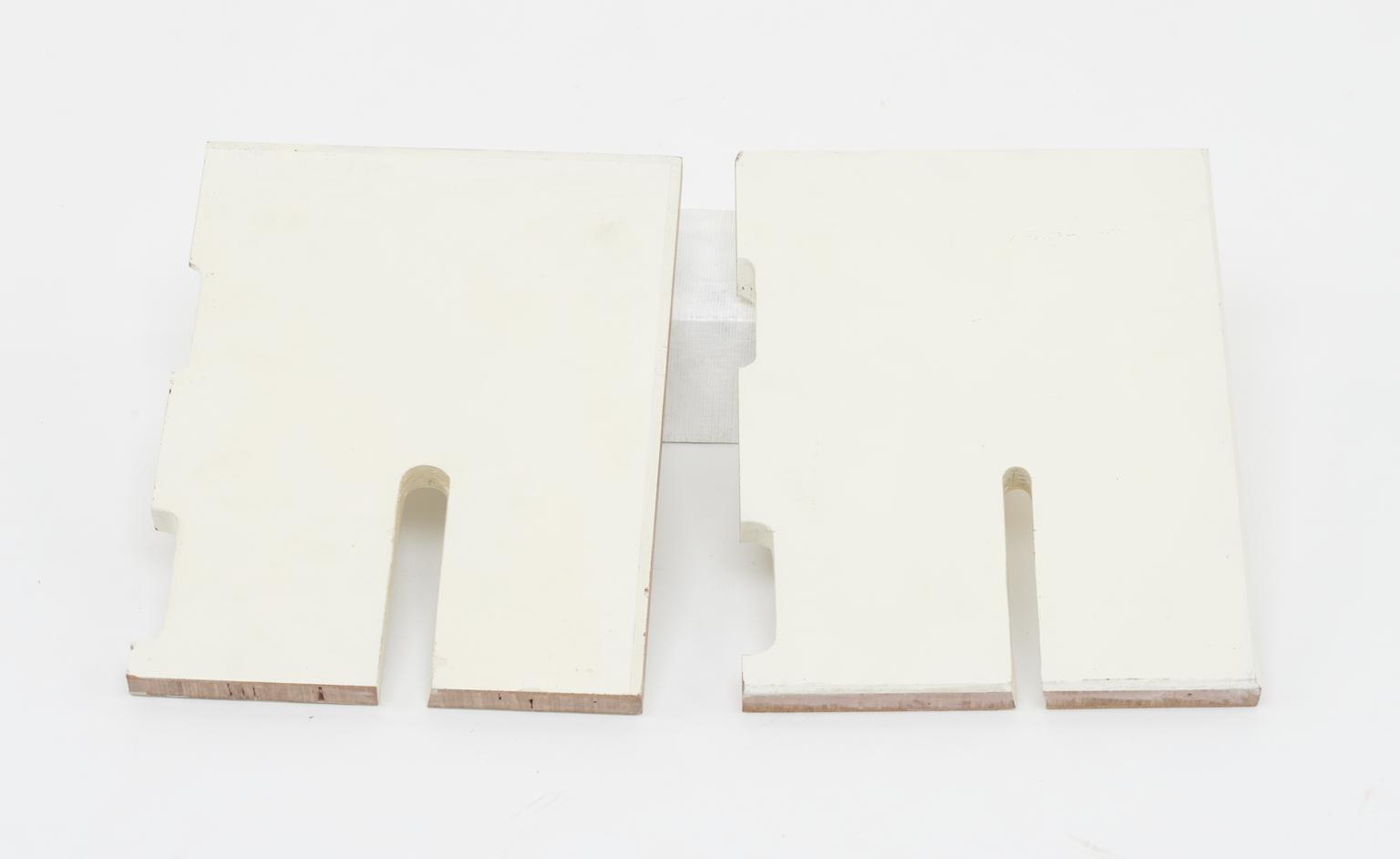
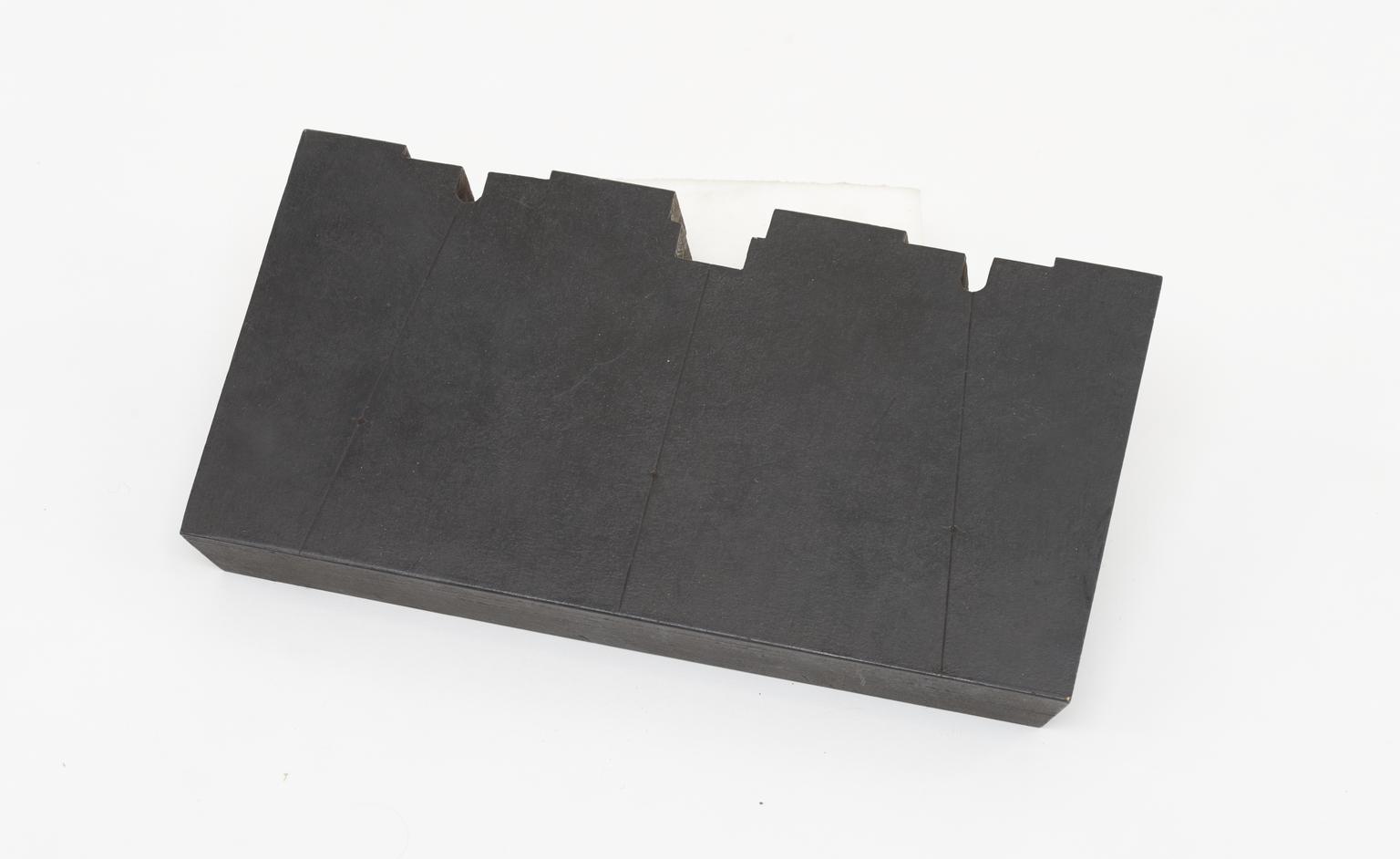
Pair of White Wooden Plates with Rounded Notches

Pair of White Wooden Plates with Rounded Notches

Pair of white wooden plates with rounded notches, possibly to support components behind the Radcliffe Observatory Photothermograph’s thermometers.

More

The photothermograph was an instrument designed for meteorological observatories that enabled a continuous photographic record of external wet and dry bulb temperatures to be taken, providing readings of atmospheric temperature and humidity.

The thermometers had a modified design so that they had an additional mercury column above the main mercury stem, separated by a small air gap; the long bent stems meant this air gap was indoors. Light from the gas lamps was focussed on the thermometer stems in the region of the air gap by a system of lenses and mirrors. The light passing through the air gap was focussed on the photographically sensitive paper of the recording drum, with the wet bulb recording below the dry bulb. A shutter blocked the light for four minutes every two hours, leaving time marks on the record.

The thermometers themselves were installed in an external louvred enclosure, similar to a Stevenson screen, which protected them from direct sunlight, wind and rain. Standard wet and dry bulb thermometers were also installed in the enclosure, providing readings that could be compared with that of the photographic record.
Measurements:
overall: 40 mm x 240 mm x 323 mm,
Materials:
wood (unidentified)
Object Number:
1926-938 Pt11
type:
frame
Image ©
The Board of Trustees of the Science Museum
Reproduction wooden bedplate for Radcliffe Observatory Photothermograph

Reproduction wooden bedplate for Radcliffe Observatory Photothermograph

Reproduction wooden bedplate for Radcliffe Observatory Photothermograph, made to replace original slate bedplate which was damaged before 1961.

More

The photothermograph was an instrument designed for meteorological observatories that enabled a continuous photographic record of external wet and dry bulb temperatures to be taken, providing readings of atmospheric temperature and humidity.

The thermometers had a modified design so that they had an additional mercury column above the main mercury stem, separated by a small air gap; the long bent stems meant this air gap was indoors. Light from the gas lamps was focussed on the thermometer stems in the region of the air gap by a system of lenses and mirrors. The light passing through the air gap was focussed on the photographically sensitive paper of the recording drum, with the wet bulb recording below the dry bulb. A shutter blocked the light for four minutes every two hours, leaving time marks on the record.

The thermometers themselves were installed in an external louvred enclosure, similar to a Stevenson screen, which protected them from direct sunlight, wind and rain. Standard wet and dry bulb thermometers were also installed in the enclosure, providing readings that could be compared with that of the photographic record.

Measurements:
overall: 1230 mm x 1220 mm x 40 mm,
Materials:
wood (unidentified)
Object Number:
1926-938 Pt12
type:
bedplate
Image ©
The Board of Trustees of the Science Museum
Black Wooden Support

Black Wooden Support

Black wooden support, probably for the 2 long thermometers in the Radcliffe Observatory Photothermograph.

More

The photothermograph was an instrument designed for meteorological observatories that enabled a continuous photographic record of external wet and dry bulb temperatures to be taken, providing readings of atmospheric temperature and humidity.

The thermometers had a modified design so that they had an additional mercury column above the main mercury stem, separated by a small air gap; the long bent stems meant this air gap was indoors. Light from the gas lamps was focussed on the thermometer stems in the region of the air gap by a system of lenses and mirrors. The light passing through the air gap was focussed on the photographically sensitive paper of the recording drum, with the wet bulb recording below the dry bulb. A shutter blocked the light for four minutes every two hours, leaving time marks on the record.

The thermometers themselves were installed in an external louvred enclosure, similar to a Stevenson screen, which protected them from direct sunlight, wind and rain. Standard wet and dry bulb thermometers were also installed in the enclosure, providing readings that could be compared with that of the photographic record.

Measurements:
overall: 180 mm x 350 mm x 40 mm,
Materials:
wood (unidentified)
Object Number:
1926-938 Pt13
type:
support
Image ©
The Board of Trustees of the Science Museum
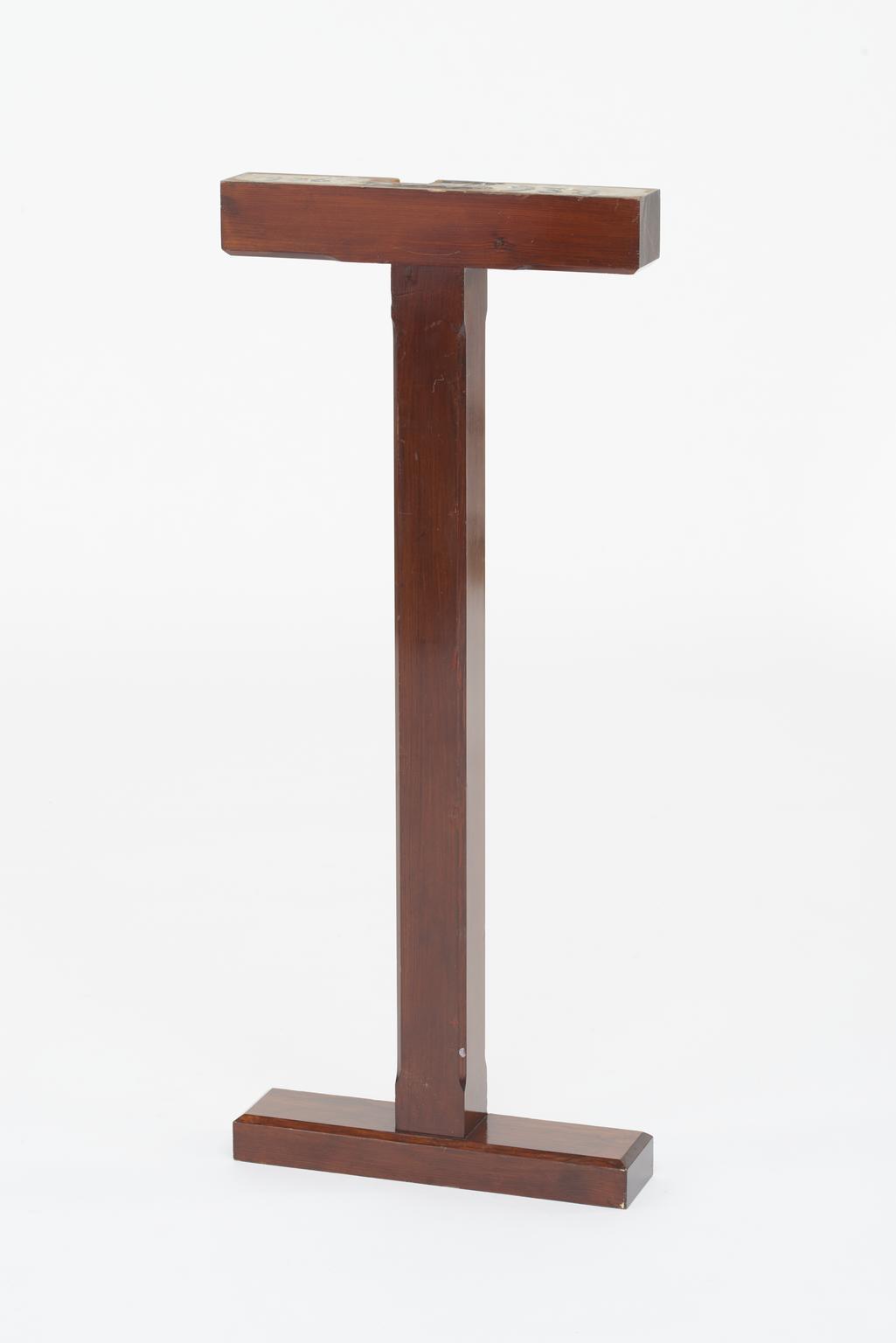
Wooden Mount for the Radcliffe Observatory Photothermograph

Wooden Mount for the Radcliffe Observatory Photothermograph

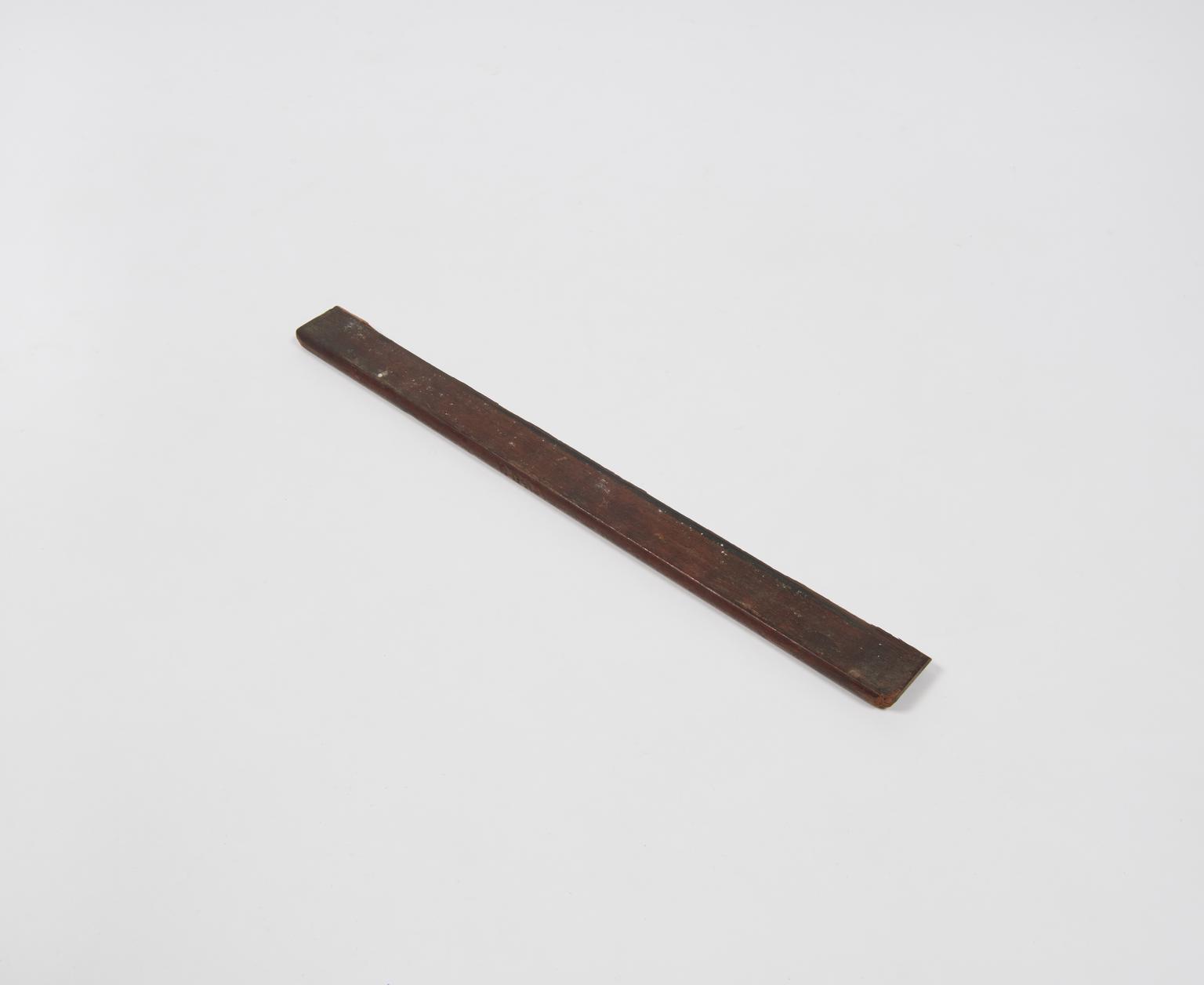
Wooden mount for the Radcliffe Observatory Photothermograph, “I” shaped, unpainted.

More

The photothermograph was an instrument designed for meteorological observatories that enabled a continuous photographic record of external wet and dry bulb temperatures to be taken, providing readings of atmospheric temperature and humidity.

The thermometers had a modified design so that they had an additional mercury column above the main mercury stem, separated by a small air gap; the long bent stems meant this air gap was indoors. Light from the gas lamps was focussed on the thermometer stems in the region of the air gap by a system of lenses and mirrors. The light passing through the air gap was focussed on the photographically sensitive paper of the recording drum, with the wet bulb recording below the dry bulb. A shutter blocked the light for four minutes every two hours, leaving time marks on the record.

The thermometers themselves were installed in an external louvred enclosure, similar to a Stevenson screen, which protected them from direct sunlight, wind and rain. Standard wet and dry bulb thermometers were also installed in the enclosure, providing readings that could be compared with that of the photographic record.

Measurements:
overall: 100 mm x 1030 mm x 430 mm,
Materials:
wood (unidentified)
Object Number:
1926-938 Pt14
type:
support
Image ©
The Board of Trustees of the Science Museum
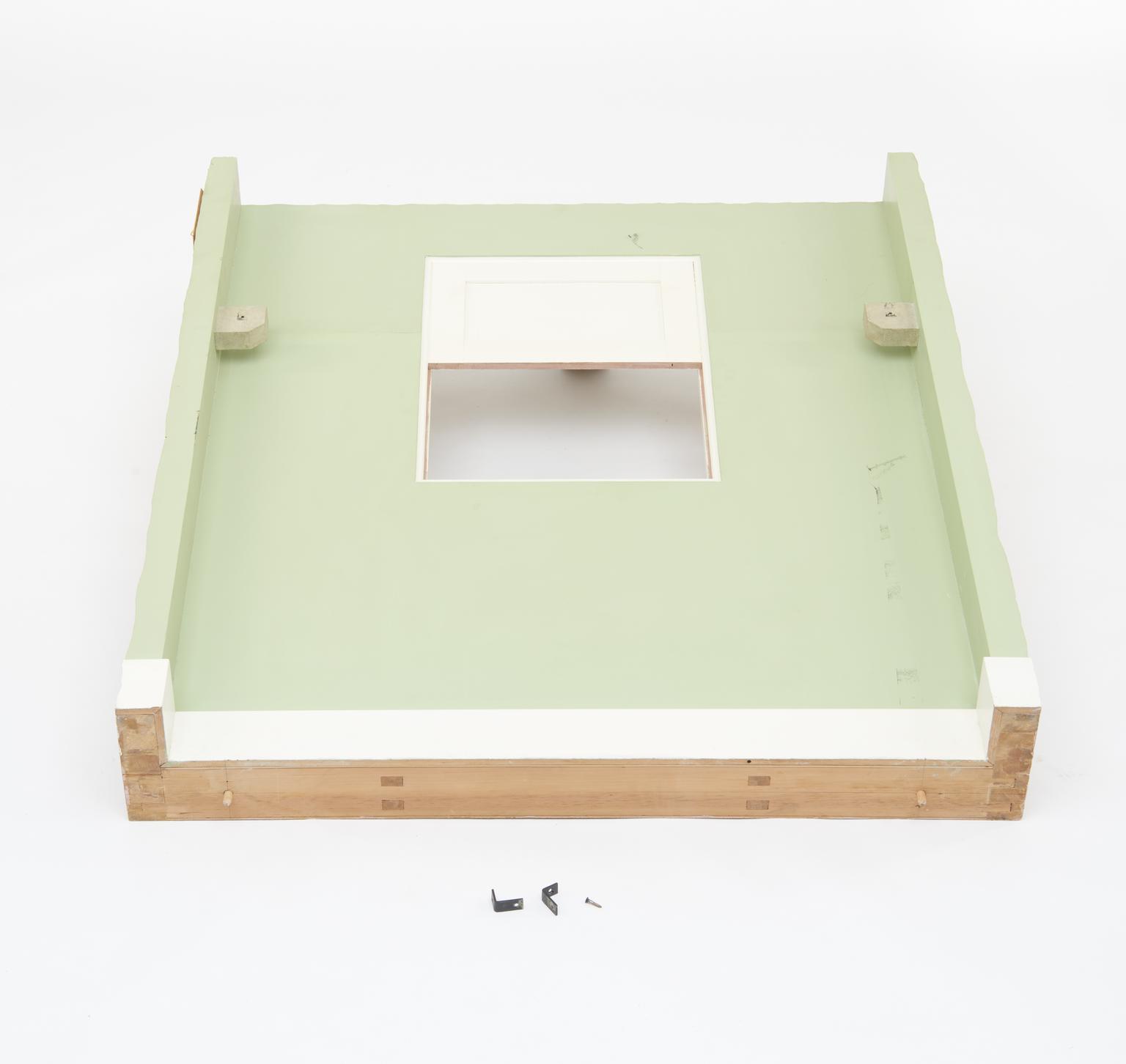
Display Panel for the Radcliffe Observatory Photothermograph

Display Panel for the Radcliffe Observatory Photothermograph

Display panel with white hatch and painted brickwork, probably used to display the Radcliffe Observatory Photothermograph on gallery.

More

The photothermograph was an instrument designed for meteorological observatories that enabled a continuous photographic record of external wet and dry bulb temperatures to be taken, providing readings of atmospheric temperature and humidity.

The thermometers had a modified design so that they had an additional mercury column above the main mercury stem, separated by a small air gap; the long bent stems meant this air gap was indoors. Light from the gas lamps was focussed on the thermometer stems in the region of the air gap by a system of lenses and mirrors. The light passing through the air gap was focussed on the photographically sensitive paper of the recording drum, with the wet bulb recording below the dry bulb. A shutter blocked the light for four minutes every two hours, leaving time marks on the record.

The thermometers themselves were installed in an external louvred enclosure, similar to a Stevenson screen, which protected them from direct sunlight, wind and rain. Standard wet and dry bulb thermometers were also installed in the enclosure, providing readings that could be compared with that of the photographic record.

Measurements:
overall: 1370 mm x 1480 mm x 235 mm,
Materials:
wood (unidentified)
Object Number:
1926-938 Pt15
type:
panel
Image ©
The Board of Trustees of the Science Museum
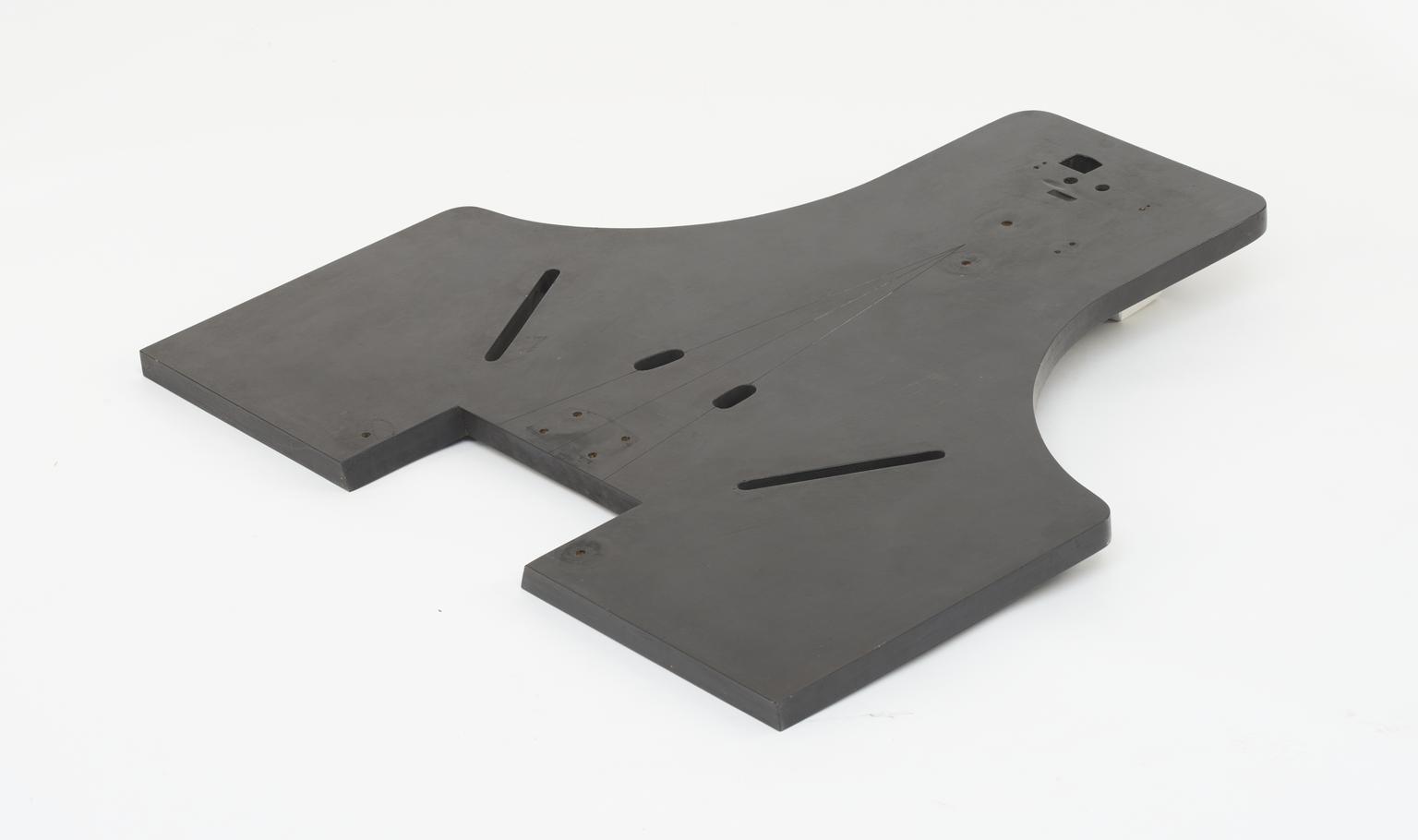
Original Bedplate for the Radcliffe Observatory Photothermograph

Original Bedplate for the Radcliffe Observatory Photothermograph

Original slate bed plate for the Radcliffe Observatory Photothermograph.

More

The photothermograph was an instrument designed for meteorological observatories that enabled a continuous photographic record of external wet and dry bulb temperatures to be taken, providing readings of atmospheric temperature and humidity.

The thermometers had a modified design so that they had an additional mercury column above the main mercury stem, separated by a small air gap; the long bent stems meant this air gap was indoors. Light from the gas lamps was focussed on the thermometer stems in the region of the air gap by a system of lenses and mirrors. The light passing through the air gap was focussed on the photographically sensitive paper of the recording drum, with the wet bulb recording below the dry bulb. A shutter blocked the light for four minutes every two hours, leaving time marks on the record.

The thermometers themselves were installed in an external louvred enclosure, similar to a Stevenson screen, which protected them from direct sunlight, wind and rain. Standard wet and dry bulb thermometers were also installed in the enclosure, providing readings that could be compared with that of the photographic record.

Materials:
stone
Object Number:
1926-938 Pt16
type:
panel