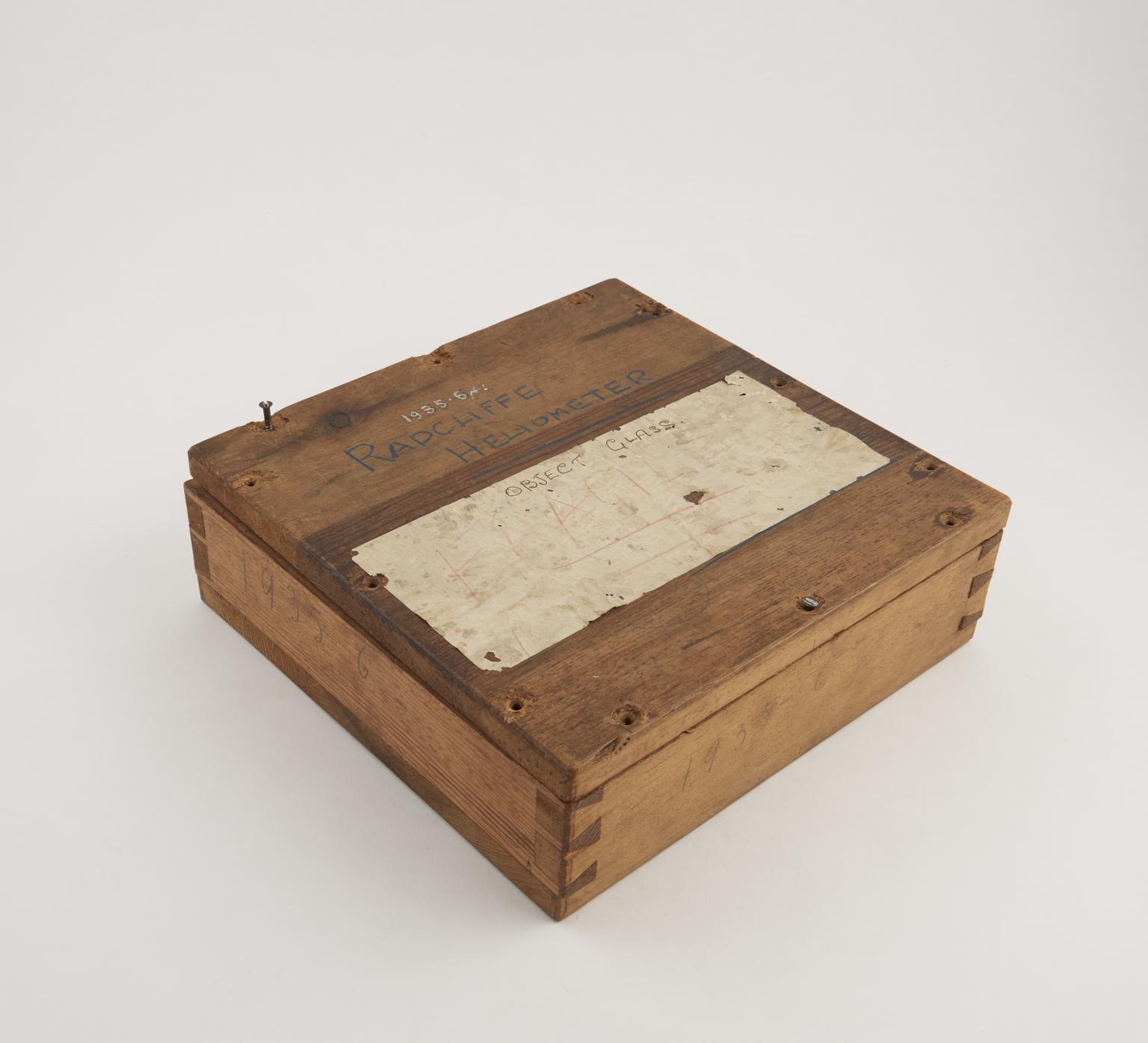
Heliometer built by A. & G. Repsold of Hamburg with a 7 1/2 inch object lens by Merz of Munich. Ordered in 1840 and delivered to the Radcliffe Observatory, Oxford, in 1848 where it was used for stellar parallax observations. Includes observer's desk, chair and stool.
Completed in 1848, this heliometer was made by A & G Repsold, Hamburg and installed in the Radcliffe Observatory at Oxford. It was the first and only large example of this sort of instrument to be used in England. The heliometer is a split-lens micrometer originally developed for accurately measuring the angular diameter of the Sun. The instrument was later adapted to make precise measurement of star positions. It was used to detect the tiny shifts in nearby stars due to parallax as the Earth orbits the Sun. In 1838, the German astronomer Friedrich Bessel was able to make the first accurate parallax measurements and hence calculate the distance to the nearby star of 61 Cygni.

 This image is released under a