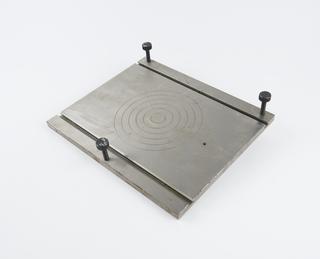
Straight line dividing engine, Ramsden type
 This image is released under a CC BY-NC-SA 4.0
Licence
This image is released under a CC BY-NC-SA 4.0
Licence
License this image for commercial use at Science and Society Picture Library
License
Science Museum Group
© The Board of Trustees of the Science Museum
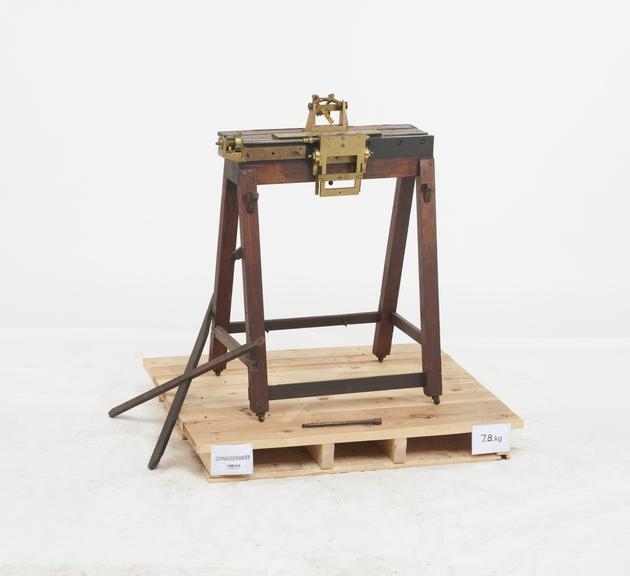
Straight line dividing engine, Ramsden type
Dividing engines partially mechanised the process of finely and accurately dividing scales for small instruments, helping to meet growing demand from navigators. A sextant or octant was fixed to the top of the engine, and angular divisions were marked on it using the engine’s precision screw and a ratchet to rotate the instrument by very small and precisely-measured amounts. Instrument-maker Jesse Ramsden constructed the first such engine in London in 1767, later reluctantly sharing its design with other makers at the request of the government’s Board of Longitude. This engine is for straight rather than angular scales. It is to the design originally developed by Ramsden, but has a cast-iron bed.
Details
- Category:
- Industrial Metrology
- Object Number:
- 1930-368
- Measurements:
-
overall: 1130 mm x 840 mm x 580 mm,
- type:
- linear dividing engine
- credit:
- Parsons, W V
Related Objects
M.S. Letter from John Barton to Matthew Boulton
Verni Jigger Variable Drilling Jig with Vernier Setting Scales in Wooden Case
2 Single-Start Screws and a 2-Start screw
Conical Centre Fitted to a Bar
