


 This image is released under a CC BY-NC-SA 4.0
Licence
This image is released under a CC BY-NC-SA 4.0
Licence
License this image for commercial use at Science and Society Picture Library
LicenseThis image is released under a CC BY-NC-SA 4.0
Licence
License this image for commercial use at Science and Society Picture Library
LicenseThis image is released under a CC BY-NC-SA 4.0
Licence
License this image for commercial use at Science and Society Picture Library
LicenseThis image is released under a CC BY-NC-SA 4.0
Licence
License this image for commercial use at Science and Society Picture Library
LicenseThis image is released under a CC BY-NC-SA 4.0
Licence
License this image for commercial use at Science and Society Picture Library
License
Science Museum Group
© The Board of Trustees of the Science Museum
Science Museum Group
© The Board of Trustees of the Science Museum
Science Museum Group
© The Board of Trustees of the Science Museum
Science Museum Group
© The Board of Trustees of the Science Museum
Science Museum Group Collection
© The Board of Trustees of the Science Museum, London
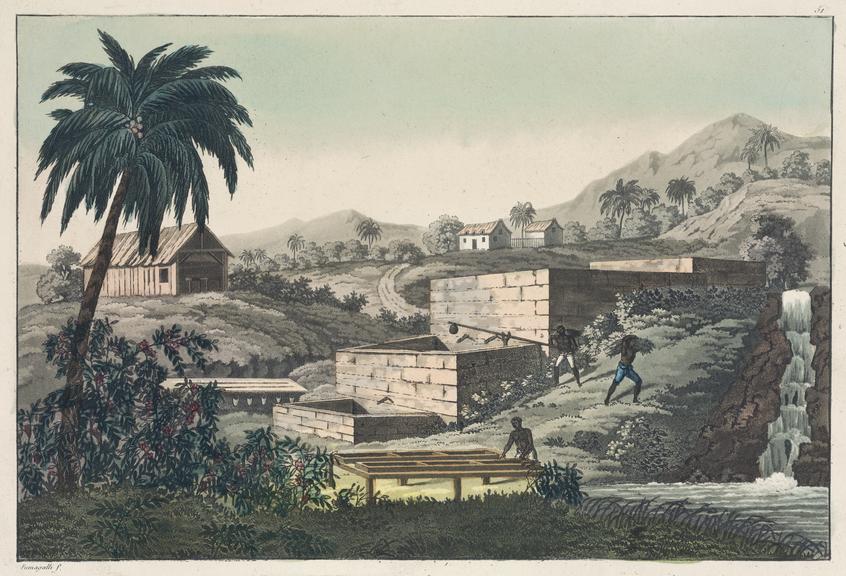
Making indigo print (aquatint) by Fumagalli, c.1801-1900
This aquatint was created by the Italian artist and engraver Paolo Fumagalli for Giulio Ferrario's encyclopaedia Il Costume Antico e Moderno (The Old and Modern Costumes), published between 1817 and 1834. The encyclopaedia was a survey of the peoples, customs, flora and fauna of the world, compiled from travel accounts, geographical descriptions, historical sources and earlier illustrations. Included in Volume IV, devoted to Asia, the print presents an idealised representation of indigo production in India rather than a direct record of a specific plantation.
Indigo had been cultivated in India since ancient times, and the blue dye extracted from Indigofera tinctoria, a plant native to the Indian subcontinent, became one of the world's most important commercial dyes. During the late eighteenth and early nineteenth centuries, the British East India Company controlled the colonial indigo industry, particularly in Bengal. European planters relied on coercive systems of cultivation that forced many farmers to grow indigo instead of food crops such as rice. The print depicts labourers working in an indigo plantation and can be understood within this broader history of colonial exploitation, although the workers' legal status (for example enslaved or indentured) cannot be determined.
Natural indigo remained one of India's most valuable export commodities throughout the nineteenth century before declining following the commercial production of synthetic indigo in the late nineteenth and early twentieth centuries.