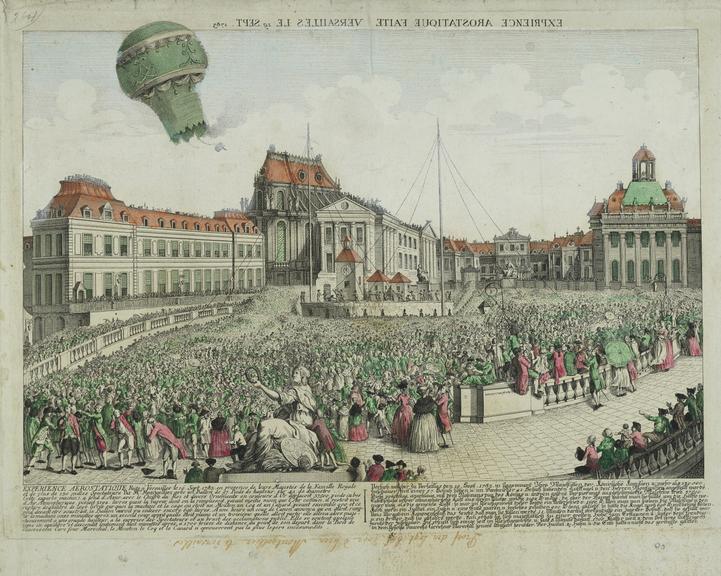
Coloured vue d'optique print showing the ascent of a Montgolfière balloon at Versailles, 19 September 1783
- Made:
- 1783
 This image is released under a CC BY-NC-SA 4.0
Licence
This image is released under a CC BY-NC-SA 4.0
Licence
License this image for commercial use at Science and Society Picture Library
License
Science Museum Group
© The Board of Trustees of the Science Museum
Landscape-oriented vue d'optique or perspective print showing the ascent of a Montgolfière balloon. Hand-coloured etching on paper by an unidentified artist, publication details unknown. Titled in French, printed in reverse above the image and reading 'EXP[É]RIENCE A[Ë]ROSTATIQUE FAITE [À] VERSAILLES LE 19. SEPT. 1783.' ('Aerostatic experiment performed at Versailles on 19 Sept. 1783'). The print shows a huge crowd of men, women, and children gathered in the courtyard outside the Palace of Versailles, whose buildings form the backdrop to the scene. In the middle of the throng stands a raised gantry from which the hot air balloon has just taken flight, a small cage trailing beneath it. Watercolour wash is used to pick out various features: pink, green, and black are used for members of the crowd, reddish brown for the palace rooftops, pale blue for the upper sky, and green for some of the palace windows, a rooftop canopy, and the balloon itself. Two paragraphs of text are printed below the image describing the event and technical information about the balloon, in French on the left and German on the right.
This lively print shows a milestone moment: the world's first ever hot air balloon flight with living passengers. Carrying a sheep, a rooster, and a duck, the balloon was launched from the Palace of Versailles on 19 September 1783. The extraordinary event was witnessed by King Louis XVI, Queen Marie-Antoinette, and – according to this print’s inscription – a crowd of more than 130,000 people. Some spectators can even be seen on the palace rooftops. In a playful touch, the print's composition depicts the balloon as if beginning to break free from the picture plane, enhancing its sense of dynamic movement.
Hot air balloons such as this became known as ‘Montgolfières’ after their inventors, the brothers Jacques-Etienne and Joseph-Michel Montgolfier, who were paper manufacturers from southern France. They had performed their first demonstration only a few months earlier, launching a paper balloon from their hometown of Annonay on 4 June 1783.
The flight which followed at Versailles, overseen by Jacques-Etienne, was a masterstroke of propaganda. The backdrop of the palace firmly claimed the invention as French and associated it with the monarchy. To emphasise the point, the balloon itself was decorated with the French royal colours of blue and gold and with the king’s cipher of intertwined letter L’s. Although the balloon is inaccurately coloured green in this print, the detail of the cipher is clearly visible.
The Versailles flight was both spectacle and experiment: the three animal passengers were suspended in a wicker cage to demonstrate the balloon’s safety. Airborne for about 8 minutes, they travelled some 3km northeast before eventually landing safely in the Bois de Vaucresson, Carrefour Maréchal. The flight’s success earned Jacques-Etienne financial support from the king. And just two months later, on 21 November 1783, the marquis François Laurent d’Arlandes and the physician Jean-François Pilâtre de Rozier became the first humans to ever take to the skies in a free-flying balloon, which launched from Château de la Muette near Paris.
The Science Museum Group’s collections hold a rich variety of material from the ‘balloonomania’ craze inspired by such early ascents, which included balloon-themed textiles, jewellery, furniture, tableware, snuffboxes, fans, and prints. This particular print is of a popular type from the later 18th century known as a vue d'optique or perspective print. These prints were designed to be viewed through zograscopes, optical devices whose magnifying lenses created a sense of depth and immersion for the viewer.