

 This image is released under a CC BY-NC-SA 4.0
Licence
This image is released under a CC BY-NC-SA 4.0
Licence
License this image for commercial use at Science and Society Picture Library
LicenseThis image is released under a CC BY-NC-SA 4.0
Licence
License this image for commercial use at Science and Society Picture Library
LicenseThis image is released under a CC BY-NC-SA 4.0
Licence
License this image for commercial use at Science and Society Picture Library
LicenseThis image is released under a CC BY-NC-SA 4.0
Licence
License this image for commercial use at Science and Society Picture Library
LicenseThis image is released under a CC BY-NC-SA 4.0
Licence
License this image for commercial use at Science and Society Picture Library
License
Science Museum Group
© The Board of Trustees of the Science Museum
Science Museum Group
© The Board of Trustees of the Science Museum
Science Museum Group
© The Board of Trustees of the Science Museum
Science Museum Group
© The Board of Trustees of the Science Museum
Science Museum Group
© The Board of Trustees of the Science Museum
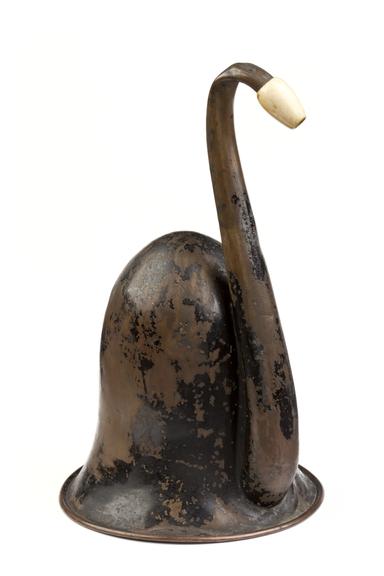
Brass swan-shaped ear trumpet hearing aid, with ivory earpiece, similar in style to the 'London dome' design, made by F.C. Rein, London, 1801-1900.
Ear trumpets or hearing trumpets came in many designs but fundamentally they usually consisted of a conical or bell shaped structures connected to an earpiece via a funnel. They were intended to help people experiencing hearing loss hear a little better. The ear trumpet worked by ‘gathering’ sound and channelling it directly towards the ear canal. Such devices were designed to be portable and could be carried around and used when needed.
The style of this trumpet is similar to what was known as a ‘London Dome’ design, which is said to be so-called due to its similarity to the shape of the dome of St. Paul’s Cathedral. It was a smaller, more compact variation from traditional trumpets, which tended to have longer funnels. These designs were also popularly known as a swan trumpet due to the shape of its ‘neck’, which resembles that of a swan.
It was made by the company founded by Frederic C Rein in 1800, one of the very earliest firms known to manufacture hearing aids on a commercial basis. Originally based at 108 Strand, London they made a range of other hearing aids alongside hearing trumpets, such as speaking tubes and acoustic urns - devices which could be placed at the centre of a table to collect sounds from around the room which would be funnelled down a long tube towards the listener. The company remained in business until 1963.
Details
- Category:
- Audiology
- Collection:
- Sir Henry Wellcome's Museum Collection
- Object Number:
- A602544
- Materials:
- brass (copper, zinc alloy) and ivory
- Measurements:
-
overall: 210 mm x 123 mm .24 kg
- type:
- hearing aids