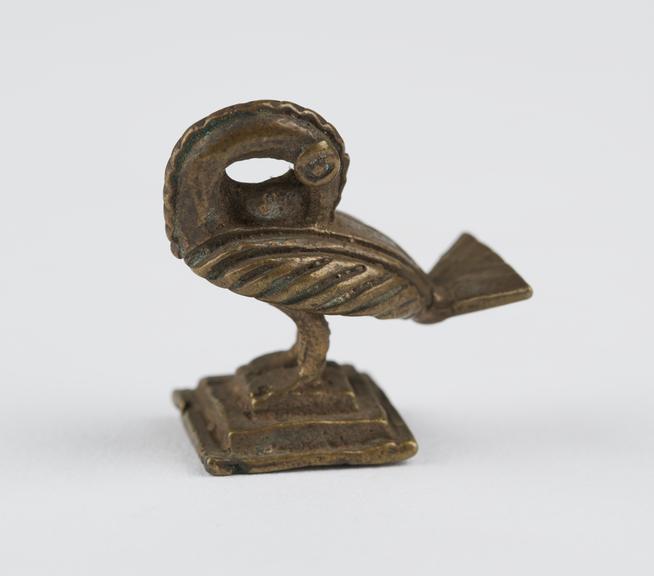
Asante (Ashanti) weight in the form of a Sankofa bird
- PART OF:
- Eighty-four Asante
- Made:
- 1400-1940 in West Africa


 This image is released under a CC BY-NC-SA 4.0
Licence
This image is released under a CC BY-NC-SA 4.0
Licence
License this image for commercial use at Science and Society Picture Library
LicenseThis image is released under a CC BY-NC-SA 4.0
Licence
License this image for commercial use at Science and Society Picture Library
LicenseThis image is released under a CC BY-NC-SA 4.0
Licence
License this image for commercial use at Science and Society Picture Library
LicenseThis image is released under a CC BY-NC-SA 4.0
Licence
License this image for commercial use at Science and Society Picture Library
License
Science Museum Group
© The Board of Trustees of the Science Museum
Science Museum Group
© The Board of Trustees of the Science Museum
Science Museum Group
© The Board of Trustees of the Science Museum
Science Museum Group
© The Board of Trustees of the Science Museum
One of 84 Asante (Ashanti) brass weights for measuring gold in the form of a bird preening itself.
This is an Asante (Ashanti) weight in the form of a Sankofa bird used by the Asante people of West Africa to measure and trade commodities. Asante weights were produced in a wide variety of shapes, patterns, and sizes by skilled metalworkers. Each design could carry a particular meaning and provide an insight into the Akan people and their culture.
This one represents the Sankofa bird which was a symbol widely used by Akan people. It originated from a proverb that translates to ‘to go back and get it’. This expressed the importance of learning from the past to confidently move forward with life. Birds featured frequently in Asante weights and while the Sankofa bird has this specific association, birds could also represent the transcendence of boundaries, particularly between the earth and the sky.
The Asante were part of the wider Akan civilisation, which comprised several populations that shared a language and many cultural traditions. They were primarily located in what is now Ghana. The region became known as the ‘Gold Coast’ because of its long-established and lucrative gold trade, which connected Akan states with merchants from across West Africa and European traders with whom they eventually also exchanged enslaved people and firearms. Gold brought considerable wealth to the region contributing to the rise of powerful Akan states. From around 1700, the Asante consolidated their power and expanded to become one of the most powerful empires in West Africa until after a series of conflicts, the British annexed it as a colony in 1902.
Details
- Category:
- Weighing & Measuring
- Object Number:
- 1943-192/10
- Materials:
- brass (copper, zinc alloy)
- Measurements:
-
overall: 28 mm x 34 mm x 24 mm, .015 kg
- type:
- gold weight (ashanti)
- credit:
- Major W.R. Gosling