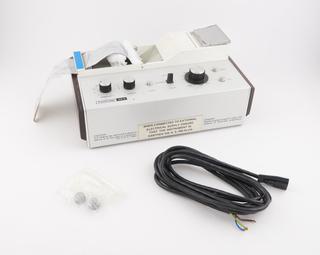
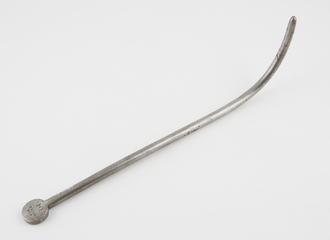
Prototype logoscope, an aid to differential diagnosis in ‘slide rule’ form, about 1953

Made:
circa 1953 in England
maker:
Firmin Nash
Prototype logoscope in wooden box Prototype logoscope in wooden box

Creative Commons LicenseThis image is released under a CC BY-NC-SA 4.0 Licence

License this image for commercial use at Science and Society Picture Library

License

Creative Commons LicenseThis image is released under a CC BY-NC-SA 4.0 Licence

License this image for commercial use at Science and Society Picture Library

License

Prototype logoscope in wooden box
Science Museum Group Collection
© The Board of Trustees of the Science Museum

Prototype logoscope in wooden box
Science Museum Group Collection
© The Board of Trustees of the Science Museum

Prototype logoscope in wooden box, an aid to differential diagnosis in 'slide-rule' form, developed by Dr Firmin Nash, England, c.1953

The logoscope was designed by Dr Firmin Nash in the age before the personal computer. It was an attempt to provide GPs with a diagnostic tool that would provide a broad, but accurate, list of possibilities for them to consider along with those arising from their own diagnostic skills. Devices such as this that ‘mechanise’ diagnosis have not usually caught on. As a museum object it is a fascinating symbol of the tension between the art and the science of medicine. It also acts as an interesting precursor to the computer diagnosis aids of the present day.

Details

Category:
Clinical Diagnosis
Object Number:
2004-248
Materials:
wood (unidentified), plastic (unidentified) and metal (unknown)
Measurements:
Case: 590 x 115 x 40 mm
type:
logoscope
credit:
Trueman, Angela

Parts

Prototype logoscope, an aid to differential diagnosis in ‘slide rule’ form, about 1953

Prototype logoscope, an aid to differential diagnosis in ‘slide rule’ form, about 1953

Prototype logoscope in wooden box, an aid to differential diagnosis in 'slide-rule' form, developed by Dr Firmin Nash, England, c.1953

More

The logoscope was designed by Dr Firmin Nash in the age before the personal computer. It was an attempt to provide GPs with a diagnostic tool that would provide a broad, but accurate, list of possibilities for them to consider along with those arising from their own diagnostic skills. Devices such as this that ‘mechanise’ diagnosis have not usually caught on. As a museum object it is a fascinating symbol of the tension between the art and the science of medicine. It also acts as an interesting precursor to the computer diagnosis aids of the present day.

Measurements:
overall: 40 mm x 590 mm x 115 mm,
Materials:
wood (unidentified) , plastic (unidentified) and metal (unknown)
Object Number:
2004-248/1
type:
logoscope
Data set to compile an aid to differential diagnosis

Data set to compile an aid to differential diagnosis

Bundle of cards to comile data for the Logoscope, developed by Dr Firmin Nash, England, c.1953

More

The logoscope was designed by Dr Firmin Nash in the age before the personal computer. It was an attempt to provide GPs with a diagnostic tool that would provide a broad, but accurate, list of possibilities for them to consider along with those arising from their own diagnostic skills. Devices such as this that ‘mechanise’ diagnosis have not usually caught on. As a museum object it is a fascinating symbol of the tension between the art and the science of medicine. It also acts as an interesting precursor to the computer diagnosis aids of the present day.

Measurements:
overall (bundle): 87 mm x 210 mm x 130 mm,
Materials:
paper
Object Number:
2004-248/2
type:
logoscope
Data set to compile an aid to differential diagnosis

Data set to compile an aid to differential diagnosis

Bundle of cards to compile data for a tropical medicine version of the Logoscope, developed by Dr Firmin Nash, England, c.1953

More

The logoscope was designed by Dr Firmin Nash in the age before the personal computer. It was an attempt to provide GPs with a diagnostic tool that would provide a broad, but accurate, list of possibilities for them to consider along with those arising from their own diagnostic skills. Devices such as this that ‘mechanise’ diagnosis have not usually caught on. As a museum object it is a fascinating symbol of the tension between the art and the science of medicine. It also acts as an interesting precursor to the computer diagnosis aids of the present day.

Measurements:
overall (bundle): 45 mm x 215 mm x 140 mm,
Materials:
paper
Object Number:
2004-248/3
type:
logoscope