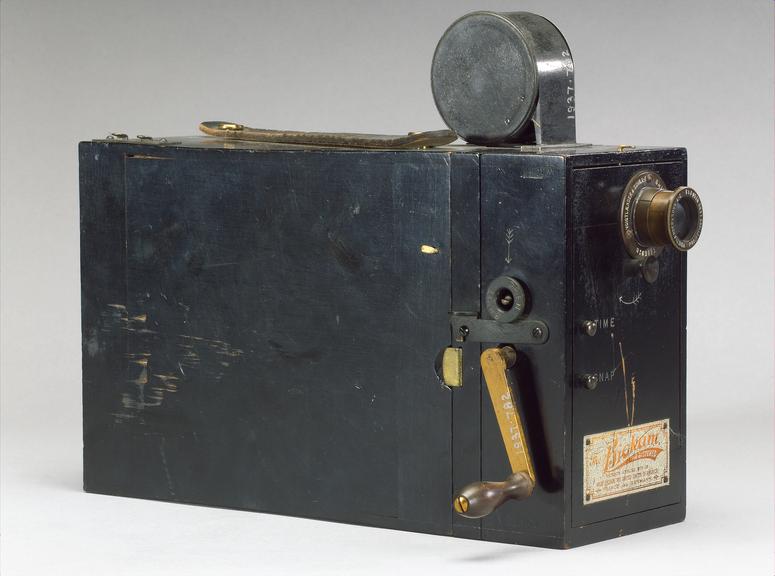
The Biokam cine camera/projector 17.5mm
- PART OF:
- "Biokam" Amateur Cine Outfit, 1899
- maker:
- Voigtlander, Alfred Darling and Warwick Trading Company


 This image is released under a CC BY-NC-SA 4.0
Licence
This image is released under a CC BY-NC-SA 4.0
Licence
License this image for commercial use at Science and Society Picture Library
LicenseThis image is released under a CC BY-NC-SA 4.0
Licence
License this image for commercial use at Science and Society Picture Library
License
Science Museum Group Collection
© The Board of Trustees of the Science Museum
Science Museum Group Collection
© The Board of Trustees of the Science Museum
Biokam 17.5mm combined camera, printer and projector, 1899. Voigtlander & Sohn shutter and lens; shutter serial no 6305; lens serial number 64018.
One of the earliest amateur cine devices, the Biokam was demonstrated by T C Hepworth at the London Camera Club on 24th March 1899, where it was advertised as ‘A combined Cinematograph & Snap-Shot Camera, Printer, Projector, Reverser and Enlarger’. It used 17.5mm film with central perforations between frames (like the later 9.5mm film). The film box had two separate compartments, so that two rolls of film could be exposed in succession. The mechanism unit could be converted into a printer, and with the addition of a light source, into a projector. Manufactured by Alfred Darling in Brighton and distributed by the Warwick Trading Company, the full outfit cost eleven guineas (£11.55).
Details
- Category:
- Cinematography
- Object Number:
- 1937-782/1
- Materials:
- steel (metal), wood (unidentified), brass (copper, zinc alloy), glass, plastic (unidentified) and leather
- Measurements:
-
overall (standing): 194 mm x 125 mm x 260 mm, 1 kg
- type:
- cine projector and cine camera
- credit:
- The National Media Museum, Bradford