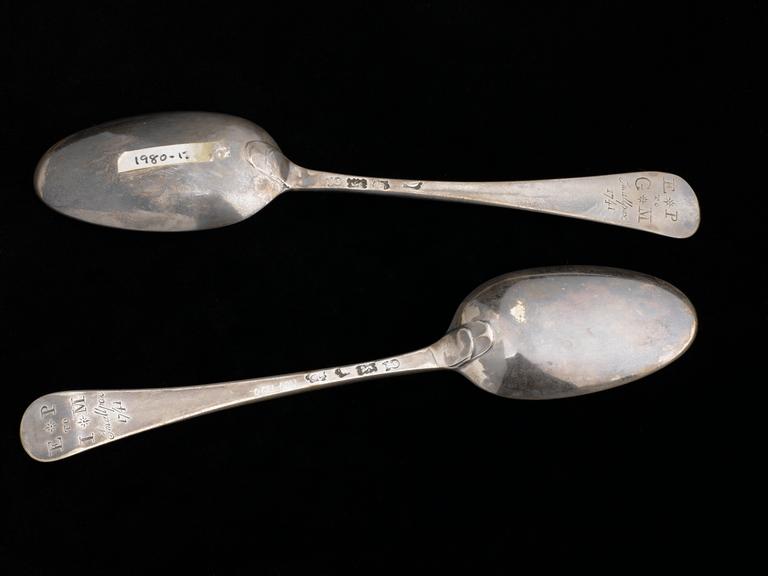
Spoon commemorating smallpox recovery, London, England, 1740
 This image is released under a CC BY-NC-SA 4.0
Licence
This image is released under a CC BY-NC-SA 4.0
Licence
License this image for commercial use at Science and Society Picture Library
License
Science Museum Group Collection
© The Board of Trustees of the Science Museum
Silver spoon, one of two, made in London in 1740 and engraved to commemorate a recovery from smallpox in 1741.
This silver spoon is engraved with the following - 'EP to GM Smallpox 1741'. It’s thought that it was intended to commemorate the recovery of an individual from that disease. Smallpox was one of the most deadly infections during the 18th century, believed to have accounted for well over 5% of all deaths nationwide, with higher rates in cities like London. Once infected, around one in four cases proved fatal so surviving it was well worth celebrating. However, many individuals would be left with numerous scars on the skin as permanent reminders of the disease – although they would also receive long term immunity from it.
Although these cases occurred several decades before a smallpox vaccine became available – which was the first vaccine against any disease, developed by Edward Jenner – there was another method recently introduced into Britain that could provide a good level of protection against smallpox. Known as variolation, it was a technique for introducing live smallpox virus into the skin or nose that was probably developed in China or India, before being taken up in North Africa, the Middle East and eventually Europe. For most who received it, it caused a mild illness that usually provided lifelong protection, but it was a dangerous procedure that could sometime be fatal. An early British advocate of the practice in Britain from 1721 was Lady Mary Wortley Montagu who had witnessed it while in Türkiye.
Details
- Category:
- Public Health & Hygiene
- Object Number:
- 1980-1320/1
- Materials:
- silver (metal)
- Measurements:
-
overall: 36 mm x 200 mm x 45 mm, .0582 kg
- type:
- spoon