'Patholux' binocular microscope No. 320307 by Vickers Instruments Ltd, with four Vickers objective lenses and one pair of eyepieces, on base unit containing high pressure mercury and tungsten halogen lamps, with camera No. 373862 fitted with photometer and mounted on bracket and pillar, and automatic exposure unit for camera, c1960-69. 'Patholux' binocular microscope No. 320307 by Vickers Instruments Ltd
Metallux metallographic (i.e. metallurgical) microscope by Leitz, Wetzlar, Germany, for use with top illumination of opaque specimens only, c. 1956, fitted with lamp housing for filament lamp, mechanical stage, quintuple revolving nosepiece with five Leitz objective lenses (5/0.9, 10/0.18, 20/0.35, 50/0.85 & 100/0/95), and binocular tube with Ernst Leitz Periplan 10X eyepieces for spectacle wearers; plus 6 V 5 A rated (6 A max.) transformer and fitted wooden case containing Normkam 6.5 cm by 9 cm camera attachment with focussing screen, viewing hood and cable release; two (ordinary) Periplan 10X eyepieces, four 78 mm square metal object slides, two ground glass, two blue glass and two green glass filters to fit the lamp housings (many accessories missing from the case) Metallux metallographic microscope, Leitz
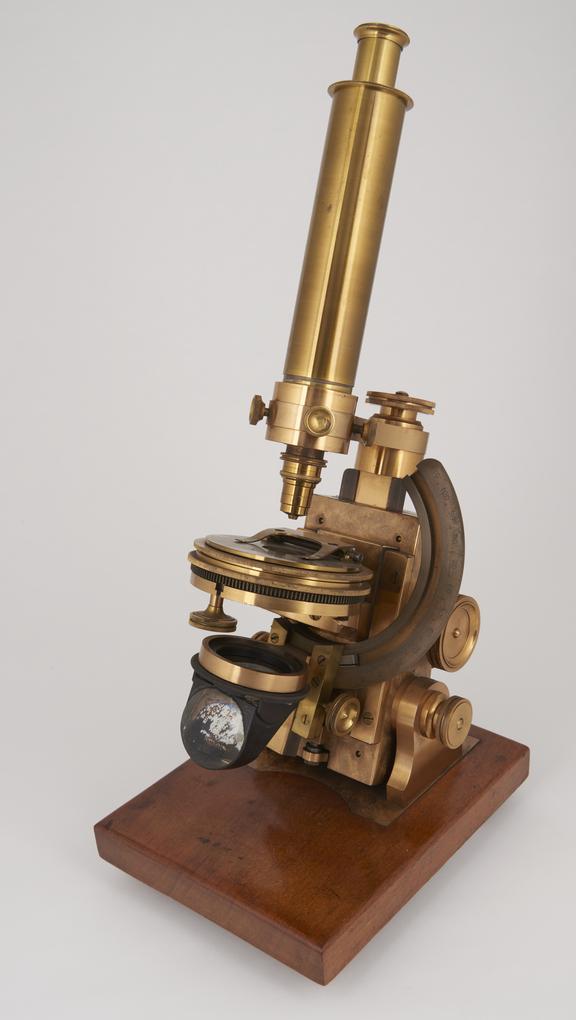
Brass microscope by G.F. Brander & Hoschel, on flat tripod foot; no case or accessories, stage forceps and stage ivory holder, single o.g and 4 lenses in ocular part Brass microscope by G.F. Brander & Hoschel
Lucernal microscope, by G. Adams, late 18th century, in case; Withering's botanical microscope (see 2 stroke nos). Lucernal microscope
Microscope by J. Mann, body in green vellum, gold stamped, mahogany base replaced, 1 objective and eyepiece and cap, 1687-1699 Microscope by James Mann, 1687-1699
Projection microscope for opaque objects, date about 1820 (in mahogany case with 2 keys, size of case 22 3/4" x 9" 11 3/4", drawers contains many specimens) Projection microscope for opaque objects