
Aeroscope Cine Camera

Aeroscope Cine Camera Aeroscope Cine Camera

Creative Commons LicenseThis image is released under a CC BY-NC-SA 4.0 Licence

License this image for commercial use at Science and Society Picture Library

License

Creative Commons LicenseThis image is released under a CC BY-NC-SA 4.0 Licence

License this image for commercial use at Science and Society Picture Library

License

Science Museum Group
© The Board of Trustees of the Science Museum

Science Museum Group
© The Board of Trustees of the Science Museum

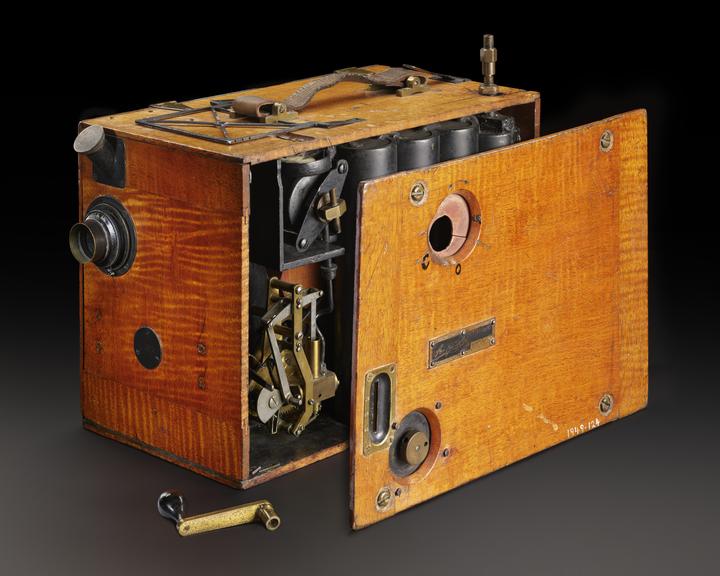
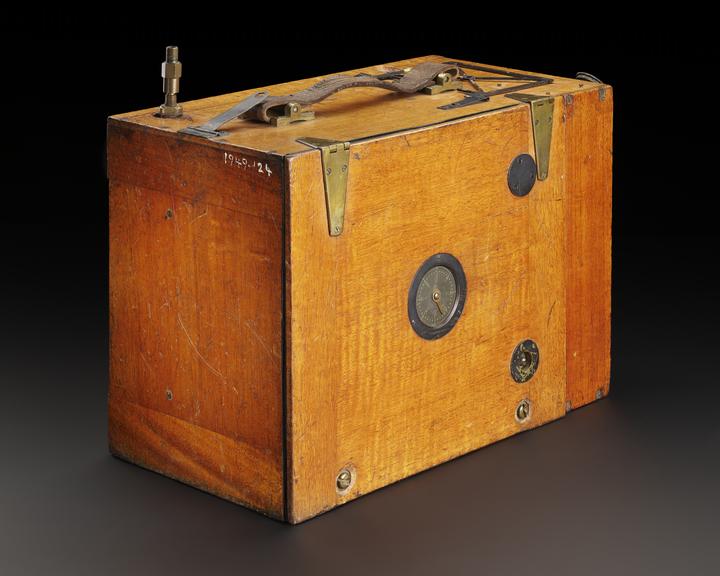
'Aeroscope' portable 35mm cine camera. Film magazine and crank handle, feet per second meter on side. Patented by Proszynski in 1910.

Patented in 1910 by the Polish engineer Kazimierz Proszynski, the Aeroscope was the first completely successful hand-held 35mm cine camera. It was powered by compressed air, and used by the British War Office, newsreel cameramen and most of the leading film companies from 1912 until the advent of sound. As the camera was 'charged' with compressed air prior to use, the camera operator did not need to turn the crank to advance the film, leaving both hands free to hold the camera and control focus. This made it possible to film with the Aeroscope in most difficult circumstances such as war zones and from airplanes. An Aeroscope camera was used by Arthur Herbert Malins to film at the Battle of the Somme.

A separate compartment could carry up to 400 feet (122 metres) of 35mm film.

Details

Category:
Cinematography
Object Number:
1949-124/1
Materials:
wood (unidentified), brass (copper, zinc alloy), iron, glass, leather and white metal (unknown)
Measurements:
camera: 225 mm x 170 mm x 308 mm, 9kg
winding handle: 70 mm x 58 mm
type:
35 mm ciné camera
credit:
The National Media Museum, Bradford

Parts

'Aeroscope' portable 35mm cine camera. Film magazine and crank handle, feet per second meter on side. Patented by Proszynski in 1910.

Aeroscope Cine Camera

'Aeroscope' portable 35mm cine camera. Film magazine and crank handle, feet per second meter on side. Patented by Proszynski in 1910.

More

Patented in 1910 by the Polish engineer Kazimierz Proszynski, the Aeroscope was the first completely successful hand-held 35mm cine camera. It was powered by compressed air, and used by the British War Office, newsreel cameramen and most of the leading film companies from 1912 until the advent of sound. As the camera was 'charged' with compressed air prior to use, the camera operator did not need to turn the crank to advance the film, leaving both hands free to hold the camera and control focus. This made it possible to film with the Aeroscope in most difficult circumstances such as war zones and from airplanes. An Aeroscope camera was used by Arthur Herbert Malins to film at the Battle of the Somme.

A separate compartment could carry up to 400 feet (122 metres) of 35mm film.

Measurements:
camera: 225 mm x 170 mm x 308 mm, 9 kg
winding handle: 70 mm x 58 mm
Materials:
wood (unidentified) , brass (copper, zinc alloy) , iron , glass , leather and white metal (unknown)
Object Number:
1949-124/1/1
type:
35 mm ciné camera
Side panel for 'Aeroscope' portable 35mm cine camera, patented by Proszynski in 1910.

Side panel for Aeroscope Cine Camera

Side panel for 'Aeroscope' portable 35mm cine camera, patented by Proszynski in 1910.

More

Patented in 1910 by the Polish engineer Kazimierz Proszynski, the Aeroscope was the first completely successful hand-held 35mm cine camera. It was powered by compressed air, and used by the British War Office, newsreel cameramen and most of the leading film companies from 1912 until the advent of sound. As the camera was 'charged' with compressed air prior to use, the camera operator did not need to turn the crank to advance the film, leaving both hands free to hold the camera and control focus. This made it possible to film with the Aeroscope in most difficult circumstances such as war zones and from airplanes. An Aeroscope camera was used by Arthur Herbert Malins to film at the Battle of the Somme.

A separate compartment could carry up to 400 feet (122 metres) of 35mm film.

Materials:
wood (unidentified) and metal (unknown)
Object Number:
1949-124/1/2
type:
panel