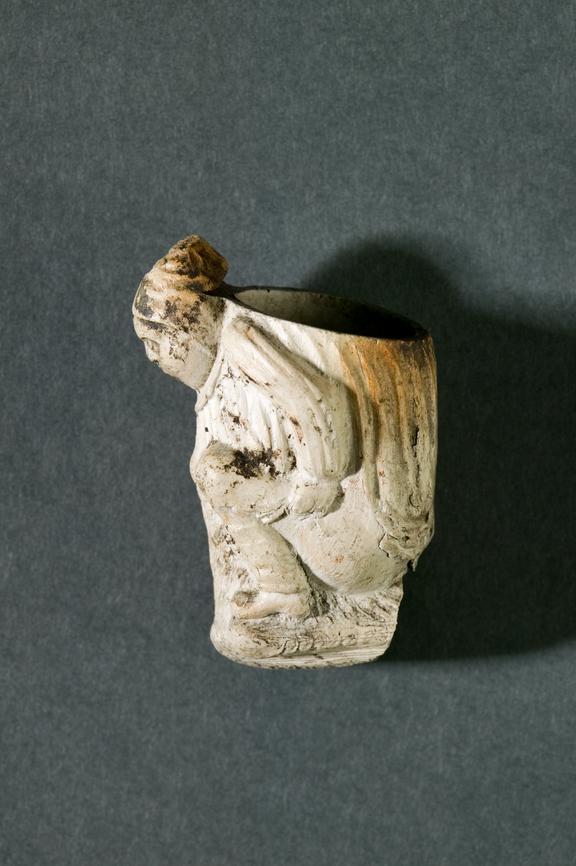
Clay tobacco pipe bowl depicting a man crouched over whilst using the toilet
 This image is released under a CC BY-NC-SA 4.0
Licence
This image is released under a CC BY-NC-SA 4.0
Licence
License this image for commercial use at Science and Society Picture Library
LicenseClay tobacco pipe bowl depicting a man crouched over whilst
Science Museum Group Collection
© The Board of Trustees of the Science Museum
Clay tobacco pipe bowl depicting a man crouched over whilst using the toilet.
This unusual depiction of a person crouching while using the toilet with their long roped clothes hiked up and their bottom bare is the bowl of a novelty tobacco pipe. The mouthpiece and stem are missing.
Novelty pipes started appearing in the late 18th century and reached their peak in the mid-19th century. It was common for artistically designed pipes to be inspired by celebrities and politicians as well as commemorative and political events.
Tobacco pipes like this one could be inexpensively made so designs could react to contemporary affairs and fashions. A common way to make the pipes was for workers to press clay into one of the hundreds of different mould designs before firing the shaped clay in a kiln to harden. More intricate and expensive designed pipe bowls were carved into meerschaum.
The first commercial production of clay pipes for the consumption of tobacco began in England in the late 1500s. Clay tobacco pipes were the easiest way to smoke tobacco. Shredded tobacco was placed in the bowl of the pipe and lit, and the smoke inhaled through the mouthpiece. When tobacco was first introduced from the Americas, it was expensive, so pipe bowls were small.
Tobacco plantations were established by newly settled Europeans in the Virginia region of North America. From the 1620s enslaved African people were forced to produce the crop. Their exploitation enabled tobacco to become more readily available and cheaper.
Cigarettes, introduced in the mid-19th century, gradually took over as the most popular way to smoke tobacco. Most clay pipe manufacturers had gone out of business by the 1930s.
Today smoking tobacco is widely known to have huge impacts on our health. Since the adoption of smoking tobacco, there have been concerns over its effect on our bodies. During the 1800s, physicians linked chronic pipe use with mouth cancers and revealed the poisonous nature of nicotine, a substance found in tobacco. This did not stop tobacco from becoming woven into social practices, cultural identity and ideas of class and gender.
The consumption of the tobacco plant’s highly addictive active ingredient, nicotine, continues to evolve with the fast-moving e-cigarette and vape industry.
Details
- Category:
- Local History
- Object Number:
- Y1992.167.3
- Materials:
- clay
- Measurements:
-
overall: 40 mm x 25 mm x 30 mm,
- type:
- clay tobacco pipe bowl
Related Objects

Hat from 'Windmill' costume, Manchester 2002 Commonwealth Games

Shorts for the 'Windmill' costume, Manchester 2002 Commonwealth Games
Aerialist body stocking, Manchester 2002 Commonwealth Games

Left-foot shoe from 'Windmill', Manchester 2002 Commonwealth Games