

 This image is released under a CC BY-NC-SA 4.0
Licence
This image is released under a CC BY-NC-SA 4.0
Licence
License this image for commercial use at Science and Society Picture Library
License
Science Museum Group
© The Board of Trustees of the Science Museum
Science Museum Group
© The Board of Trustees of the Science Museum
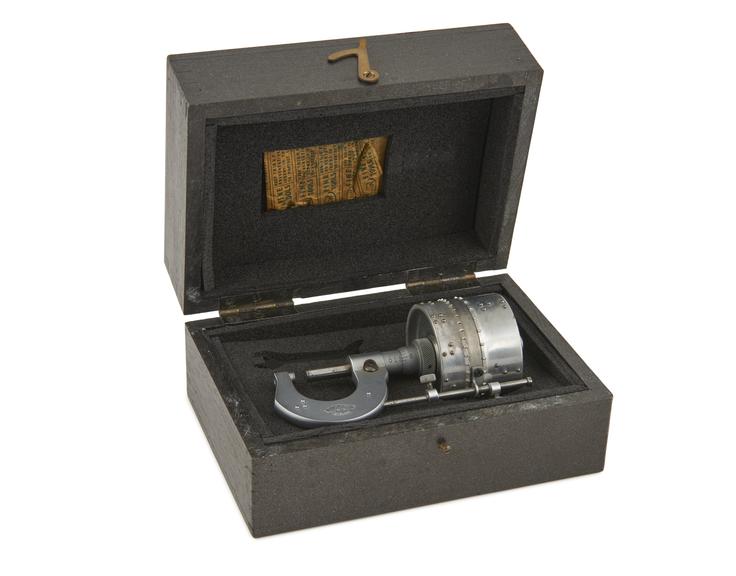
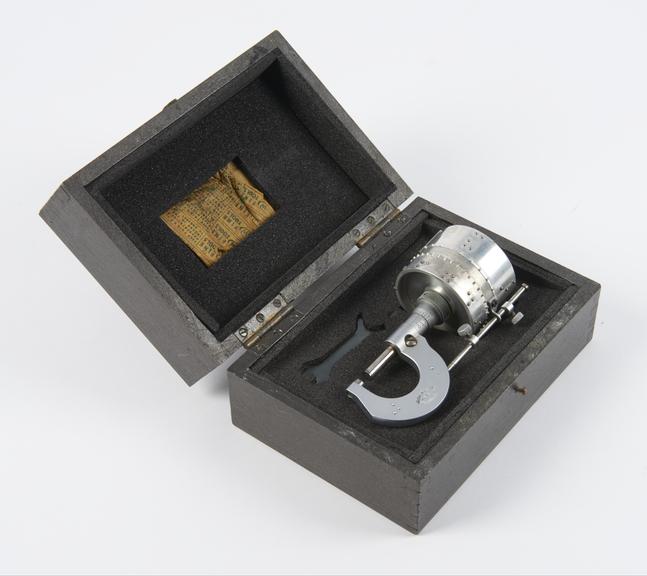
Braille micrometer made by Moore & Wright of Sheffield, accurate to a thousandth of an inch.
This micrometer has been modified to include braille characters to enable people who are blind and partially sighted to read and use the instrument. Moore & Wright developed this version of their micrometer in the 1950s with the Royal National Institute for the Blind, now the Royal National Institute of Blind People.
A micrometer is a tool used to take very accurate measurements. Micrometers are an essential tool for precision engineering work, used by machinists and engineers to measure things like the diameter of shafts or gears with an accuracy up to .001 inches (1 /1000"). Machine parts need to be measured very precisely so that they fit closely together. If they don’t, the machine might be inefficient or unreliable, or it may not even work at all.
To use the micrometer, you place the part you want to measure into its jaws, then slowly turn the screw, adjusting the dials, until the object is tightly held. This will give you a reading of the size.
Braille is a tactile writing system developed in the 1820s by French teenager Louis Braille, who had lost his sight at a young age. Braille uses a combination of up to 6 raised dots in a 2x3 grid to represent each letter of the alphabet as well as equivalents for punctuation marks and symbols. It has been adopted worldwide and is read through your fingertips by moving your hands from left to right across the text.
Details
- Category:
- Weighing & Measuring
- Object Number:
- Y2000.35
- Materials:
- metal, wood, paper, brass (copper, zinc alloy) and polyurethane
- Measurements:
-
box: 90 mm x 176 mm x 134 mm,
- type:
- micrometer
- credit:
- Gift of Stephen Hartley