 This image is released under a CC BY-NC-SA 4.0
Licence
This image is released under a CC BY-NC-SA 4.0
Licence
License this image for commercial use at Science and Society Picture Library
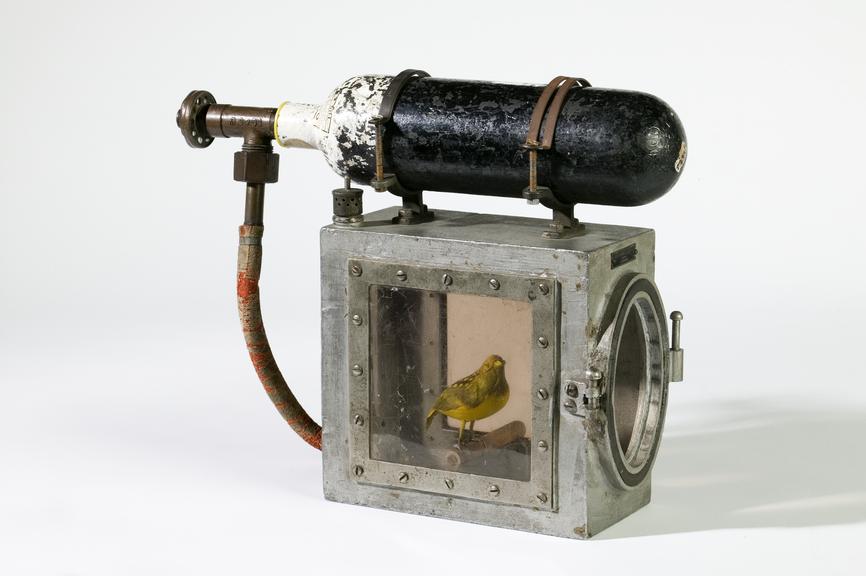
LicenseCage for reviving canary, with oxygen cylinder
Science Museum Group Collection
© The Board of Trustees of the Science Museum
Cage for reviving canary, with oxygen cylinder, made by Siebe Gorman & Co. Ltd, London, 1896-1986.
Canaries were used in mines from the late 1800s to detect deadly gases such as carbon monoxide (known in mining as 'Whitedamp'). The gas is deadly to humans and canaries, but canaries are much more sensitive to small amounts of the gas, and so will react more quickly than humans, thereby acting as a live 'detector'.
This was discovered by John Haldane, who was asked to help determine the cause of an explosion at Tylorstown Colliery in 1896. He concluded the explosion was caused by a build-up of carbon monoxide and set out to find a way of detecting the odourless gas before it could harm humans. He proposed the use of small, sensitive animals such as mice or birds as a 'sentinel species.' Canaries were used as their respiratory anatomy means that airborne toxins circulate quickly around their bodies causing obvious symptoms long before the levels become deadly to humans.
This sealable container with an oxygen tank shows the intention to save the canary following exposure to harmful carbon monoxide. The circular door would be kept open and had a grill to prevent the canary escaping. Once the canary showed signs of carbon monoxide poisoning the door would be closed and a valve opened, allowing oxygen from the tank on top to be released and revive the canary. The miners would then be expected to evacuate the danger area.
Details
- Category:
- Coal Mining
- Collection:
- Lancashire Coal Mining Collection
- Object Number:
- Y2002.19.254.1
- Measurements:
-
Overall: 300 mm x 110 mm x 380 mm,
- type:
- resuscitation equipment
- credit:
- Gift of Salford Museum and Art Gallery